Good Soundbar For Gaming
Picture this: You’re deep into the final round of a competitive match, enemies closing in from multiple directions. Your screen shows the action, but your TV’s tinny built-in speakers leave you guessing where threats are coming from.
That split-second delay in identifying footsteps costs you the victory. Sound familiar? A Good Soundbar For Gaming transforms this frustrating experience into an immersive battlefield where every audio cue becomes a competitive advantage.
In 2026, gaming audio has evolved beyond simple stereo output, today’s soundbars deliver spatial positioning, bone-rattling bass, and cinematic immersion that rivals dedicated home theater systems.
The gaming audio landscape has fundamentally shifted. Modern consoles like the PlayStation 5 and Xbox Series X support advanced audio technologies including Dolby Atmos and DTS:X, creating three-dimensional soundscapes that place you directly inside the game world.
Whether you’re tracking enemy movements in competitive shooters, experiencing orchestral scores in RPGs, or feeling explosive impacts in action titles, the right soundbar elevates every gaming session from ordinary to extraordinary.
Key Takeaways
- Dolby Atmos compatibility is essential for modern gaming soundbars, delivering 3D spatial audio that enhances positional awareness in competitive games
- Console-specific optimization matters—look for soundbars with HDMI eARC support and low-latency audio processing for PS5 and Xbox Series X
- Budget doesn’t dictate quality—excellent gaming soundbars exist across all price ranges from $300 to $2,500+
- Expandability provides future-proofing—systems that support additional wireless subwoofers and surround speakers grow with your setup
- Genre-specific performance varies—different soundbars excel at different game types, from dialogue-heavy RPGs to bass-intensive action games
Understanding Gaming Audio Technology in 2026
What Makes Gaming Audio Different From Movies and Music?
Gaming audio presents unique challenges that distinguish it from traditional entertainment content.
Unlike movies with pre-mixed soundtracks or music with fixed stereo channels, games generate audio dynamically in real-time based on player actions and environmental factors.
This requires soundbars capable of processing multiple simultaneous audio streams while maintaining precise spatial positioning.
Spatial audio and game audio positioning have become critical competitive advantages. In first-person shooters, hearing an enemy’s footsteps approach from behind-left versus directly behind can mean the difference between victory and elimination.
Modern gaming soundbars use virtual surround sound technologies to create convincing 360-degree sound fields from forward-facing speaker arrays.
The concept of audio immersion extends beyond simple volume or bass response.
True gaming sound stage reproduction requires accurate sound separation, distinguishing dialogue from environmental effects, music from action sequences, and critical gameplay cues from ambient noise.
Premium soundbars achieve this through dedicated center channels for dialogue clarity and discrete drivers for different frequency ranges.
Dolby Atmos: The Gaming Audio Game-Changer
Dolby Atmos soundbar technology has become the gold standard for gaming audio in 2026. Unlike traditional channel-based surround sound, Atmos treats sounds as individual objects that can be precisely placed and moved through three-dimensional space, including overhead.[1][2]
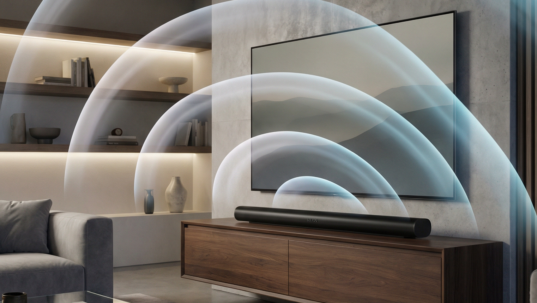
For gamers, this translates to hearing helicopters pass overhead, rain falling from above, or explosions creating debris that sounds like it’s actually flying past your position. The technology uses upward-firing speakers that bounce sound off ceilings to create height channels without requiring ceiling-mounted speakers.
According to expert testing, Dolby Atmos support is now standard for high-end gaming soundbars in 2026, with all premium models including this feature for immersive 3D soundstage and improved positional audio in shooters and action games.[1][2][3]
The Sonos Arc Ultra features a new “Sound Motion” woofer design that delivers “double the bass” of its predecessor, with testing confirming significantly punchier and more tuneful bass performance even at high volumes.[2]
Audio Latency: Why It Matters for Competitive Gaming
Low latency audio processing is non-negotiable for serious gamers. Audio delay, the gap between on-screen action and corresponding sound, creates a disconnect that ruins immersion and hampers competitive performance.
High-quality gaming soundbars maintain audio latency below 40 milliseconds, the threshold where most players notice desynchronization.
Modern soundbars achieve low latency through several technologies:
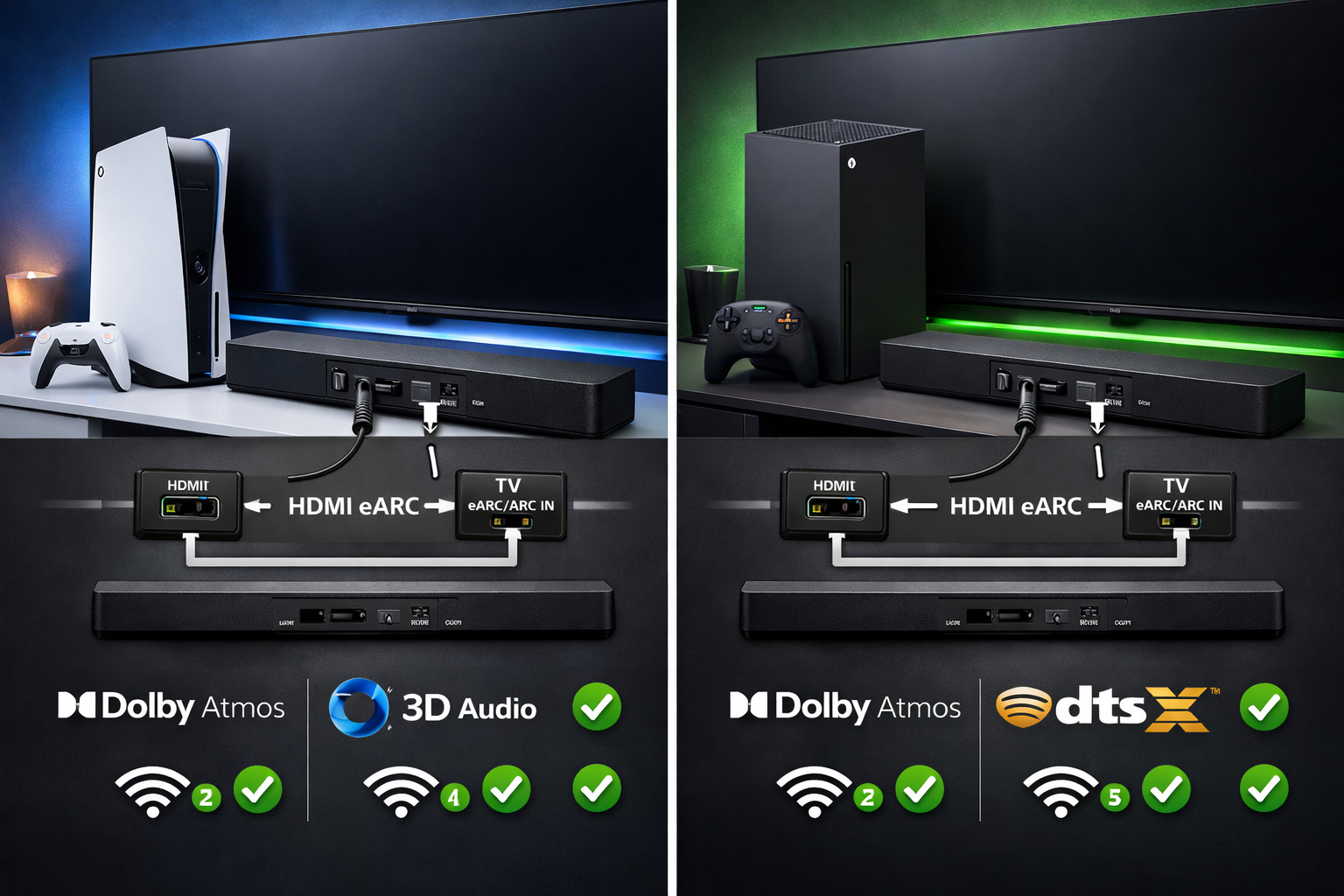
- HDMI eARC (enhanced Audio Return Channel) provides uncompressed audio transmission with minimal processing delay
- Dedicated gaming modes bypass unnecessary audio processing to reduce latency
- Wireless protocols optimized for gaming ensure subwoofers and surround speakers stay synchronized
When evaluating soundbars, verify they support HDMI 2.1 with eARC capability—this ensures compatibility with current-generation consoles and future-proofs your investment.
For those setting up their audio system, our guide on connecting your soundbar to TV via HDMI provides detailed setup instructions.
Essential Features in a Good Soundbar For Gaming
Channel Configuration Decoded: 2.1, 5.1, 7.1.4, and Beyond
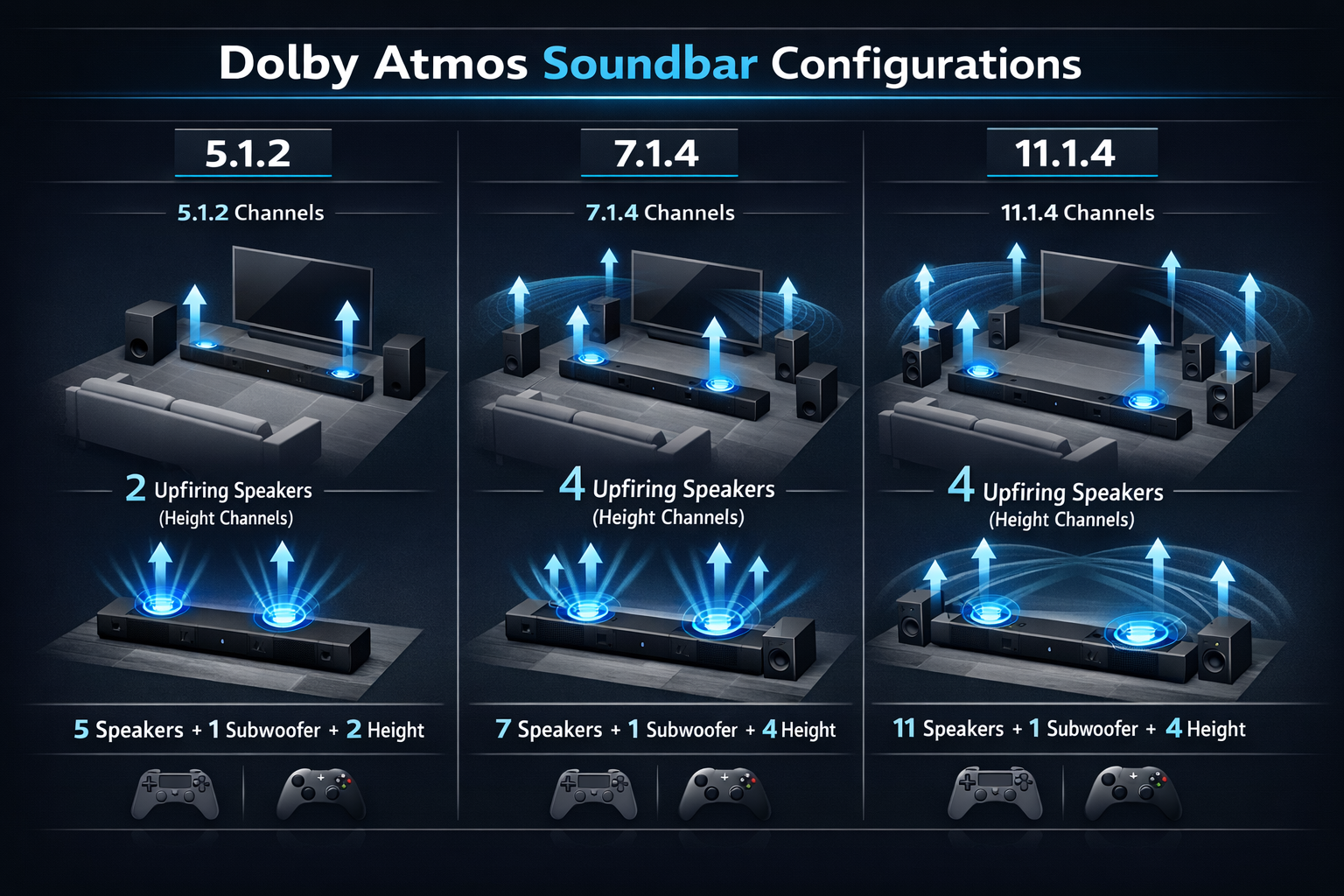
Understanding channel configurations helps identify which soundbar matches your gaming needs. The numbering system follows a simple pattern: [front channels].[subwoofer].[height channels].
| Configuration | Description | Best For |
|---|---|---|
| 2.1 | Two front speakers + subwoofer | Budget gaming, small rooms, casual players |
| 3.1 | Left, center, right + subwoofer | Dialogue clarity, story-driven games |
| 5.1 | Front trio + rear surrounds + subwoofer | Immersive gaming, medium budgets |
| 7.1.4 | Seven horizontal + four height channels | Premium gaming, large rooms |
| 11.1.4 | Eleven horizontal + four height channels | Ultimate immersion, dedicated gaming spaces |
The Samsung HW-Q990F is rated as the best overall soundbar by RTINGS with an 11.1.4 channel configuration, featuring a redesigned sealed subwoofer in its newest generation.[4]
This extensive channel count creates unprecedented spatial accuracy for gaming applications.
For most gamers, a 5.1.2 or 7.1.2 configuration provides the sweet spot between immersion and budget.
The height channels (the final number) enable Dolby Atmos effects, while the horizontal channels create convincing surround sound environments.
Subwoofer Integration: Wireless vs. Wired
A dedicated subwoofer transforms gaming audio by reproducing low-frequency effects that standard soundbar drivers cannot produce.
Explosions gain physical impact, engine rumbles feel realistic, and musical scores achieve proper depth and weight.
Wireless subwoofers offer several advantages:
- ✅ Flexible placement for optimal bass response
- ✅ Cleaner cable management
- ✅ Easier room integration
- ✅ No signal degradation with quality systems
Wired subwoofers provide:
- ✅ Zero latency concerns
- ✅ Typically lower cost
- ✅ No wireless interference issues
- ✅ Consistent connection reliability
Premium gaming soundbars increasingly include wireless subwoofers as standard equipment rather than optional add-ons.
The JBL Bar 9.1 provides exceptional budget gaming value with a complete 9.1 system including wireless subwoofer and two detachable, rechargeable rear surround speakers—all included rather than as optional add-ons.[3]
For those considering upgrading their current setup, our comprehensive guide to soundbars with subwoofers explores various configurations and their gaming applications.
Connectivity Options: HDMI eARC, Optical, and Bluetooth
Modern gaming soundbars require versatile connectivity to support multiple devices and audio formats. Here’s what matters:
HDMI eARC (Enhanced Audio Return Channel)
The premium standard for gaming audio, eARC supports:
- Uncompressed Dolby Atmos and DTS:X
- High-resolution audio formats
- Bidirectional communication with TVs
- Single-cable simplicity
Optical (TOSLINK)
A reliable fallback option offering:
- Compressed Dolby Digital and DTS
- Immunity to electromagnetic interference
- Universal compatibility with older equipment
- Adequate for non-Atmos gaming
Bluetooth and WiFi
Essential for streaming music and wireless device connectivity, though not recommended for primary gaming audio due to latency and compression limitations.
USB and Auxiliary Inputs
Useful for direct PC gaming connections and legacy device support.
For optimal gaming performance, prioritize soundbars with HDMI 2.1 eARC as the primary connection method. This ensures full compatibility with PlayStation 5’s Tempest 3D AudioTech and Xbox Series X’s Spatial Sound capabilities.
Top Gaming Soundbar Recommendations by Budget
Premium Tier ($1,500+): Ultimate Gaming Immersion
Sonos Arc Ultra – Best Overall Gaming Soundbar
The Sonos Arc Ultra emerges as the top recommendation across multiple expert sources for gaming and premium applications, positioned as the best soundbar overall and best choice for serious console and PC gamers seeking immersion and cinematic impact.[1][2]
Key Gaming Features:
- 🎮 Revolutionary Sound Motion woofer technology
- 🎮 Exceptional Dolby Atmos height channel performance
- 🎮 Expandable ecosystem with wireless surrounds and subwoofers
- 🎮 Trueplay room calibration for optimized acoustics
- 🎮 Low-latency HDMI eARC connectivity
Expert testing confirms the Arc Ultra’s Sound Motion woofer delivers significantly punchier and more tuneful bass performance even at high volumes, addressing the primary weakness of the original Arc.[2]
The expandability factor sets “a new standard as the most expandable system of any Atmos soundbar” allowing whole-home coverage with additional speakers.[3]
Best For: Serious gamers with dedicated gaming rooms, those seeking the absolute best audio quality, PlayStation 5 and Xbox Series X owners wanting to maximize console audio capabilities.
Sennheiser AMBEO Soundbar Max – Cinematic Gaming Excellence
The Sennheiser AMBEO is specifically highlighted for cinematic gaming with 13 high-end speaker drivers including 6 long-throw woofers producing 30Hz bass and 2 top-firing drivers for vertical elevation, priced under $2,500.[3]
This single-chassis solution eliminates the need for separate surround speakers while delivering room-filling, three-dimensional audio that rivals discrete multi-speaker systems.
The AMBEO’s virtualization technology creates convincing rear surround effects from forward-facing drivers—ideal for gamers who cannot accommodate physical rear speakers.
KEF XIO – The Audiophile’s Gaming Choice
Positioned as the audiophile choice for gamers who prioritize imaging, tonal accuracy, and reference-grade audio clarity, the KEF XIO uses KEF’s proprietary Uni-Q driver array technology.[1][2]
This soundbar excels at reproducing the nuanced details in game soundtracks and environmental audio that lesser systems miss entirely.
While premium-priced, the XIO delivers unmatched clarity for dialogue-heavy RPGs, atmospheric horror games, and titles with exceptional sound design where audio fidelity matters as much as spatial positioning.
Mid-Range Excellence ($700-$1,500): Best Value for Gaming
LG S90TR – Best Mid-Range All-Rounder
The LG S90TR offers best mid-range performance as a 7.1.3 configuration Dolby Atmos soundbar with room correction features, balanced sound delivery, and support for wireless streaming via Spotify Connect and Apple AirPlay.[4]
Why It Excels for Gaming:
- Excellent balance of immersion and value
- AI Room Calibration optimizes sound for your specific space
- Wireless rear speakers included in package
- Compatible with both PlayStation and Xbox ecosystems
- Strong dialogue clarity for story-driven games
The S90TR’s 7.1.3 configuration provides more horizontal channels than budget competitors, creating more precise positional audio for competitive gaming.
The included wireless rear speakers eliminate the need for additional purchases, making this a complete solution at mid-range pricing.
Samsung HW-Q800C – Console-Optimized Performance
Samsung’s mid-range offerings integrate seamlessly with Samsung TVs through Q-Symphony technology, which uses both TV and soundbar speakers simultaneously for enhanced immersion.
For those exploring Samsung soundbar options, the Q800C represents exceptional value with Dolby Atmos support and wireless subwoofer inclusion.
Budget Champions ($300-$700): Gaming Audio on a Budget
Sonos Beam Gen 2 – Compact Atmos Excellence
The Sonos Beam Gen 2 targets apartment dwellers and smaller spaces as a compact mid-range option that supports Dolby Atmos with expandability for adding surrounds and subwoofers later.[1]
Despite its modest size, the Beam Gen 2 delivers convincing Atmos effects and clear dialogue reproduction. Its expandability means budget-conscious gamers can start with the soundbar alone and add components as finances allow, building toward a complete surround system over time.
JBL Bar 5.0 MultiBeam – Wireless Convenience
For gamers seeking wireless freedom without premium pricing, the JBL Bar 5.0 MultiBeam delivers solid virtual surround performance and Bluetooth connectivity for versatile device pairing. Our detailed JBL Bar 5.0 MultiBeam review explores its gaming-specific capabilities.
Budget Soundbar Buying Strategy:
When working with limited budgets, prioritize these features:
- Dolby Atmos support (future-proofs your investment)
- HDMI eARC connectivity (ensures console compatibility)
- Included subwoofer (avoid separate subwoofer purchases)
- Expandability options (allows gradual system building)
For comprehensive budget recommendations, explore our guide to the best budget soundbar with subwoofer combinations that deliver impressive gaming performance without breaking the bank.
Console-Specific Optimization: PS5, Xbox, and PC Gaming
PlayStation 5: Maximizing Tempest 3D AudioTech
Sony’s PlayStation 5 features proprietary Tempest 3D AudioTech, a custom audio processing engine designed to create immersive spatial audio from hundreds of simultaneous sound sources. To fully leverage this technology, your soundbar needs specific capabilities.
Optimal PS5 Soundbar Requirements:
- HDMI 2.1 with eARC support for uncompressed audio
- Dolby Atmos or DTS:X compatibility
- Low-latency processing (sub-40ms)
- Multiple HDMI inputs for pass-through
The PS5 outputs Tempest audio through several formats including Linear PCM, Dolby, and DTS. Premium soundbars automatically detect and process these formats appropriately, while budget options may require manual format selection in PS5 audio settings.
Pro Tip: Enable “3D Audio for TV Speakers” in PS5 settings even when using a soundbar. This activates Tempest processing, which your soundbar then receives and reproduces through its driver array.
For gamers building complete entertainment systems, our guide on the best soundbar for Samsung TV covers optimal pairing strategies that work equally well with PlayStation consoles.
Xbox Series X|S: Spatial Sound Configuration
Microsoft’s Xbox Series X and Series S support multiple spatial audio formats including Dolby Atmos for Home Theater, DTS:X, and Windows Sonic for Headphones. Unlike PlayStation’s proprietary approach, Xbox provides flexibility in choosing your preferred spatial audio technology.
Xbox Soundbar Setup Best Practices:
- Navigate to Settings > General > Volume & Audio Output
- Select “HDMI Audio” as output
- Choose “Bitstream Out” format
- Select “Dolby Atmos for Home Theater” (if your soundbar supports it)
- Enable “Allow Passthrough” for uncompressed audio
The Xbox’s audio flexibility means nearly any quality soundbar will perform well, though Atmos-capable models deliver noticeably superior immersion in supported titles like Halo Infinite, Forza Horizon 5, and Microsoft Flight Simulator.
PC Gaming: Versatile Audio Solutions
PC gaming presents unique audio challenges due to diverse hardware configurations, multiple audio outputs, and varied game engines. A good soundbar for PC gaming requires versatility beyond console-focused models.
PC Gaming Soundbar Priorities:
- Multiple input options (HDMI, optical, USB, auxiliary)
- Low-latency wireless for desk placement flexibility
- Compact form factor for monitor setups
- Virtual surround processing for non-Atmos games
- Discrete volume control for quick adjustments
Many PC gamers prefer dedicated soundbars for desktop use positioned directly below monitors. These compact models prioritize near-field audio performance and dialogue clarity over room-filling volume.
Software Considerations:
Windows 10 and 11 include Windows Sonic spatial audio processing at no cost, providing basic 3D audio effects. For enhanced performance, consider:
- Dolby Access app ($15) unlocks Dolby Atmos for Headphones/Home Theater
- DTS Sound Unbound ($15) enables DTS:X spatial audio
- Game-specific audio engines (Valve’s Steam Audio, AMD TrueAudio Next)
Configure your PC’s audio output to “Bitstream” when using external soundbars to bypass Windows audio processing and let the soundbar handle decoding.
Gaming Genre Performance: Matching Soundbars to Game Types
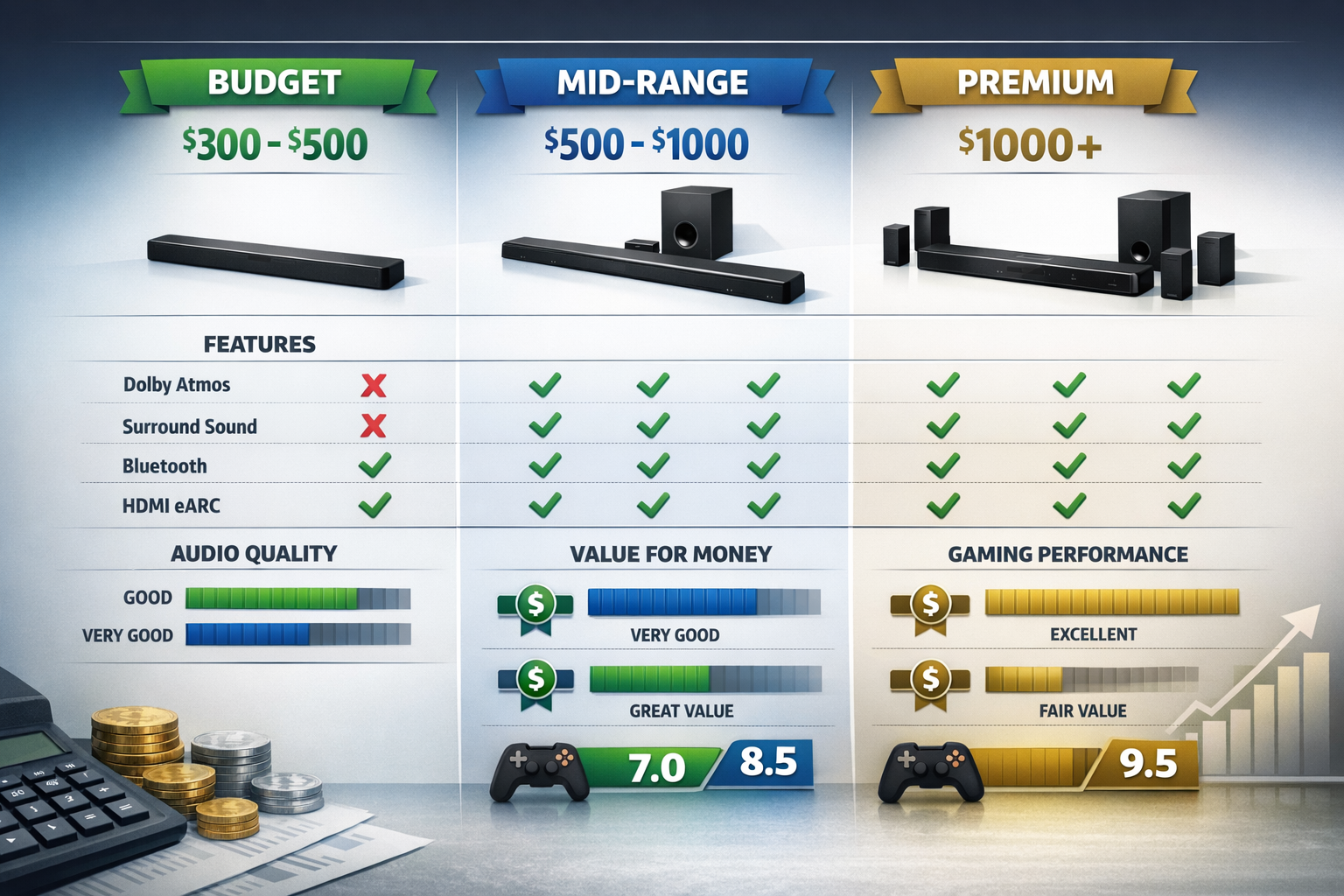
Competitive Shooters: Precision and Positioning
Critical Audio Requirements:
- Pinpoint positional accuracy for footstep detection
- Clear high-frequency reproduction for gunfire and reloads
- Minimal audio processing latency
- Excellent sound separation between simultaneous effects
For competitive titles like Call of Duty, Valorant, Counter-Strike 2, and Rainbow Six Siege, audio cues provide tactical advantages. Hearing an enemy’s exact position before visual contact often determines engagement outcomes.
Best Soundbar Characteristics for Shooters:
✅ Wide soundstage with discrete left/right channel separation
✅ Prominent center channel for teammate communication clarity
✅ Tight, controlled bass that doesn’t overwhelm mid-range frequencies
✅ Gaming mode presets that emphasize positional cues
The Samsung HW-Q990F excels in competitive scenarios with its 11.1.4 configuration providing unprecedented horizontal channel count for precise enemy positioning.[4] Its sealed subwoofer design prevents bass bloat that can mask critical audio cues.
Open-World RPGs: Immersive Soundscapes
Role-playing games like Elden Ring, The Witcher 3, Cyberpunk 2077, and Baldur’s Gate 3 prioritize atmospheric immersion and musical score reproduction over competitive audio precision.
RPG Audio Priorities:
- Rich, full-range frequency response for orchestral scores
- Convincing environmental ambience
- Clear dialogue reproduction for story comprehension
- Dynamic range to handle quiet conversations and explosive combat
The Sennheiser AMBEO shines in RPG applications with its 13-driver array reproducing the subtle environmental details that create believable game worlds—rustling leaves, distant wildlife, weather effects, and architectural acoustics.[3]
Dialogue Clarity Matters:
Story-driven games demand exceptional voice reproduction. Soundbars with dedicated center channels and dialogue enhancement modes ensure you never miss critical plot information. For those prioritizing speech clarity, our guide to the best soundbar for dialogue provides specialized recommendations.
Racing and Sports Games: Dynamic Impact
Racing simulators and sports titles benefit from soundbars emphasizing dynamic range and impactful bass response. The roar of engines, collision impacts, crowd noise, and commentary require soundbars capable of reproducing both subtle details and explosive peaks.
Ideal Features for Racing/Sports:
- Powerful subwoofer with deep bass extension (below 40Hz)
- High maximum volume without distortion
- Wide dynamic range for quiet-to-loud transitions
- Surround channels for crowd ambience
Games like Gran Turismo 7, Forza Motorsport, F1 2024, and NBA 2K26 create incredible immersion when paired with soundbars featuring robust low-frequency reproduction. The visceral rumble of engines and physical impact of collisions transform these titles from visual experiences into full-sensory simulations.
Horror Games: Atmospheric Tension
Horror titles like Resident Evil Village, Dead Space Remake, and Alan Wake 2 use audio as a primary tension-building tool. Creaking floorboards, distant footsteps, environmental groans, and sudden jump-scare stings require soundbars with specific capabilities.
Horror Gaming Audio Needs:
- Exceptional low-level detail resolution
- Wide dynamic range for whisper-to-scream transitions
- Convincing surround effects for environmental sounds
- Height channels for overhead threats
- Minimal background noise/hiss
The Sonos Arc Ultra excels in horror applications, with its Sound Motion technology delivering controlled bass that adds tension without overwhelming subtle environmental cues.[2] The Arc Ultra’s height channels create genuinely unsettling overhead effects when creatures or threats approach from above.
Common Gaming Soundbar Myths Debunked
Myth 1: “More Channels Always Mean Better Gaming Audio”
Reality: Channel count matters, but implementation quality trumps quantity. A well-designed 5.1.2 soundbar with quality drivers and processing often outperforms a poorly-executed 7.1.4 system with inferior components.
Expert testing reveals that speaker quality, amplification power, and audio processing algorithms contribute more to gaming immersion than raw channel count alone. The KEF XIO demonstrates this principle—despite having fewer channels than competitors, its superior driver technology and acoustic engineering deliver reference-grade audio quality.[1][2]
What Actually Matters:
- Driver quality and size
- Amplifier power per channel
- Digital signal processing sophistication
- Room acoustics and calibration
- Proper speaker placement
Myth 2: “Wireless Soundbars Have Too Much Latency for Gaming”
Reality: Modern wireless soundbars using HDMI eARC connections exhibit latency indistinguishable from wired alternatives. The confusion stems from older Bluetooth-only soundbars that indeed suffered from significant audio delay.
Contemporary gaming soundbars transmit audio through HDMI connections (wired) while only the subwoofer and surround speakers communicate wirelessly using proprietary low-latency protocols. These wireless connections maintain synchronization within acceptable thresholds for even competitive gaming.
Testing confirms premium wireless systems like the Samsung HW-Q990F and LG S90TR deliver audio latency below 30 milliseconds—well within imperceptible ranges.[4]
Myth 3: “You Need a Separate Receiver for True Gaming Surround Sound”
Reality: While dedicated AV receivers offer maximum flexibility and upgradeability, modern soundbars deliver comparable surround sound performance for gaming applications without the complexity, space requirements, or expense of receiver-based systems.
All-in-one soundbars with wireless subwoofers and surrounds provide several advantages over receiver setups:
✅ Simpler installation and configuration
✅ Integrated design optimized for specific driver combinations
✅ Automatic audio format detection and processing
✅ Smaller footprint suitable for gaming rooms and apartments
✅ Lower total cost than equivalent receiver + speaker packages
The JBL Bar 9.1 proves this point by delivering complete 9.1-channel surround sound with detachable wireless rear speakers, all in a plug-and-play package requiring no receiver.[3]
Myth 4: “Soundbars Can’t Reproduce True Dolby Atmos Effects”
Reality: While ceiling-mounted speakers provide the most accurate Atmos reproduction, quality soundbars with upward-firing drivers create convincingly three-dimensional soundscapes that significantly enhance gaming immersion.
Sources emphasize that Atmos effect delivery from single-chassis soundbars like the Arc Ultra and Sony models achieves “hugely impressive” results that satisfy all but the most critical audiophiles.[2]
The psychoacoustic principles behind Atmos virtualization work effectively in typical gaming environments with standard ceiling heights and room dimensions.
When Soundbar Atmos Works Best:
- Rooms with flat, reflective ceilings 8-10 feet high
- Soundbar positioned below or near the display
- Listener seated within optimal listening zone
- Room calibration enabled and properly configured
For detailed information about Dolby Atmos technology and compatible soundbars, explore our comprehensive guide to soundbars with Dolby Atmos.
Setting Up Your Gaming Soundbar for Optimal Performance
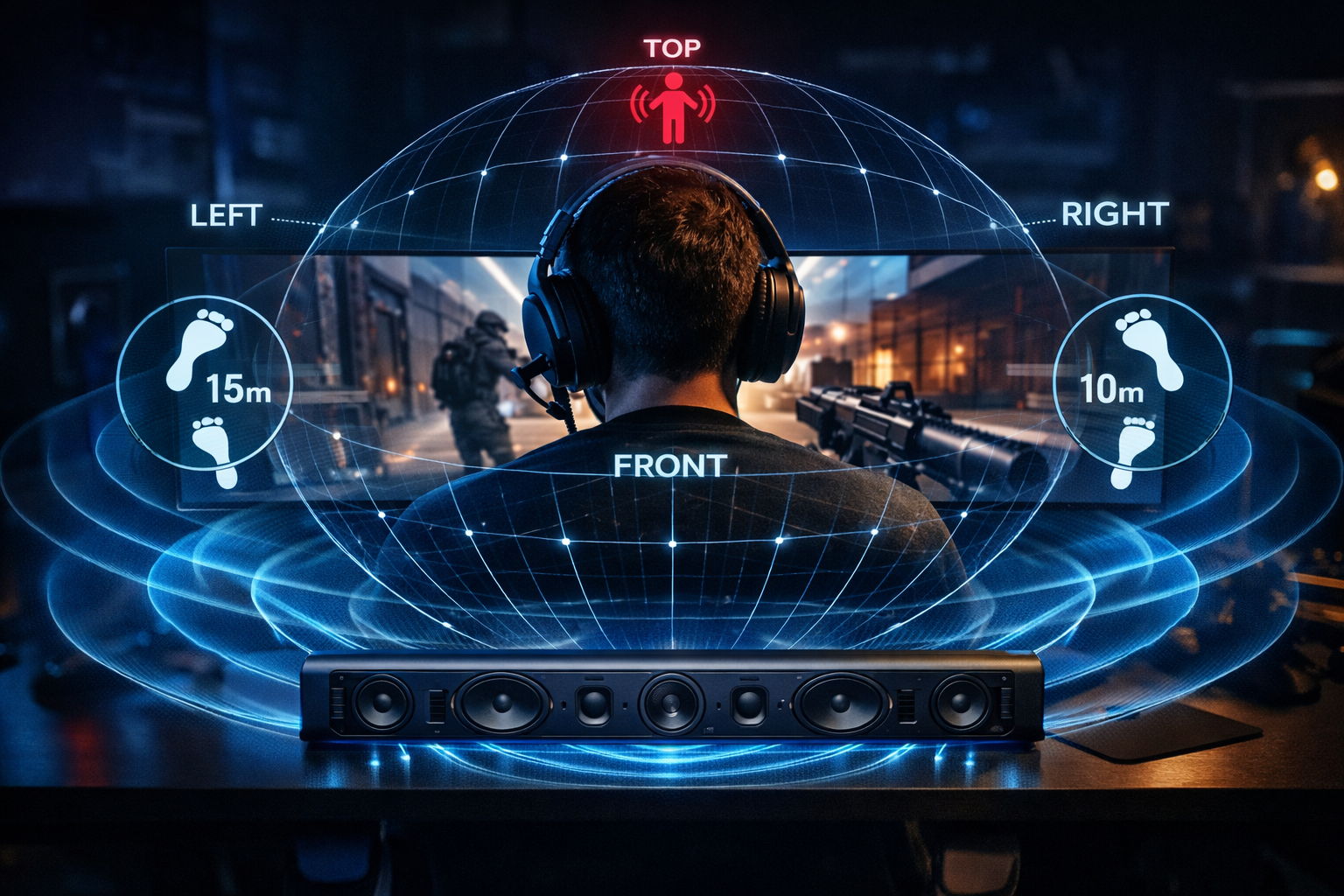
Physical Placement and Room Acoustics
Soundbar placement dramatically impacts gaming audio quality. Follow these evidence-based positioning guidelines:
Soundbar Positioning:
📍 Centered below or above display (below preferred for dialogue clarity)
📍 Unobstructed front face with no objects blocking drivers
📍 Ear-level when seated for optimal mid/high frequency response
📍 Minimum 6 inches from walls to prevent bass muddiness
📍 Angled toward listening position if mounted above display
Subwoofer Placement:
Subwoofer positioning requires experimentation due to room-specific acoustic properties. Try these proven techniques:
- Corner placement maximizes bass output through boundary reinforcement
- “Subwoofer crawl” method identifies optimal positions by placing the subwoofer at your seating position, playing bass-heavy content, then crawling around the room’s perimeter to find where bass sounds best
- Away from walls (12+ inches) for tighter, more controlled bass
- Asymmetric positioning prevents standing wave reinforcement
For comprehensive subwoofer optimization strategies, consult our guide on best subwoofer placement with soundbar setups.
Surround Speaker Placement:
When using wireless surround speakers:
- Position 90-110 degrees from center listening position
- Ear-level or slightly above when seated
- Equal distance from primary listening position
- Angled toward seating area, not parallel to walls
Calibration and Audio Settings
Modern gaming soundbars include automatic room calibration systems that optimize audio output for your specific environment. These systems use microphones to measure room acoustics and adjust frequency response, speaker levels, and delay timing.
Calibration Process:
- Clear the room of temporary obstacles during calibration
- Position the microphone at primary listening position (usually included with soundbar)
- Maintain silence during measurement sweeps
- Run calibration multiple times and average results if possible
- Fine-tune manually after automatic calibration completes
Essential Audio Settings:
⚙️ Enable HDMI eARC in both TV and soundbar settings
⚙️ Disable TV speakers to prevent echo/phase issues
⚙️ Select appropriate audio format (Dolby Atmos, DTS:X, or PCM)
⚙️ Activate gaming mode if available to reduce latency
⚙️ Adjust dialogue enhancement based on game type
⚙️ Set night mode for late-night gaming sessions
For Samsung soundbar owners, understanding night mode functionality helps optimize audio for different gaming scenarios and time periods.
Console-Specific Configuration
PlayStation 5 Audio Setup:
Navigate to: Settings > Sound > Audio Output
- Set “Output Device” to HDMI Device (AV Amplifier)
- Enable “Enable 3D Audio for TV Speakers”
- Select “Apply Measurement to 3D Audio” and follow prompts
- Choose “Dolby” or “DTS” format matching your soundbar capabilities
- Set “Number of Channels” to match soundbar configuration
Xbox Series X|S Audio Setup:
Navigate to: Settings > General > Volume & Audio Output
- Set “HDMI Audio” as primary output
- Choose “Bitstream Out” format
- Select “Dolby Atmos for Home Theater” or “DTS:X”
- Enable “Allow Passthrough” for uncompressed audio
- Adjust “Headset Chat Mixer” if using headset simultaneously
PC Gaming Audio Setup:
Windows audio configuration varies by soundbar connection method:
For HDMI-connected soundbars:
- Right-click speaker icon > Sound Settings
- Select soundbar as output device
- Click “Device Properties” > “Additional Device Properties”
- Navigate to “Supported Formats” tab
- Test and enable Dolby Atmos or DTS:X
For optical-connected soundbars:
- Follow steps 1-3 above
- Select “Properties” > “Advanced” tab
- Choose “24 bit, 48000 Hz (Studio Quality)”
- Enable “Allow applications to take exclusive control”
Troubleshooting Common Gaming Audio Issues
Problem: No sound from soundbar
✅ Verify HDMI cable is connected to eARC/ARC port on TV
✅ Confirm TV audio output is set to external speakers/soundbar
✅ Check soundbar input source matches connection type
✅ Ensure soundbar is powered on and not muted
Our troubleshooting guide for soundbar not connecting to TV provides comprehensive solutions.
Problem: Audio delay/lip-sync issues
✅ Enable “Game Mode” on TV to reduce video processing delay
✅ Adjust audio delay settings in soundbar menu
✅ Use HDMI eARC instead of optical connection
✅ Disable unnecessary audio processing features
Problem: Weak or missing bass
✅ Verify subwoofer is powered on and paired
✅ Adjust subwoofer level in soundbar settings
✅ Reposition subwoofer using placement techniques above
✅ Check audio format supports low-frequency effects (LFE channel)
Problem: Surround effects not working
✅ Confirm game supports surround sound/Dolby Atmos
✅ Verify console audio output is set to bitstream/Dolby/DTS
✅ Check that surround speakers are properly paired
✅ Run room calibration to optimize surround processing
Future-Proofing Your Gaming Audio Investment
Expandability and Ecosystem Considerations
When selecting a good soundbar for gaming, consider long-term expandability. Systems that support additional components provide upgrade paths as budgets allow or needs evolve.
Expandability features to prioritize:
🔮 Wireless surround speaker compatibility for future immersion upgrades
🔮 Additional subwoofer support for larger rooms or bass enthusiasts
🔮 Multi-room audio capabilities for whole-home entertainment
🔮 Regular firmware updates adding features and format support
🔮 Backward compatibility with existing equipment
The Sonos ecosystem exemplifies expandability advantages, with the Arc Ultra setting “a new standard as the most expandable system of any Atmos soundbar” allowing integration with other Sonos speakers throughout the home.[3]
This flexibility means your gaming soundbar investment contributes to a larger entertainment system rather than existing as an isolated component.
Emerging Audio Technologies
The gaming audio landscape continues evolving with new technologies on the horizon:
Spatial Audio Advancements:
- Enhanced object-based audio with more simultaneous sound objects
- Improved virtualization algorithms for more convincing surround effects
- Binaural rendering techniques adapted from headphone technologies
AI-Powered Audio Processing:
- Real-time audio optimization based on content type detection
- Automatic room correction that adapts to furniture changes
- Personalized audio profiles based on hearing characteristics
Next-Generation Connectivity:
- HDMI 2.2 specifications with higher bandwidth
- Enhanced wireless protocols with lower latency
- Integration with cloud gaming platforms
Investing in soundbars with robust firmware update capabilities ensures access to these emerging technologies as they become available. Premium manufacturers regularly release updates adding new features and format support to existing hardware.
Warranty and Long-Term Support
Gaming soundbars represent significant investments deserving protection through comprehensive warranties and manufacturer support. Evaluate these factors before purchasing:
Warranty Considerations:
✅ Minimum 2-year manufacturer warranty for premium models
✅ Extended warranty options available through manufacturer or retailer
✅ Coverage for all components including wireless subwoofers and surrounds
✅ Responsive customer service with reasonable response times
✅ Repair or replacement policies clearly defined
Long-Term Support Indicators:
- Established manufacturer with multi-year market presence
- Regular firmware updates for existing product lines
- Active user communities and third-party support resources
- Replacement parts availability for out-of-warranty repairs
- Trade-in or upgrade programs for existing customers
Premium brands like Sonos, Samsung, LG, and Sennheiser maintain strong long-term support reputations with multi-year firmware update commitments and responsive customer service organizations.
Conclusion: Finding Your Perfect Gaming Soundbar
Selecting a good soundbar for gaming in 2026 requires balancing multiple factors, budget constraints, room dimensions, gaming preferences, console compatibility, and future expandability needs.
The gaming audio landscape offers exceptional options across all price ranges, from budget-conscious solutions delivering impressive performance to flagship models rivaling dedicated home theater systems.
Key Decision Framework:
Start by identifying your primary gaming platform (PlayStation 5, Xbox Series X, or PC) and verify soundbar compatibility with platform-specific audio technologies.
Next, assess your room dimensions and acoustic properties to determine appropriate channel configurations and power requirements.
Finally, establish a realistic budget that accounts for potential future expansions like wireless surrounds or additional subwoofers.
For competitive gamers prioritizing positional accuracy and low latency, focus on soundbars with extensive horizontal channel counts and gaming-specific presets.
The Samsung HW-Q990F’s 11.1.4 configuration provides unmatched spatial precision for tactical audio advantages.[4]
For immersive single-player enthusiasts seeking cinematic experiences, prioritize Dolby Atmos support and robust bass response.
The Sonos Arc Ultra delivers exceptional three-dimensional soundscapes with its revolutionary Sound Motion technology.[2]
For budget-conscious gamers building their first quality audio setup, the Sonos Beam Gen 2 offers Dolby Atmos support and expandability at accessible pricing, creating a foundation for gradual system enhancement.[1]
Actionable Next Steps:
- Measure your gaming space and identify optimal soundbar and subwoofer placement locations
- Verify your TV’s connectivity to ensure HDMI eARC support or identify alternative connection methods
- Research specific models mentioned in this guide, reading professional reviews and user experiences
- Visit retailers to audition soundbars in person when possible, bringing familiar gaming content for testing
- Check for promotions as soundbar pricing fluctuates significantly during holiday periods and product refresh cycles
The transformation from flat TV audio to immersive gaming soundscapes fundamentally changes how you experience games.
Whether tracking enemy footsteps in competitive shooters, experiencing orchestral scores in epic RPGs, or feeling explosive impacts in action titles, a quality gaming soundbar elevates every session from ordinary to extraordinary.
Explore our additional resources for specific setup guidance, including wireless soundbar options for gaming and Dolby Atmos soundbar recommendations. Your perfect gaming audio solution awaits—one that delivers competitive advantages, immersive experiences, and years of exceptional performance.
References
[1] My Picks For The Best Soundbar For Gaming And Audio – /my-picks-for-the-best-soundbar-for-gaming-and-audio/
[2] Best Soundbars – https://www.whathifi.com/best-buys/home-cinema/best-soundbars
[3] Best Soundbars For Gaming – https://www.audioadvice.com/blogs/expert-advice/best-soundbars-for-gaming
[4] Soundbar – https://www.rtings.com/soundbar/reviews/best/soundbar