Top Soundbar Brands Battle in 2026
The soundbar market in 2026 has evolved into a fierce battleground where innovation meets affordability, and spatial audio technology has become the new standard rather than a luxury feature.
As streaming services continue to dominate home entertainment and consumers demand cinema-quality sound without the complexity of traditional surround systems, the Top Soundbar Brands Battle in 2026: Samsung vs Sony vs Bose vs Sonos Compared reveals fascinating differences in how each manufacturer approaches audio excellence.
This comprehensive comparison examines the latest flagship models, breakthrough technologies, and strategic positioning that define the current competitive landscape.
Key Takeaways
🔊 Sonos Arc Ultra dominates the premium single-unit category with integrated Sound Motion technology delivering nearly double the bass of its predecessor, making it the best one-box solution for most buyers[2]
🎬 Samsung HWQ990D offers the most complete home theater experience with an 11.1.4 configuration featuring wireless rear speakers and dual subwoofers that rival traditional surround systems[1][2]
🎯 Dolby Atmos and spatial audio are now standard features across all flagship models, shifting competition toward ecosystem integration, room adaptation technology, and price-performance ratios[1][2][3]
🏠 Ecosystem compatibility has emerged as a critical decision factor, with each brand offering distinct advantages: Sonos for multiroom audio, Samsung for smart home integration, Sony for PlayStation gamers, and Bose for adaptive sound processing[1][2]
💰 Price positioning varies dramatically from $799 for premium single-bar solutions to $2,000+ for complete surround systems, with 2026 seeing aggressive price drops as brands compete for market share[4][5]
Understanding the Current Soundbar Landscape in 2026
The soundbar industry has undergone remarkable transformation over the past year. What once represented a simple upgrade from TV speakers has evolved into sophisticated audio systems capable of delivering immersive three-dimensional soundscapes.
The Top Soundbar Brands Battle in 2026: Samsung vs Sony vs Bose vs Sonos Compared highlights how manufacturers have responded to consumer demands for both simplicity and performance.
The Rise of Spatial Audio Technology
Dolby Atmos and DTS:X support has transitioned from premium features to baseline expectations across competitive flagship models[1][2][3].
Every major brand now incorporates height channels and sophisticated processing algorithms that create the illusion of sound coming from above and around listeners.
This democratization of spatial audio has fundamentally changed how consumers evaluate soundbars.
The technology works by bouncing sound off ceilings and walls to create virtual height channels. However, implementation quality varies significantly between manufacturers.
Some brands rely purely on psychoacoustic processing, while others incorporate dedicated upward-firing drivers for more convincing effects.
Market Share and Consumer Preferences
Industry data reveals that consumers increasingly prioritize ease of setup over raw specifications. The days of complex receiver-based systems appeal only to dedicated audiophiles.
Modern buyers want cinema-quality sound with minimal cables and simple connectivity. This shift has benefited brands like Sonos and Bose, which emphasize user experience alongside performance.
Price sensitivity remains high, with the majority of soundbar purchases falling between $300-$800.
However, the premium segment ($1,000+) has grown substantially as consumers recognize the value proposition of flagship models that eliminate the need for separate components.
For those exploring wireless options, our guide to the best wireless soundbar 2026 provides additional context on connectivity trends.
Samsung: The Feature-Packed Powerhouse
Samsung has established itself as the brand for consumers who want everything included in their soundbar package. The company’s approach emphasizes complete systems with wireless rear speakers, powerful subwoofers, and extensive smart home integration.
Samsung HWQ990D: The Flagship Contender
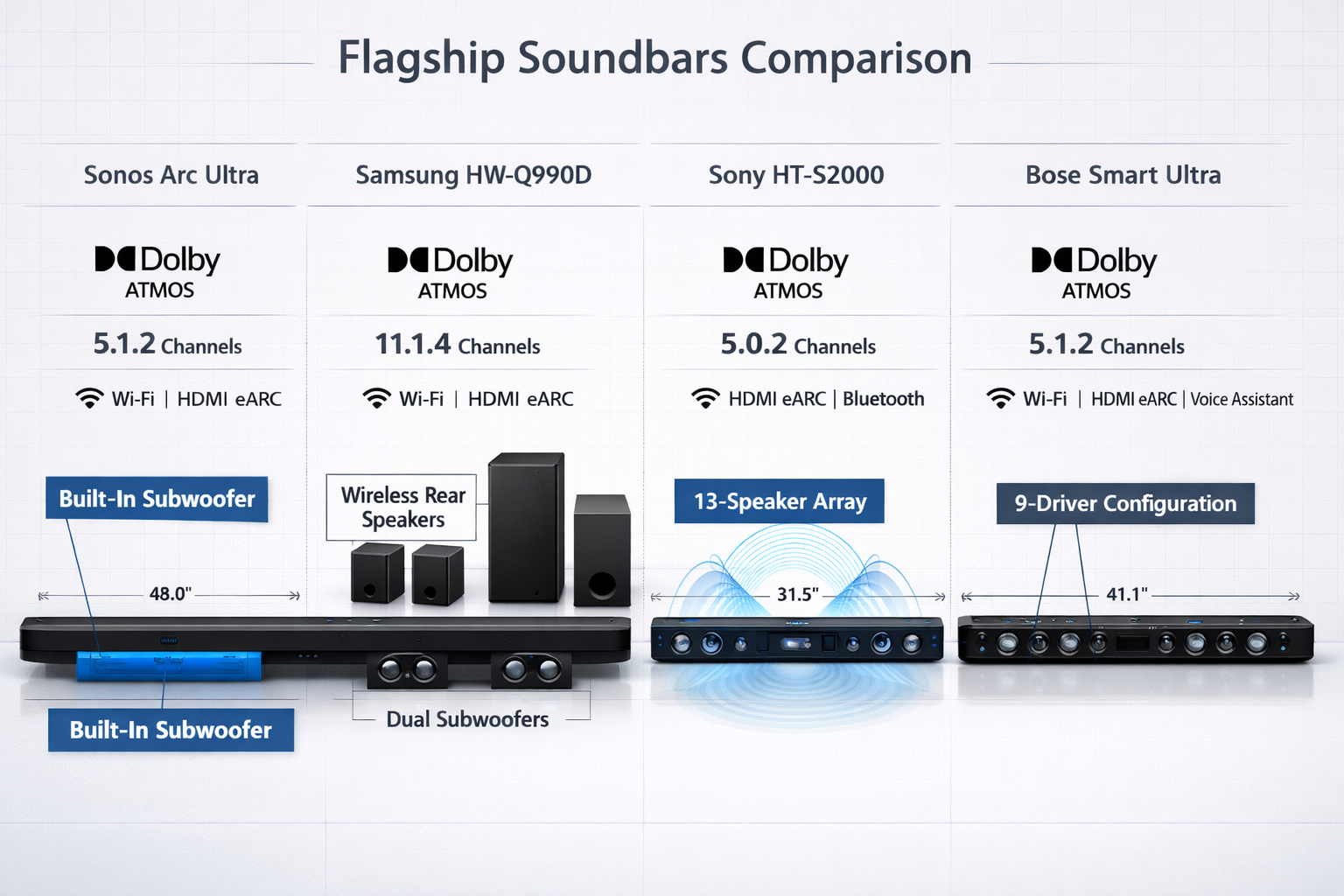
The Samsung HWQ990D represents the pinnacle of the brand’s 2026 lineup, featuring an impressive 11.1.4 channel configuration that rivals traditional home theater setups[1][2].
This system includes the main soundbar, two wireless rear speakers, and dual subwoofers that together create genuine 360-degree audio coverage.
Key specifications include:
- 11.1.4 channel Dolby Atmos and DTS:X support
- Dual wireless subwoofers with AI-driven bass control
- Wireless rear surround speakers
- Q-Symphony technology for Samsung TV integration
- Built-in Alexa and Bixby voice assistants
- SpaceFit Sound Pro room calibration
- Spotify Connect and AirPlay 2 streaming
The dual subwoofer configuration deserves special attention. Samsung employs AI-driven control algorithms that prevent the boomy, overwhelming bass that plagues many competitor systems[2].
The subwoofers punch hard during action sequences but remain controlled and articulate during quieter moments. This balanced tuning makes the HWQ990D equally capable with movies and music.
Samsung’s Ecosystem Advantages
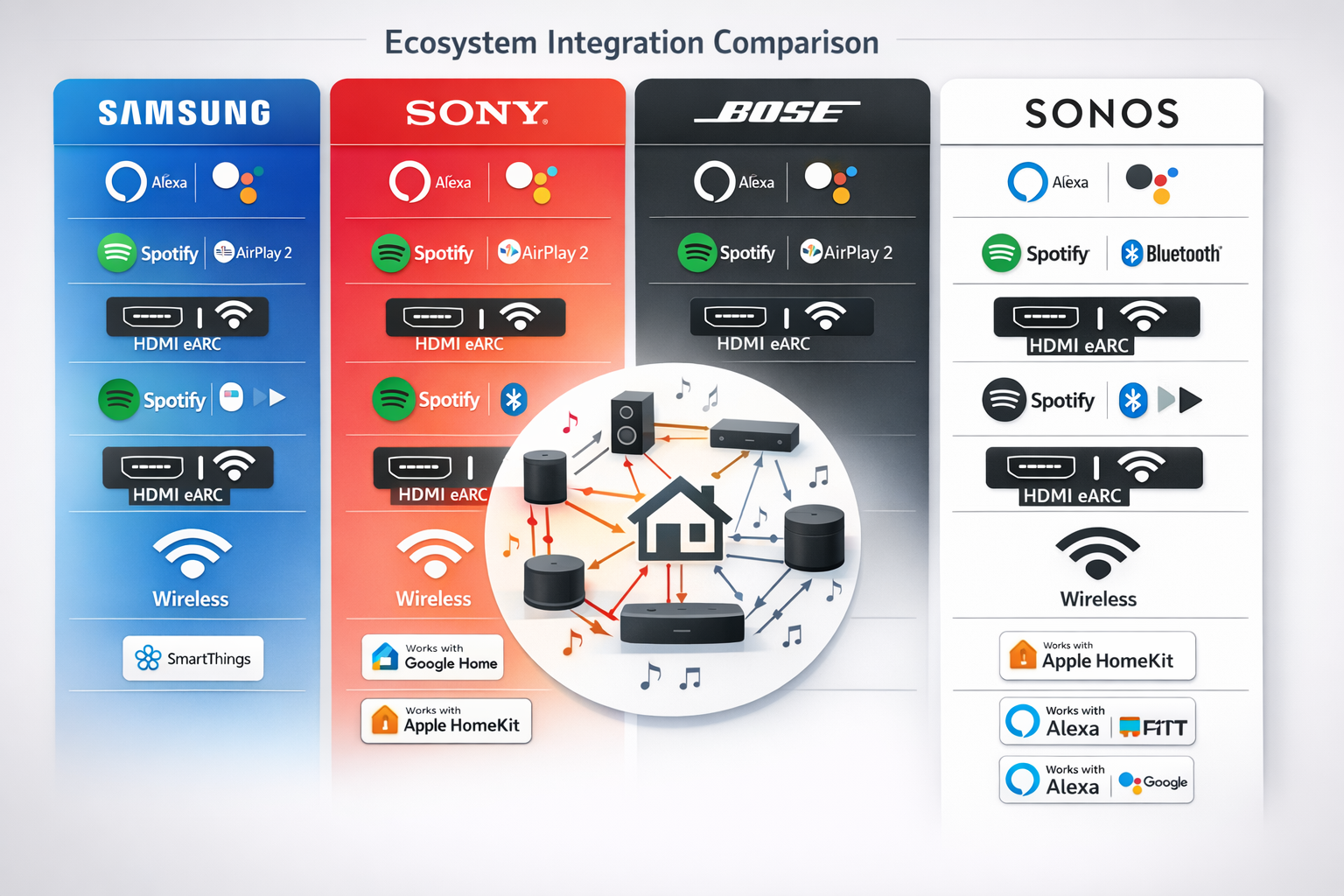
Samsung soundbars integrate seamlessly with the company’s broader smart home ecosystem.
Q-Symphony technology allows compatible Samsung TVs to work in concert with the soundbar, using the TV’s built-in speakers as additional channels rather than disabling them[1].
This creates a more enveloping soundstage without requiring additional hardware.
The brand also offers extensive connectivity options including HDMI eARC, optical, Bluetooth, and Wi-Fi.
For users building a Samsung-centric smart home, the integration with SmartThings provides centralized control over audio, lighting, and other connected devices.
Those interested in Samsung’s technical features can explore our guide on understanding CH level on Samsung soundbars.
Considerations and Limitations
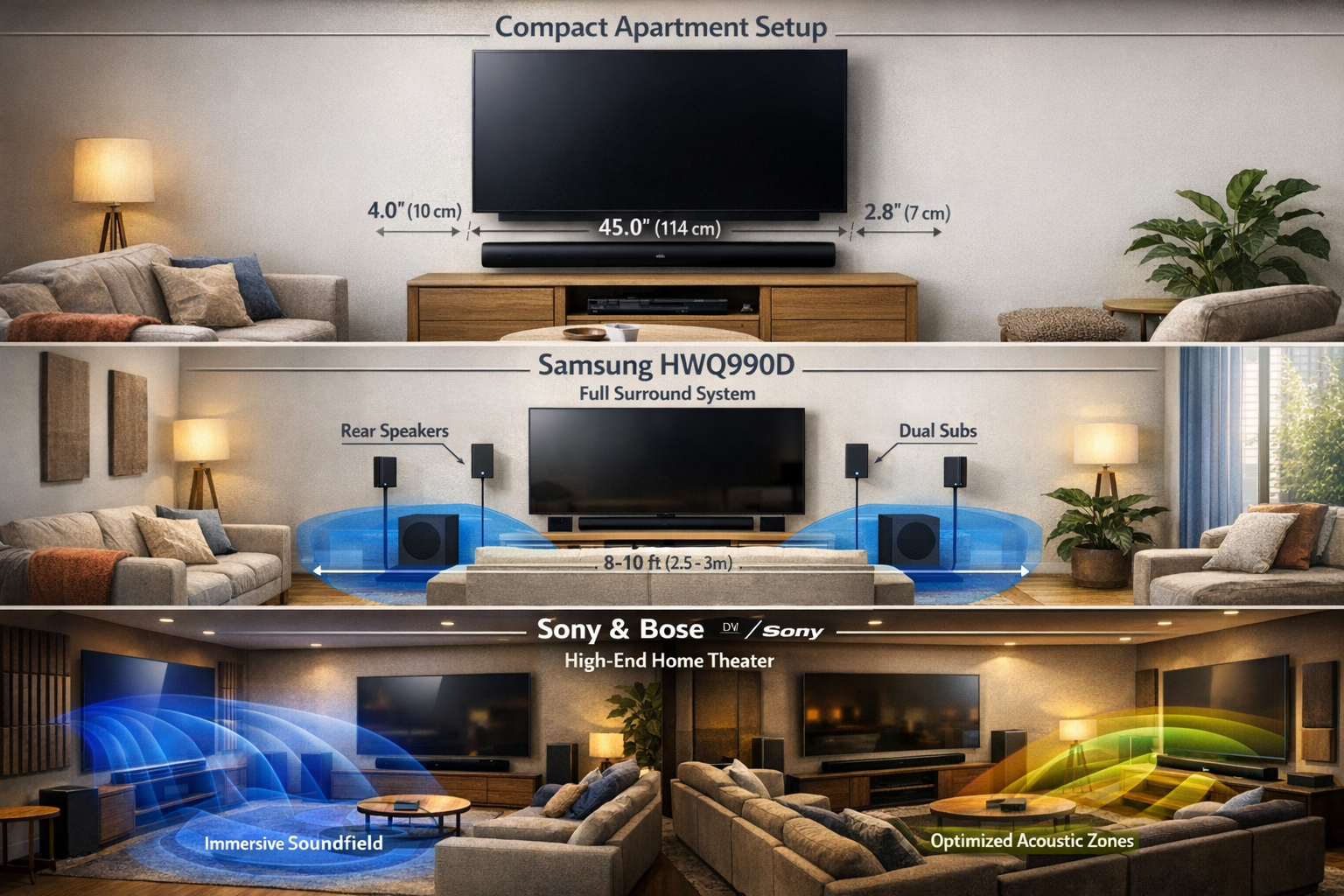
Despite its impressive capabilities, the Samsung HWQ990D presents some practical challenges. The complete system requires significant space for optimal placement.
The dual subwoofers alone demand dedicated floor space, and the wireless rears need appropriate positioning behind the listening area[2].
Some reviewers note slight bass compression when pushed to absolute maximum volume levels[2], though this occurs well beyond typical listening volumes.
For smaller rooms, the system actually provides more power than necessary, making mid-tier Samsung models potentially more appropriate.
Budget-conscious buyers should review our comparison of Samsung HW-C450 vs VIZIO 5.1 SE vs LG S40T for more affordable alternatives.
Price positioning: The HWQ990D typically retails around $1,799-$1,999, though 2026 has seen periodic sales bringing it closer to $1,500.
Sony: The Balanced Innovator
Sony approaches soundbar design with a philosophy rooted in the company’s professional audio heritage. The brand emphasizes accurate sound reproduction and innovative form factors that challenge conventional wisdom about what soundbars require.
Sony HT-S2000: Rethinking the Soundbar Formula
The Sony HT-S2000 represents a bold departure from traditional soundbar design. This 5.0.2 configuration features 13 built-in speakers packed into a 48-inch metal bar[2], eliminating the need for a separate subwoofer through clever acoustic engineering.
Sony relies on 360 Spatial Sound Mapping technology rather than physical wireless components to create immersive audio.
Technical highlights include:
- 13 integrated speakers in compact form factor
- 5.0.2 virtual surround configuration
- Dolby Atmos, DTS:X, and IMAX Enhanced support
- 360 Spatial Sound Mapping technology
- Soundfield Optimization auto-calibration
- Center speaker lift for enhanced dialogue clarity
- Optional wireless rear speakers (SA-RS5) sold separately
The single-bar approach offers significant advantages for minimalist setups. Without a subwoofer to position and connect, installation becomes dramatically simpler. The HT-S2000 works exceptionally well in apartments or condos where space is limited and neighbors might object to deep bass.
Performance Trade-offs
The elephant in the room is bass performance. Without a dedicated subwoofer, the HT-S2000 delivers relatively thin low-end response compared to systems with separate bass drivers[2]. Action movies lack the chest-thumping impact that many viewers expect from premium soundbars. Music reproduction favors clarity over weight.
Sony offers the SA-SW5 wireless subwoofer as an optional upgrade, which significantly improves bass extension. However, adding this component plus the optional SA-RS5 wireless rear speakers pushes the total system cost well above $1,500, diminishing the value proposition.
For those interested in Sony’s rear speaker ecosystem, our guide on Sony Soundbar SA-RS5 wireless rear speakers provides compatibility details.
Reviewers note that Atmos effects are somewhat restrained compared to systems with actual height drivers and subwoofers[2]. The virtual surround processing creates a wider soundstage than TV speakers, but falls short of the three-dimensional immersion delivered by Samsung’s or Sonos’s flagship models.
Sony’s Unique Strengths
Where Sony excels is dialogue clarity and midrange accuracy. The dedicated center channel keeps voices crisp and intelligible even during complex action sequences[1].
The Soundfield Optimization technology uses microphones to analyze room acoustics and automatically adjusts EQ settings for optimal performance in any space.
PlayStation 5 owners gain additional benefits through seamless integration with Sony’s gaming ecosystem.
The HT-S2000 supports 3D audio from PS5 games and can be controlled through the console’s interface. For more on Sony’s TV integration features, see our guide on setting up Sony Bravia soundbar Acoustic Center Sync.
Price positioning: The HT-S2000 retails around $699-799, making it competitive with premium single-bar solutions. Adding the optional subwoofer ($699) and rear speakers ($349) brings the complete system to approximately $1,800.
Bose: The Adaptive Audio Specialist
Bose has built its soundbar reputation on proprietary processing technology that automatically adapts to content type and room acoustics. The brand targets consumers who want excellent sound without manual tweaking or complex setup procedures.
Bose Smart Ultra: Intelligence Meets Performance
The Bose Smart Ultra Soundbar features a sophisticated nine-driver array enhanced with Dolby Atmos and Bose TrueSpace Processing[1].
This proprietary technology analyzes incoming audio signals in real-time and adjusts the sound profile based on content type—delivering lighter, dialogue-focused audio for dramas and fuller, more dynamic sound for action sequences or music.
Core features include:
- Nine-driver configuration with upward-firing speakers
- Dolby Atmos and proprietary TrueSpace processing
- ADAPTiQ audio calibration system
- Voice4Video technology for enhanced dialogue
- Built-in Alexa and Google Assistant
- Wi-Fi, Bluetooth, AirPlay 2, and Spotify Connect
- HDMI eARC and optical connectivity
- Optional Bass Module 700 and Surround Speakers 700
The ADAPTiQ calibration system represents one of Bose’s key differentiators.
Using a special headset microphone (included), the system measures acoustic characteristics from multiple listening positions and creates a custom EQ profile optimized for the specific room.
This addresses the common problem of soundbars sounding dramatically different depending on room size, furniture placement, and wall materials.
The Bose Ecosystem Approach
Bose takes a modular approach similar to Sonos, allowing users to start with the soundbar and add components as budget allows. The Bass Module 700 wireless subwoofer adds deep bass extension, while the Surround Speakers 700 create true rear channel effects for a complete 5.1 system.
The brand’s SimpleSync technology enables pairing with Bose headphones for private listening without disturbing others—a unique feature that competitors don’t offer.
This proves particularly valuable for late-night viewing in shared living spaces. For those considering Bose’s entry-level options, our Bose Solo 5 TV Sound System review covers budget alternatives.
Bose Limitations and Considerations
The Smart Ultra’s primary weakness is limited HDMI connectivity. With only one HDMI eARC port and no pass-through capability, all source device switching must occur at the TV level. This mirrors Sonos’s approach but frustrates users with multiple gaming consoles or media players who prefer direct soundbar connections.
Some audiophiles criticize Bose’s signature sound profile as overly processed, favoring smoothness over absolute accuracy.
The TrueSpace processing creates an impressively wide soundstage, but purists argue it colors the audio in ways that deviate from the original mix. This comes down to personal preference—many listeners prefer Bose’s warm, forgiving sound over more analytical competitors.
Price positioning: The Bose Smart Ultra soundbar alone retails for $899. Adding the Bass Module 700 ($849) and Surround Speakers 700 ($849) brings a complete system to approximately $2,600—the most expensive configuration among the four brands compared.
Sonos: The Streaming Audio Champion
Sonos has revolutionized home audio through its focus on wireless multiroom capabilities and seamless streaming integration. The brand appeals to consumers who prioritize music streaming alongside movie watching and value ecosystem simplicity above all else.
Sonos Arc Ultra: The New Single-Bar King
The Sonos Arc Ultra represents the company’s 2026 flagship, incorporating breakthrough Sound Motion technology that delivers integrated bass performance previously impossible in single-bar designs[2]. This innovation allows the Arc Ultra to produce nearly double the bass output of the original Arc[2] without requiring a separate subwoofer.
Standout specifications:
- 5.1.2 Dolby Atmos configuration
- Integrated Sound Motion subwoofer technology
- 14 precision-engineered drivers
- Trueplay room tuning (iOS devices)
- Speech Enhancement and Night Sound modes
- Wi-Fi, Bluetooth, AirPlay 2, and Spotify Connect
- Single HDMI eARC connection
- Seamless Sonos ecosystem integration
Reviewers consistently describe the Arc Ultra as “the best sounding one-box soundbar for the price”[2]. The Sound Motion technology represents a genuine innovation rather than incremental improvement, allowing the soundbar to reproduce bass frequencies down to approximately 50Hz without external assistance—impressive for a single-bar design.
Sonos Ecosystem Excellence
Where Sonos truly differentiates itself is multiroom audio integration. The Arc Ultra seamlessly connects with other Sonos speakers throughout the home, allowing users to play synchronized music across all rooms or different content in each space.
The Sonos app provides intuitive control over streaming services, with direct integration for Spotify, Apple Music, Amazon Music, Tidal, and dozens of other platforms.
The Trueplay room tuning feature uses iPhone or iPad microphones to analyze room acoustics and optimize EQ settings.
While limited to iOS devices (a frustrating restriction for Android users), the technology delivers noticeable improvements in tonal balance and imaging. For those exploring Sonos’s premium lineup, our Sonos Beam Gen 2 review covers the brand’s mid-tier option.
Sonos Trade-offs
The Arc Ultra’s most significant limitation is connectivity. With only one HDMI eARC port and no pass-through capability[2], all source devices must connect to the TV, which then passes audio to the soundbar via eARC. This works perfectly for most modern TVs but can cause compatibility issues with older displays or complex multi-source setups.
Sonos also takes a closed ecosystem approach that prevents integration with non-Sonos components. Users cannot add third-party subwoofers or rear speakers—only Sonos-branded components work within the system. This ensures seamless operation but limits flexibility and can increase long-term costs.
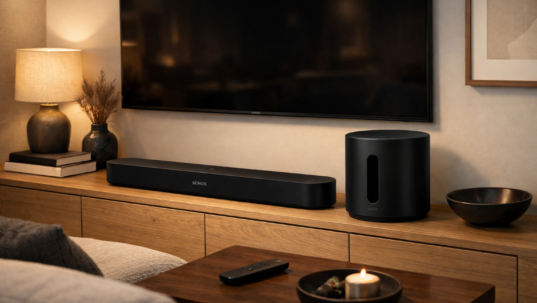
The Arc Ultra delivers impressive bass for a single-bar design, but users seeking truly deep bass extension will want to add the Sonos Sub ($799), which brings the total system cost to approximately $1,700. Wireless rear speakers (Sonos Era 300 pair at $599) push a complete surround system above $2,300.
Price positioning: The Sonos Arc Ultra retails for $999, positioning it as a premium single-bar solution. However, 2026 sales have occasionally brought it down to $899, improving its value proposition.
Head-to-Head Comparison: Top Soundbar Brands Battle in 2026
To help clarify the competitive landscape, this detailed comparison examines how Samsung vs Sony vs Bose vs Sonos stack up across critical decision factors.
Performance Comparison Table
| Feature | Samsung HWQ990D | Sony HT-S2000 | Bose Smart Ultra | Sonos Arc Ultra |
|---|---|---|---|---|
| Configuration | 11.1.4 channels | 5.0.2 channels | 5.1.2 channels | 5.1.2 channels |
| Dolby Atmos | ✅ Yes | ✅ Yes | ✅ Yes | ✅ Yes |
| Included Subwoofer | ✅ Dual wireless | ❌ None | ❌ Optional | ❌ Optional |
| Rear Speakers | ✅ Included | ❌ Optional | ❌ Optional | ❌ Optional |
| HDMI Ports | Multiple + eARC | eARC + passthrough | eARC only | eARC only |
| Voice Assistant | Alexa, Bixby | Google Assistant | Alexa, Google | Alexa, Google |
| Room Calibration | SpaceFit Sound Pro | Soundfield Optimization | ADAPTiQ | Trueplay (iOS) |
| Multiroom Audio | Limited | Limited | Bose ecosystem | ✅ Excellent |
| Base Price | $1,799 | $699 | $899 | $999 |
| Complete System | $1,799 (included) | ~$1,800 (with add-ons) | ~$2,600 (with add-ons) | ~$2,300 (with add-ons) |
Bass Performance and Low-End Extension
Samsung HWQ990D delivers the most authoritative bass among the four competitors, thanks to its dual wireless subwoofers with AI-driven control[2].
The system reproduces frequencies down to approximately 30Hz with substantial impact, satisfying even demanding action movie enthusiasts.
Sonos Arc Ultra achieves impressive bass for a single-bar design, reaching approximately 50Hz through its integrated Sound Motion technology[2].
This represents a significant improvement over traditional soundbar designs and eliminates the subwoofer requirement for many users.
Bose Smart Ultra offers moderate bass extension in standalone configuration, requiring the optional Bass Module 700 for deep low-frequency reproduction. With the subwoofer added, the system competes effectively with Samsung’s offering.
Sony HT-S2000 delivers the thinnest bass response without the optional SA-SW5 subwoofer[2]. The compact design prioritizes clarity over weight, making it less suitable for bass-heavy content.
Dialogue Clarity and Center Channel Performance
Sony HT-S2000 excels in dialogue reproduction, with its dedicated center channel keeping voices crisp and intelligible even during complex soundtracks[1]. The center speaker lift technology further enhances vocal clarity.
Bose Smart Ultra employs Voice4Video technology that automatically enhances dialogue without requiring manual adjustment[1]. The adaptive processing ensures voices remain clear regardless of content type.
Samsung HWQ990D and Sonos Arc Ultra both deliver excellent dialogue clarity, though neither specializes in this area to the degree that Sony and Bose do. Both offer dedicated center channels that prevent voices from getting lost in the mix.
Spatial Audio and Atmos Performance
Samsung HWQ990D creates the most convincing three-dimensional soundstage, thanks to its physical rear speakers and multiple height channels[1][2]. The 11.1.4 configuration provides genuine surround envelopment rather than virtual processing.
Sonos Arc Ultra delivers impressive Atmos effects for a single-bar design, though the virtual surround processing cannot fully replicate physical rear speakers[2]. The wide soundbar design (approximately 46 inches) helps create lateral imaging.
Bose Smart Ultra uses TrueSpace processing to create a spacious soundstage that extends beyond the physical soundbar[1]. The proprietary algorithms work well but produce a somewhat processed quality compared to systems with discrete surround speakers.
Sony HT-S2000 provides the most restrained Atmos presentation[2]. The 360 Spatial Sound Mapping creates a wider soundstage than TV speakers but falls short of the immersion delivered by competitors with dedicated height drivers and subwoofers.
Ecosystem Integration and Smart Features
Sonos Arc Ultra dominates multiroom audio capabilities, offering seamless integration with other Sonos speakers and polished streaming service support[1]. The ecosystem approach makes Sonos ideal for users building whole-home audio systems.
Samsung HWQ990D integrates deeply with Samsung’s smart home ecosystem, including Q-Symphony TV integration and SmartThings control[1]. This benefits Samsung TV owners but offers less value for users with other TV brands. Those building a Samsung audio setup should review our guide on choosing a top Samsung soundbar.
Bose Smart Ultra provides solid smart home integration with Alexa and Google Assistant support, plus the unique SimpleSync headphone pairing feature. The Bose ecosystem works well but lacks the polish of Sonos’s multiroom implementation.
Sony HT-S2000 offers basic smart features with Google Assistant support and excellent PlayStation 5 integration. The ecosystem is less developed than competitors, focusing primarily on Sony TV and gaming console compatibility.
Connectivity and Setup Considerations
Understanding connectivity options proves essential when choosing between these flagship soundbars, as limitations can significantly impact long-term satisfaction.
HDMI and Source Device Management
Samsung HWQ990D provides the most flexible connectivity with multiple HDMI inputs plus eARC output. Users can connect gaming consoles, Blu-ray players, and streaming devices directly to the soundbar, which then passes video to the TV. This approach simplifies source switching and ensures optimal audio format support.
Sony HT-S2000 includes HDMI eARC plus pass-through capability, allowing direct connection of source devices. This matches Samsung’s flexibility while maintaining the compact single-bar form factor.
Sonos Arc Ultra and Bose Smart Ultra both feature only single HDMI eARC ports without pass-through[2].
All source devices must connect to the TV, which then sends audio to the soundbar via eARC.
This works perfectly with modern TVs supporting eARC but can cause compatibility issues with older displays or complex setups requiring multiple HDMI sources.
Wireless Streaming Options
All four brands support Wi-Fi, Bluetooth, and AirPlay 2 for wireless music streaming. Spotify Connect integration allows direct control through the Spotify app without requiring the soundbar’s dedicated app.
Sonos provides the most polished streaming experience with direct integration of dozens of music services within its app. The interface feels more refined than competitors, with better search functionality and playlist management.
Samsung, Sony, and Bose rely more heavily on Bluetooth and AirPlay 2 for music streaming, with less emphasis on built-in service integration. This approach works well but requires switching between multiple apps depending on the streaming service.
Room Calibration Technologies
Bose ADAPTiQ uses a specialized headset microphone to measure acoustics from multiple listening positions, creating a comprehensive room profile. The process takes approximately 10 minutes and delivers noticeable improvements in tonal balance.
Sonos Trueplay employs iPhone or iPad microphones for room analysis, waving the device around the listening space while test tones play. The iOS-only limitation frustrates Android users, but the technology works effectively when available.
Samsung SpaceFit Sound Pro uses the soundbar’s built-in microphones to analyze room characteristics and automatically optimize settings. The automated approach requires no user involvement beyond initial activation.
Sony Soundfield Optimization similarly employs built-in microphones for automatic room calibration. The system continuously adapts to changes in room configuration, such as furniture rearrangement.
Price-Performance Analysis for 2026
Understanding value propositions helps identify which soundbar delivers the best return on investment for different user priorities.
Best Overall Value: Samsung HWQ990D
For consumers seeking a complete home theater system in a single purchase, the Samsung HWQ990D at $1,799 represents exceptional value[2].
The package includes everything needed for true surround sound: main soundbar, dual subwoofers, and wireless rear speakers. Purchasing equivalent components separately from competitors would cost $2,300-$2,600.
The system delivers performance that rivals traditional receiver-based home theater setups costing significantly more. The AI-driven bass control and balanced tuning make it equally capable with movies and music[2].
For users with space for the complete system and budget around $1,800, Samsung offers the most complete package.
Best Single-Bar Solution: Sonos Arc Ultra
The Sonos Arc Ultra at $999 delivers the best standalone soundbar performance[2]. The integrated Sound Motion technology produces bass output that eliminates the subwoofer requirement for many users, while the 5.1.2 Dolby Atmos configuration creates convincing spatial audio effects.
The polished ecosystem integration and multiroom audio capabilities add significant value beyond pure audio performance. Users building whole-home audio systems will appreciate the seamless Sonos experience.
The Arc Ultra works exceptionally well in apartments, condos, and smaller spaces where a full surround system would overwhelm the room. For additional Sonos comparisons, see our Sonos Arc Ultra vs LG Flex Connect H7 review.
Best Budget Option: Sony HT-S2000
At $699, the Sony HT-S2000 offers the lowest entry price among flagship models[2]. The single-bar design with 13 integrated speakers delivers solid performance for dialogue-heavy content and smaller rooms. The compact form factor and simple setup appeal to minimalists who prioritize convenience.
However, the thin bass response limits its appeal for action movies and bass-heavy music. Users should consider whether adding the $699 subwoofer defeats the budget advantage, potentially making mid-tier Samsung or Sonos models better values.
For those exploring budget alternatives across brands, our guide to the best budget soundbar with subwoofer provides additional options.
Premium Choice: Bose Smart Ultra
The Bose Smart Ultra at $899 targets consumers who value adaptive audio processing and the brand’s signature sound profile. The TrueSpace technology and ADAPTiQ calibration deliver excellent results without manual tweaking[1].
However, building a complete system with Bass Module 700 and Surround Speakers 700 pushes total cost above $2,600—the highest among competitors. This premium pricing makes sense for Bose loyalists and users who prioritize the SimpleSync headphone feature, but value-conscious buyers may find better options elsewhere.
Making the Right Choice: Which Brand Wins in 2026?
The Top Soundbar Brands Battle in 2026: Samsung vs Sony vs Bose vs Sonos Compared reveals that no single winner exists—the ideal choice depends on individual priorities, room characteristics, and budget constraints.
Choose Samsung HWQ990D If You Want:
✅ Complete surround system with everything included
✅ Maximum bass impact from dual wireless subwoofers
✅ True rear channel effects without additional purchases
✅ Samsung TV integration through Q-Symphony technology
✅ Best value for a complete home theater package
Ideal for: Large living rooms, dedicated home theaters, action movie enthusiasts, users with Samsung TVs
Choose Sony HT-S2000 If You Want:
✅ Minimalist single-bar design without subwoofer cables
✅ Superior dialogue clarity from dedicated center channel
✅ PlayStation 5 integration for gaming
✅ Compact footprint for smaller spaces
✅ Lowest entry price among flagship models
Ideal for: Apartments, condos, dialogue-focused content, PlayStation gamers, minimalists
Choose Bose Smart Ultra If You Want:
✅ Adaptive audio processing that automatically adjusts to content
✅ ADAPTiQ room calibration for optimal acoustic tuning
✅ SimpleSync headphone pairing for private listening
✅ Bose’s signature warm sound profile
✅ Comprehensive voice assistant integration
Ideal for: Users who prefer set-and-forget simplicity, Bose ecosystem owners, late-night viewers who use headphones
Choose Sonos Arc Ultra If You Want:
✅ Best single-bar performance with integrated bass technology
✅ Seamless multiroom audio throughout the home
✅ Polished streaming integration with dozens of services
✅ Premium build quality and elegant design
✅ Excellent balance between performance and simplicity
Ideal for: Music streaming enthusiasts, whole-home audio systems, medium-sized rooms, users prioritizing aesthetics
Future Trends and What’s Next for Soundbar Technology
Looking beyond 2026, several emerging trends will shape the next generation of soundbar development:
AI-driven audio optimization will become more sophisticated, with soundbars automatically adjusting EQ, volume, and spatial processing based on content type, time of day, and even viewer preferences learned over time.
Wireless surround standards will improve, reducing latency and improving reliability for rear speaker connections. Current wireless implementations occasionally suffer from sync issues during demanding content.
Integration with smart home platforms will deepen, allowing soundbars to serve as central hubs for voice control, home automation, and multi-device coordination beyond pure audio functions.
Modular upgrade paths may emerge, allowing users to add processing power or speaker modules to existing soundbars rather than replacing entire systems. This would extend product lifecycles and reduce electronic waste.
Personalized sound profiles using hearing tests and individual preference mapping could optimize audio delivery for each listener’s unique hearing characteristics and preferences.
Conclusion: Navigating the Top Soundbar Brands Battle in 2026
The Top Soundbar Brands Battle in 2026: Samsung vs Sony vs Bose vs Sonos Compared demonstrates that each manufacturer has carved out distinct competitive advantages.
Samsung delivers complete systems with maximum features, Sony emphasizes compact innovation and dialogue clarity, Bose focuses on adaptive processing and ease of use, while Sonos perfects the single-bar experience with superior ecosystem integration.
Actionable Next Steps
1. Define Your Priorities: Determine whether you value complete surround sound, compact design, ecosystem integration, or adaptive processing most highly. This clarity will immediately narrow your options.
2. Assess Your Space: Measure your room and identify where components can be placed. Large rooms with space for rear speakers favor Samsung, while compact apartments suit Sonos or Sony better.
3. Consider Your Ecosystem: If you already own Samsung TVs, Sony PlayStations, or Sonos speakers, staying within that ecosystem provides additional value through enhanced integration.
4. Set a Realistic Budget: Determine whether you’re purchasing a complete system now or building incrementally. Samsung offers the best value for immediate complete systems, while Sonos and Bose allow gradual expansion.
5. Audition Before Buying: If possible, listen to each soundbar in person. Sound preferences are subjective, and specifications don’t always translate to real-world satisfaction. Many retailers offer generous return policies that allow home auditions.
6. Monitor Price Drops: The competitive 2026 market has produced frequent sales and promotions. Setting price alerts can yield savings of $200-400 on flagship models.
The soundbar market has never offered more excellent options across all price points.
Whether you choose Samsung’s feature-packed powerhouse, Sony’s innovative single-bar design, Bose’s adaptive intelligence, or Sonos’s streaming excellence, 2026’s flagship models deliver cinema-quality audio that transforms home entertainment.
The key is matching each brand’s strengths to your specific needs, room characteristics, and long-term audio goals.
For readers seeking additional guidance on specific aspects of soundbar ownership, explore our comprehensive resources on soundbar wall mounting, fixing audio delay issues, and choosing the right soundbar for your unique situation.
References
[1] Watch – https://www.youtube.com/watch?v=0iCuQipF35Y
[2] Watch – https://www.youtube.com/watch?v=bNcrWeUEngw
[3] Watch – https://www.youtube.com/watch?v=ycG2ndO3e-s
[4] All In One – https://www.rtings.com/soundbar/reviews/best/all-in-one
[5] Sonos Soundbar Speaker Headphone Home Theater Deal – https://www.popsci.com/gear/sonos-soundbar-speaker-headphone-home-theater-deal/

Pingback: Top Samsung Soundbars to Consider for Great Sound Quality