
Soundbars with Built-in Subwoofers
Picture this: You’re settling in for movie night in your compact apartment, ready to experience cinema-quality sound. But there’s a problem—where exactly are you supposed to put that bulky separate subwoofer?
Between the coffee table, your couch, and limited floor space, finding the perfect spot feels impossible. This is where soundbars with built-in subwoofers become game-changers.
In 2026, audio manufacturers have perfected the art of delivering deep, powerful bass without requiring extra equipment cluttering your living space.
Soundbars with Built-in Subwoofers: Complete Bass Without Extra Gear in 2026 represent the evolution of home audio technology, combining convenience with performance.
These all-in-one solutions integrate dedicated bass drivers directly into the soundbar chassis, eliminating the need for separate subwoofer units while maintaining the low-frequency impact that makes movies thrilling, music engaging, and gaming immersive.
Key Takeaways
- 🔊 Built-in subwoofers deliver impressive bass without requiring separate units, making them ideal for apartments and space-constrained environments
- 💰 Premium models like the Klipsch Flexus Core 300 can reproduce bass frequencies as low as dedicated subwoofer systems, rivaling traditional multi-piece setups[1]
- 🎯 Compact designs don’t sacrifice performance—advanced four-motor woofer systems and sealed enclosures provide deep, controlled bass in slim profiles[2]
- 🎮 Versatile performance across content types—these soundbars excel with movies, music, and gaming without requiring separate equipment or complex placement
- 📏 Space-saving benefits are substantial—eliminating the separate subwoofer frees up valuable floor space while reducing cable clutter and setup complexity
Understanding Built-in Subwoofer Technology in Modern Soundbars
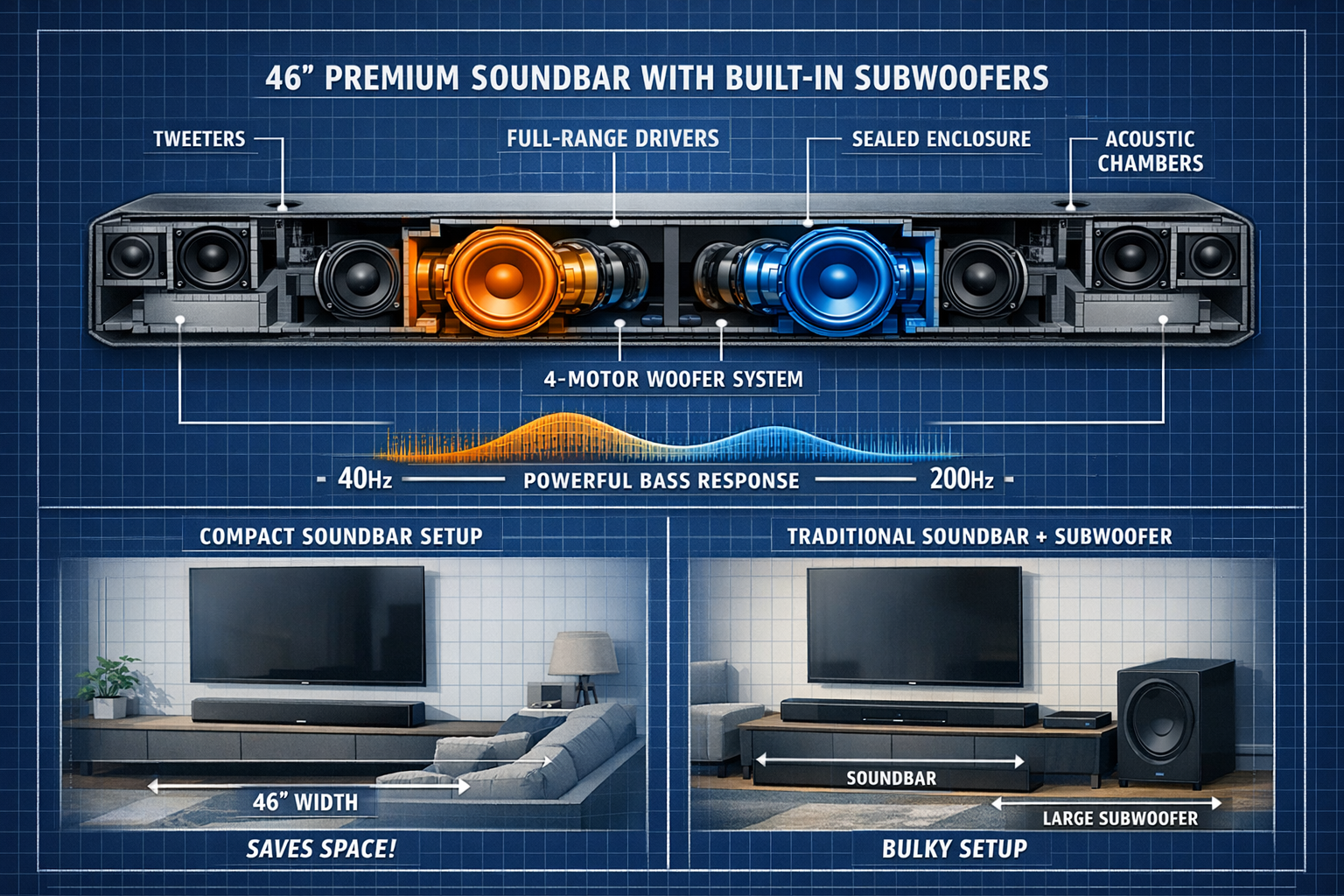
The technology behind soundbars with built-in subwoofers has advanced dramatically in recent years. Unlike traditional soundbars that rely on small drivers incapable of reproducing deep bass, modern integrated designs incorporate dedicated low-frequency drivers and acoustic chambers within the soundbar chassis itself.
How Built-in Subwoofers Work
Built-in subwoofer systems utilize several key technologies to achieve deep bass response:
Dedicated Bass Drivers: Premium models feature specialized woofer units designed specifically for low-frequency reproduction. The Sonos Arc Ultra, for example, integrates a four-motor woofer system into its compact internal design, producing noticeably stronger bass without requiring a separate subwoofer unit[2].
Sealed Acoustic Enclosures: Internal compartments within the soundbar isolate bass drivers from midrange and tweeter components. This design approach, exemplified by the Samsung HW-Q990F’s redesigned sealed enclosure, reduces unwanted vibration and rattle while maintaining bass impact[4].
Advanced Signal Processing: Digital signal processors (DSP) optimize bass response by adjusting frequency curves, managing crossover points, and preventing distortion at high volumes. Many models include bass adjustment features that let users customize low-frequency output to match their preferences and room acoustics[1].
The Physics of Compact Bass
Creating deep bass in a compact form factor presents significant engineering challenges. Bass frequencies require moving large volumes of air—something traditionally accomplished with large driver cones and substantial cabinet volumes. Modern soundbars overcome these limitations through:
- High-excursion drivers that move farther in and out, displacing more air despite smaller diameters
- Passive radiators that enhance bass output without requiring additional amplification
- Port designs that tune the internal acoustic chamber to specific frequencies
- Multiple smaller drivers working in tandem to achieve the output of larger single drivers
The Devialet Dione demonstrates this approach brilliantly, delivering some of the strongest built-in bass response of any soundbar with bass that stays “tight and controlled” while hitting with more weight than expected for its slim design[3].
Top Soundbars with Built-in Subwoofers: Complete Bass Without Extra Gear in 2026
Finding the right soundbar with integrated bass depends on your specific needs, room size, and content preferences. Here are the standout performers across different price ranges and use cases.
Premium Tier: Uncompromising Performance
Klipsch Flexus Core 300 🏆
The Klipsch Flexus Core 300 currently holds the title as the best soundbar with a built-in subwoofer available in 2026. This premium model is capable of reproducing bass frequencies as low as or close to premium models with separate subwoofers[1].
Key Features:
- Deep thump and rumble in both bass-heavy music and action movie scenes
- Adjustable bass controls for precise volume customization
- Seamless integration between low, mid, and high frequencies
- Premium build quality with Klipsch’s signature audio engineering
The Flexus Core 300 excels across all content types. During action movie testing, explosions deliver visceral impact without overwhelming dialogue clarity. Bass-heavy music tracks maintain definition and punch, while gaming scenarios benefit from directional low-frequency effects that enhance immersion.
Devialet Dione
For those seeking the absolute pinnacle of built-in bass performance, the Devialet Dione stands in a class of its own. This French-engineered soundbar delivers bass that integrates seamlessly with the midrange, creating a sound that feels “much bigger and more complete than you would expect from a standalone bar”[3].
The Dione’s sophisticated acoustic design produces controlled, tight bass that never becomes muddy or overpowering. Its premium price reflects cutting-edge engineering and materials, but the performance justifies the investment for discerning audiophiles.
Sonos Arc Ultra
Measuring approximately 46 inches wide, the Sonos Arc Ultra incorporates a four-motor woofer system that produces significant rumble and bass impact without a dedicated subwoofer[2]. While it maintains a fairly large footprint, the Arc Ultra’s wireless connectivity, multi-room audio capabilities, and ecosystem integration make it an excellent choice for Sonos users.
The Arc Ultra particularly shines with Dolby Atmos content, delivering immersive overhead effects alongside its impressive bass response. Its TruePlay room calibration technology automatically optimizes bass output based on your specific room acoustics.
Mid-Range Champions: Performance Meets Value
For those seeking excellent bass performance without premium pricing, several mid-range options deliver impressive results.
Sony HT-X8500
The Sony HT-X8500 soundbar with integrated subwoofer represents exceptional value in the mid-range segment. This compact unit incorporates dedicated bass drivers that produce surprisingly deep low-frequency response for its size and price point.
Sony’s Vertical Surround Engine creates virtual height effects, while the built-in subwoofer handles bass duties admirably for small to medium-sized rooms. It’s an ideal solution for apartment dwellers who want meaningful bass improvement over TV speakers without investing in premium models.
Bose Solo 5
The Bose Solo 5 TV Sound System offers Bose’s signature sound quality in an accessible package. While it lacks the deep bass extension of premium models, its integrated bass drivers provide noticeable improvement over standard soundbars in its price range.
The Solo 5’s dialogue mode enhances speech clarity—particularly valuable for news and TV shows—while maintaining balanced bass response during music and movie playback.
Budget-Friendly Options
Even entry-level soundbars now incorporate basic built-in subwoofer technology. While these models can’t match premium performance, they offer significant upgrades over TV speakers for budget-conscious buyers. For more affordable options that include separate subwoofers, check out our guide to the best budget soundbar with subwoofer combos.
Testing Performance: Movies, Music, and Gaming with Built-in Bass Systems
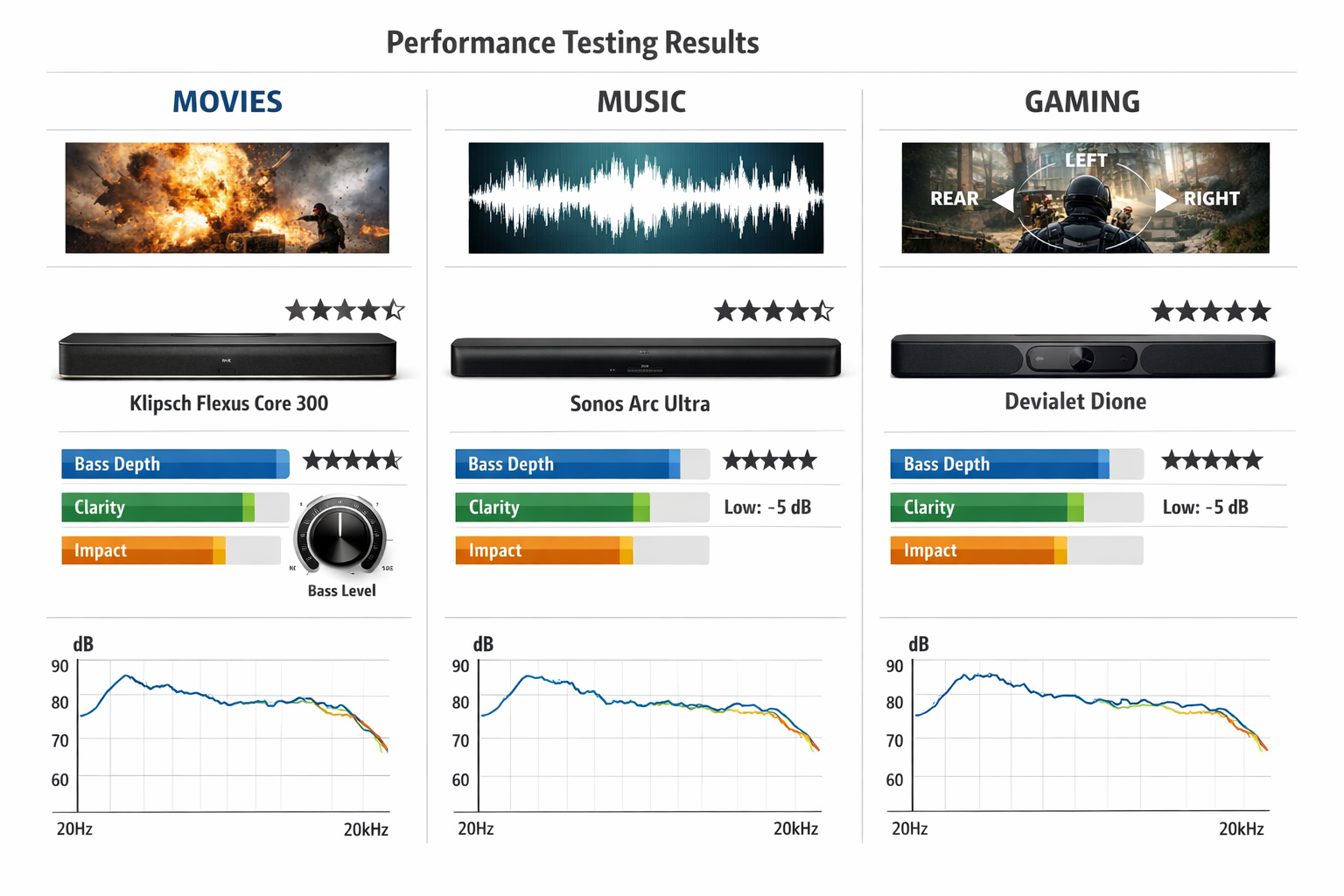
Real-world performance testing reveals how soundbars with built-in subwoofers handle different content types. Understanding these performance characteristics helps buyers choose the right model for their primary use cases.
Movie Performance Testing
Action movies provide the most demanding test for built-in subwoofer systems. Key evaluation criteria include:
Explosion Impact: Premium models like the Klipsch Flexus Core 300 deliver satisfying thump and rumble during explosive scenes without distortion or cabinet rattling[1]. The bass hits with authority while maintaining clarity in dialogue and sound effects.
Low-Frequency Extension: The deepest bass frequencies (below 40Hz) create visceral sensations during intense scenes. While separate subwoofers traditionally excel here, top-tier integrated systems now approach similar performance levels.
Dynamic Range: The ability to transition from quiet dialogue to explosive action without compression or distortion separates premium models from budget options. The Devialet Dione particularly excels in this area, maintaining composure across extreme dynamic swings[3].
Dialogue Clarity: Effective built-in subwoofer designs prevent bass frequencies from masking dialogue. Proper crossover management ensures low frequencies don’t muddy the critical midrange where speech resides.
Music Performance Evaluation
Music testing reveals how well integrated bass systems handle different genres and production styles:
Bass-Heavy Genres: Hip-hop, EDM, and modern pop tracks with synthesized bass lines demand tight, controlled low-frequency reproduction. The Klipsch Flexus Core 300’s adjustable bass controls allow precise tuning to match listener preferences[1].
Acoustic and Jazz: These genres require natural, uncolored bass response. Premium models with sealed enclosure designs, like the Samsung HW-Q990F, deliver more organic and balanced bass compared to ported designs[4].
Rock and Metal: Fast, punchy bass guitar and kick drum passages test transient response. The best built-in systems maintain definition during rapid bass notes without smearing or bloating.
Classical and Orchestral: Large-scale orchestral works demand extended bass response for instruments like timpani and double bass. Premium soundbars reproduce these low frequencies with appropriate weight and texture.
Gaming Performance Analysis
Gaming presents unique challenges that combine movie-like explosions with music soundtracks and critical directional audio cues:
Directional Bass Cues: First-person shooters and competitive games benefit from precise bass localization. While separate subwoofers can make directional bass challenging, integrated systems maintain better spatial accuracy.
Continuous Bass Response: Open-world games with constant ambient bass (vehicle engines, environmental effects) test whether systems can maintain bass output without thermal compression or distortion over extended sessions.
Low-Latency Performance: Gaming requires minimal audio delay. Most modern soundbars with built-in subwoofers support low-latency modes that prevent lip-sync issues and maintain tight audio-visual synchronization.
For gamers seeking the best wireless soundbars for gaming, models with built-in subwoofers eliminate one potential source of wireless latency while maintaining immersive bass response.
Space-Saving Benefits for Apartments and Compact Living Rooms
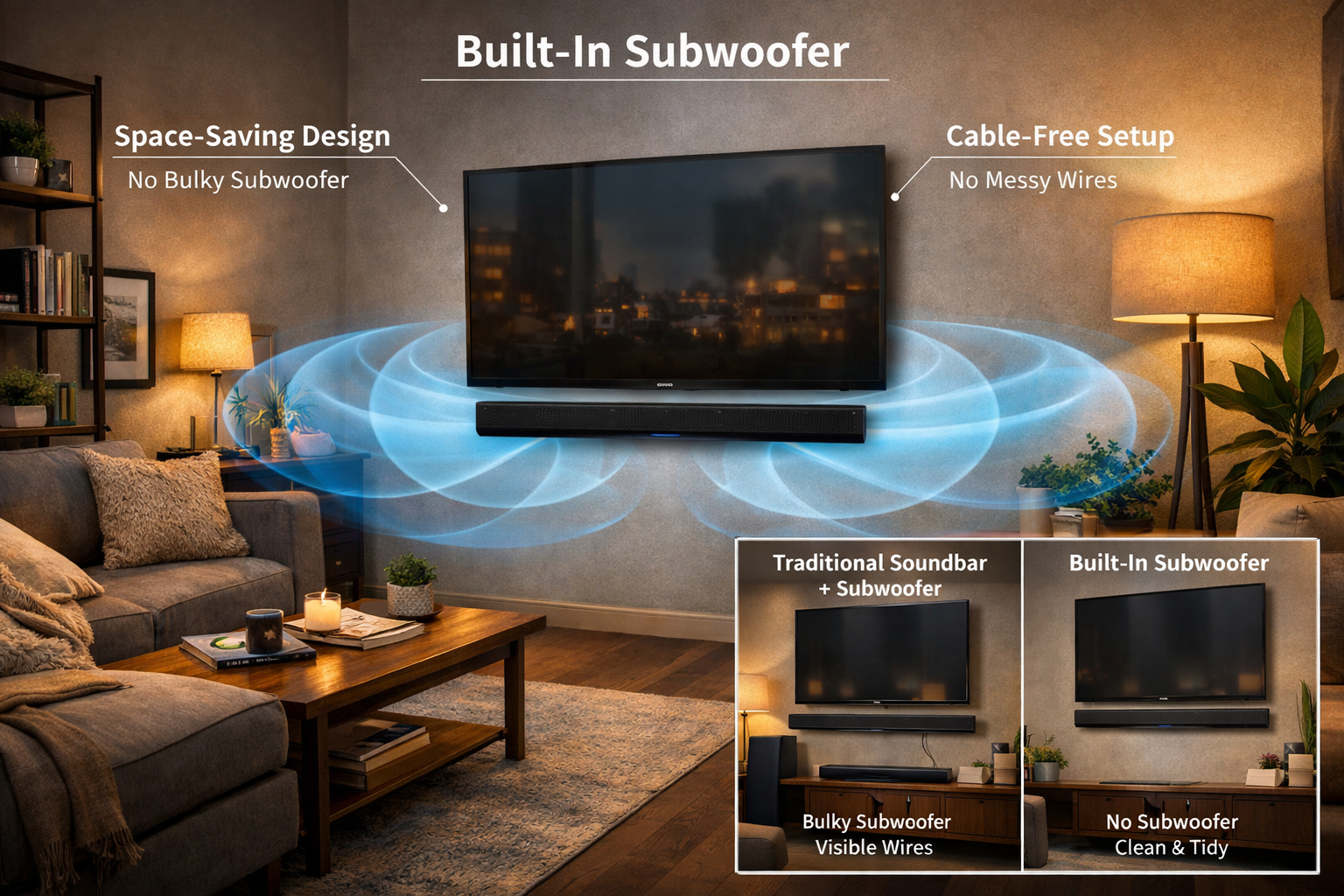
The primary advantage of Soundbars with Built-in Subwoofers: Complete Bass Without Extra Gear in 2026 lies in their space efficiency—a crucial consideration for modern urban living.
Floor Space Liberation
Traditional soundbar with subwoofer setups require dedicated floor space for the separate bass unit. In compact apartments, this presents several challenges:
Furniture Placement Constraints: Separate subwoofers limit furniture arrangement options. Optimal subwoofer placement often conflicts with desired furniture layouts, forcing compromises.
Visual Clutter: Large subwoofer boxes disrupt clean, minimalist aesthetics. Built-in solutions maintain streamlined appearances that complement modern interior design.
Cleaning and Maintenance: Eliminating the separate subwoofer means one less object to clean around and fewer surfaces collecting dust.
Rental-Friendly: Apartment renters benefit from simpler setups that don’t require optimal subwoofer placement strategies or permanent installation considerations.
Cable Management Simplification
Integrated subwoofer designs dramatically reduce cable complexity:
- Single Power Connection: Only the soundbar requires power, versus separate connections for soundbar and subwoofer
- No Subwoofer Cable: Eliminates the need to run audio cables between components
- Cleaner Aesthetics: Fewer cables mean easier concealment and tidier entertainment centers
- Simplified Setup: Reduces connection errors and troubleshooting complexity
Even wireless subwoofer systems still require power connections and occupy floor space—advantages eliminated entirely with built-in designs.
Room Acoustic Advantages
Built-in subwoofer systems offer unexpected acoustic benefits in small spaces:
Reduced Room Mode Issues: Separate subwoofers can excite room modes (standing waves) that create uneven bass response. Integrated systems with smaller bass drivers and controlled output patterns minimize these problems.
Consistent Listening Position Performance: Without a separate subwoofer creating bass hotspots and nulls, integrated systems deliver more consistent bass across different seating positions.
Neighbor-Friendly Bass: Controlled, directional bass from integrated systems typically transmits less low-frequency energy through walls and floors compared to omnidirectional separate subwoofers.
Comparison Table: Built-in vs. Separate Subwoofer Systems
| Feature | Built-in Subwoofer | Separate Subwoofer |
|---|---|---|
| Floor Space Required | None (soundbar only) | 1-2 sq ft minimum |
| Cable Connections | 1 power + 1 HDMI/optical | 2 power + audio cable |
| Setup Complexity | Minimal | Moderate to complex |
| Placement Flexibility | Limited to soundbar location | Flexible positioning |
| Maximum Bass Extension | 35-50Hz typical | 20-35Hz typical |
| Bass Customization | Moderate | Extensive |
| Visual Impact | Minimal | Moderate to high |
| Cost | $300-$2,000 | $400-$3,000+ (system) |
Making the Right Choice: Selection Criteria and Recommendations
Choosing the ideal soundbar with built-in subwoofer requires evaluating several key factors specific to your situation.
Room Size Considerations
Small Rooms (Under 150 sq ft): Compact models like the Sony HT-X8500 provide adequate bass for bedroom and small apartment setups. The limited room volume means even modest bass output creates satisfying impact.
Medium Rooms (150-250 sq ft): This represents the sweet spot for built-in subwoofer soundbars. Premium models like the Klipsch Flexus Core 300 and Sonos Arc Ultra deliver excellent performance without overwhelming the space[1][2].
Large Rooms (Over 250 sq ft): Very large spaces may challenge even premium built-in systems. The Devialet Dione represents the upper limit of what integrated designs can achieve, though users with expansive rooms might still benefit from traditional separate subwoofer systems[3].
Content Priority Assessment
Movie-Focused Users: Prioritize models with deep bass extension and high dynamic range capability. The Klipsch Flexus Core 300 excels here with bass that matches separate subwoofer systems[1].
Music Enthusiasts: Look for balanced, natural bass response with adjustable controls. The Samsung HW-Q990F’s sealed enclosure design delivers organic, musically accurate bass[4].
Gaming Priority: Consider low-latency performance and directional bass accuracy. Built-in systems generally outperform separate subwoofers for spatial accuracy in competitive gaming.
Mixed Usage: Most users consume varied content types. Premium all-rounders like the Sonos Arc Ultra and Devialet Dione excel across all categories[2][3].
Budget Framework
Under $400: Entry-level models with basic integrated bass. Expect modest improvement over TV speakers with limited deep bass extension.
$400-$800: Mid-range sweet spot featuring models like the Sony HT-X8500 and Bose Solo 5. Significant bass improvement with good overall performance.
$800-$1,500: Premium territory including the Klipsch Flexus Core 300 and Sonos Arc Ultra. Bass performance approaches separate subwoofer systems[1][2].
Over $1,500: Ultra-premium models like the Devialet Dione delivering reference-quality integrated bass[3].
Feature Checklist
When evaluating specific models, consider these essential features:
✅ Bass Adjustment Controls: Ability to customize low-frequency output to match room acoustics and preferences
✅ HDMI eARC Support: Enables lossless Dolby Atmos and DTS:X audio formats
✅ Multiple Input Options: HDMI, optical, Bluetooth, and streaming connectivity
✅ Room Calibration: Automatic optimization for your specific space
✅ Voice Assistant Integration: Alexa, Google Assistant, or Siri compatibility
✅ Upgrade Path: Ability to add separate subwoofer later if needed
✅ Build Quality: Premium materials and solid construction minimize vibration and rattling
Expert Recommendations by Use Case
Best Overall: Klipsch Flexus Core 300 – Delivers the most complete bass performance in an integrated design[1]
Top Premium: Devialet Dione – Reference-quality sound with exceptional built-in bass[3]
Best for Sonos Users: Sonos Arc Ultra – Seamless ecosystem integration with impressive bass[2]
Top Value: Sony HT-X8500 – Outstanding performance-to-price ratio for mid-range buyers
Best for Small Spaces: Bose Solo 5 – Compact footprint with balanced sound for bedrooms and small apartments
Top for Dolby Atmos: Sonos Arc Ultra – Superior height effects combined with strong bass response[2]
For those considering traditional setups, our complete guide to soundbars with subwoofers provides comprehensive comparisons between integrated and separate systems.
Installation and Optimization Tips
Maximizing performance from your built-in subwoofer soundbar requires proper installation and calibration.
Physical Placement Guidelines
TV Stand Placement: Position the soundbar directly in front of your TV with at least 2-3 inches of clearance on all sides for proper ventilation. Avoid placing objects directly against the soundbar that might block bass ports.
Wall Mounting: When wall-mounting, maintain the recommended distance from the wall surface (typically 2-4 inches) to prevent bass reflections that can cause boomy, uncontrolled low frequencies. Our soundbar wall mounting guide provides detailed installation instructions.
Height Positioning: Align the soundbar at ear level when seated for optimal midrange and treble response. The built-in subwoofer will function effectively regardless of height, but overall sound quality benefits from proper positioning.
Distance from Walls: Corner placement can artificially boost bass output but often at the expense of control and clarity. Position the soundbar at least 12 inches from side walls for balanced response.
Calibration and Settings Optimization
Run Room Calibration: If your soundbar includes automatic room calibration (like Sonos TruePlay), run this process first. It analyzes your room’s acoustic properties and adjusts bass response accordingly.
Adjust Bass Levels: Start with bass controls at the default (usually 0 or 50%) and adjust based on content and preference. The Klipsch Flexus Core 300’s bass adjustment feature allows precise customization[1].
Select Appropriate Sound Modes: Most soundbars offer preset modes (Movie, Music, Game, etc.). These adjust bass response along with other parameters. Experiment to find your preferred setting for each content type.
Enable Low-Frequency Enhancement: Features like Sony’s “Bass Boost” or similar technologies can extend perceived bass depth, though they may introduce distortion at high volumes.
Connection Best Practices
HDMI eARC Priority: Use HDMI eARC connections when available for the highest quality audio transmission, including lossless Dolby Atmos. This ensures the built-in subwoofer receives full-bandwidth bass information.
Optical Audio Limitations: Optical connections limit you to compressed audio formats (Dolby Digital, DTS). While functional, they don’t fully utilize premium soundbar capabilities.
Wireless Streaming Quality: When streaming music via Bluetooth or Wi-Fi, use the highest quality settings available. Compressed audio reduces bass detail and impact.
Common Setup Mistakes to Avoid
❌ Placing soundbar inside TV cabinet: Enclosed spaces trap and muddy bass frequencies
❌ Blocking bass ports: Obstructed ports dramatically reduce bass output and quality
❌ Excessive bass boost: Overdriving bass controls causes distortion and cabinet rattling
❌ Ignoring room calibration: Skipping this step leaves significant performance on the table
❌ Poor cable quality: Low-quality HDMI cables can cause audio dropouts and reduced fidelity
Future Trends: What’s Next for Integrated Subwoofer Technology
The market for soundbars with built-in subwoofers continues evolving rapidly. Understanding emerging trends helps buyers make future-proof purchasing decisions.
Advanced Driver Technologies
Micro-Driver Arrays: Manufacturers are developing arrays of small, high-excursion drivers that collectively produce bass output equivalent to larger traditional woofers while maintaining compact form factors.
Graphene and Carbon Fiber Cones: These advanced materials allow lighter, stiffer driver cones that move faster and more accurately, improving transient response and reducing distortion.
Dual-Voice Coil Designs: Emerging driver technologies with multiple voice coils enable more precise control and higher output from smaller driver diameters.
Digital Signal Processing Innovations
AI-Powered Room Correction: Next-generation soundbars will use machine learning to continuously analyze room acoustics and automatically optimize bass response in real-time.
Psychoacoustic Bass Extension: Advanced DSP algorithms create the perception of deeper bass than physically produced—similar to how small smartphone speakers seem to produce bass below their actual capabilities.
Adaptive Bass Management: Future systems will automatically adjust bass output based on content type, volume level, and time of day (reducing bass during late-night viewing to avoid disturbing neighbors).
Market Evolution
The current shortage of true built-in subwoofer soundbars in the premium segment reflects a market trend toward separate wireless subwoofers[1][3]. However, consumer demand for space-saving solutions is driving renewed innovation in integrated designs.
Hybrid Approaches: Expect more soundbars offering excellent built-in bass with optional subwoofer expansion for users wanting maximum flexibility.
Modular Systems: Future designs may feature detachable bass modules that can function independently or integrate into the main soundbar chassis.
Sustainability Focus: Environmental concerns are pushing manufacturers toward more efficient amplifier designs and sustainable materials, potentially reducing the size and power requirements of bass systems.
Price Point Democratization
Technologies currently exclusive to premium models will gradually filter down to mid-range and budget offerings:
- Four-motor woofer systems (currently in Sonos Arc Ultra) appearing in $600-800 models[2]
- Sealed enclosure designs (currently Samsung HW-Q990F) becoming standard across price ranges[4]
- Advanced room calibration moving from flagship to mainstream models
Conclusion: Embracing Complete Bass Without Compromise
Soundbars with Built-in Subwoofers: Complete Bass Without Extra Gear in 2026 represent the perfect convergence of performance, convenience, and modern living requirements. The technology has matured to the point where premium integrated systems like the Klipsch Flexus Core 300 can match the bass performance of traditional separate subwoofer setups[1], while models like the Devialet Dione push the boundaries of what’s possible in a single-chassis design[3].
For apartment dwellers, minimalists, and anyone seeking powerful bass without the complexity and space requirements of traditional multi-piece systems, built-in subwoofer soundbars deliver compelling advantages. The elimination of separate subwoofer placement challenges, cable management headaches, and floor space consumption makes these systems particularly attractive for modern urban living.
Action Steps for Buyers
Assess Your Space: Measure your room dimensions and identify available soundbar placement locations. This determines which models will physically fit and perform optimally in your environment.
Define Your Budget: Establish a realistic budget range. Remember that premium built-in systems ($800+) approach or match the performance of mid-range soundbar-plus-subwoofer combinations while offering superior convenience.
Prioritize Your Content: Identify whether movies, music, or gaming dominates your usage. This guides you toward models optimized for your primary use case.
Research Specific Models: Use the recommendations in this guide as starting points, then read detailed reviews and, if possible, audition models in person. Our best wireless soundbar comparison provides additional context for evaluating options.
Consider Future Needs: If you anticipate moving to a larger space, models offering optional subwoofer expansion provide upgrade paths without replacing your entire system.
Don’t Overlook Setup: Even the best soundbar performs poorly when improperly installed. Budget time for proper placement, calibration, and optimization to extract maximum performance from your investment.
The era of choosing between powerful bass and practical living space constraints has ended. Modern soundbars with built-in subwoofers prove that with sophisticated engineering and advanced technologies, you truly can have complete bass without extra gear—delivering the immersive audio experiences that make movies thrilling, music engaging, and gaming captivating, all while respecting the spatial realities of contemporary living.
References
[1] Subwoofer – https://www.rtings.com/soundbar/reviews/best/by-type/subwoofer
[2] Best Dolby Atmos Soundbar – https://www.businessinsider.com/guides/tech/best-dolby-atmos-soundbar
[3] Best Soundbars – https://www.audioadvice.com/blogs/expert-advice/best-soundbars
[4] Best Soundbars – https://www.whathifi.com/best-buys/home-cinema/best-soundbars