
AI Powered Soundbars
The living room audio experience has transformed dramatically. Gone are the days when soundbars simply amplified TV dialogue or added bass to movie explosions. In 2026, AI Powered Soundbars are rewriting the rules of home audio, delivering intelligent, adaptive sound that responds to your room, your content, and even your listening position in real-time.
AI Powered Soundbars: How Artificial Intelligence is Revolutionizing Audio in 2026 represents a fundamental shift in how we experience entertainment at home, with machine learning algorithms now doing the heavy lifting that once required expensive acoustic treatments and professional calibration.
Major manufacturers like Samsung, Sony, and LG have moved beyond simple digital signal processing. Their latest models feature dedicated AI processors that analyze room acoustics, identify content types, and optimize audio performance thousands of times per second.
The result? Crystal-clear dialogue that stays locked to your screen, immersive surround sound that adapts to your furniture layout, and bass that hits hard without disturbing your neighbors. 🎵
Key Takeaways
- AI room calibration automatically adjusts sound based on your specific room layout, furniture placement, and wall materials, eliminating the need for manual tuning or expensive acoustic treatments
- Content-aware processing identifies whether you’re watching movies, listening to music, or gaming, then optimizes dialogue clarity, spatial effects, and bass response accordingly
- Real-time adaptive audio continuously monitors and adjusts sound quality, maintaining consistent volume levels and optimal performance across all streaming services and content types
- Wireless ecosystem integration allows AI to coordinate multiple speakers, subwoofers, and rear channels seamlessly, creating true surround sound without complex wiring
- The wireless soundbar market is projected to grow at 7% annually through 2035, driven primarily by AI integration and smart home connectivity[7]
Understanding AI Technology in Modern Soundbars
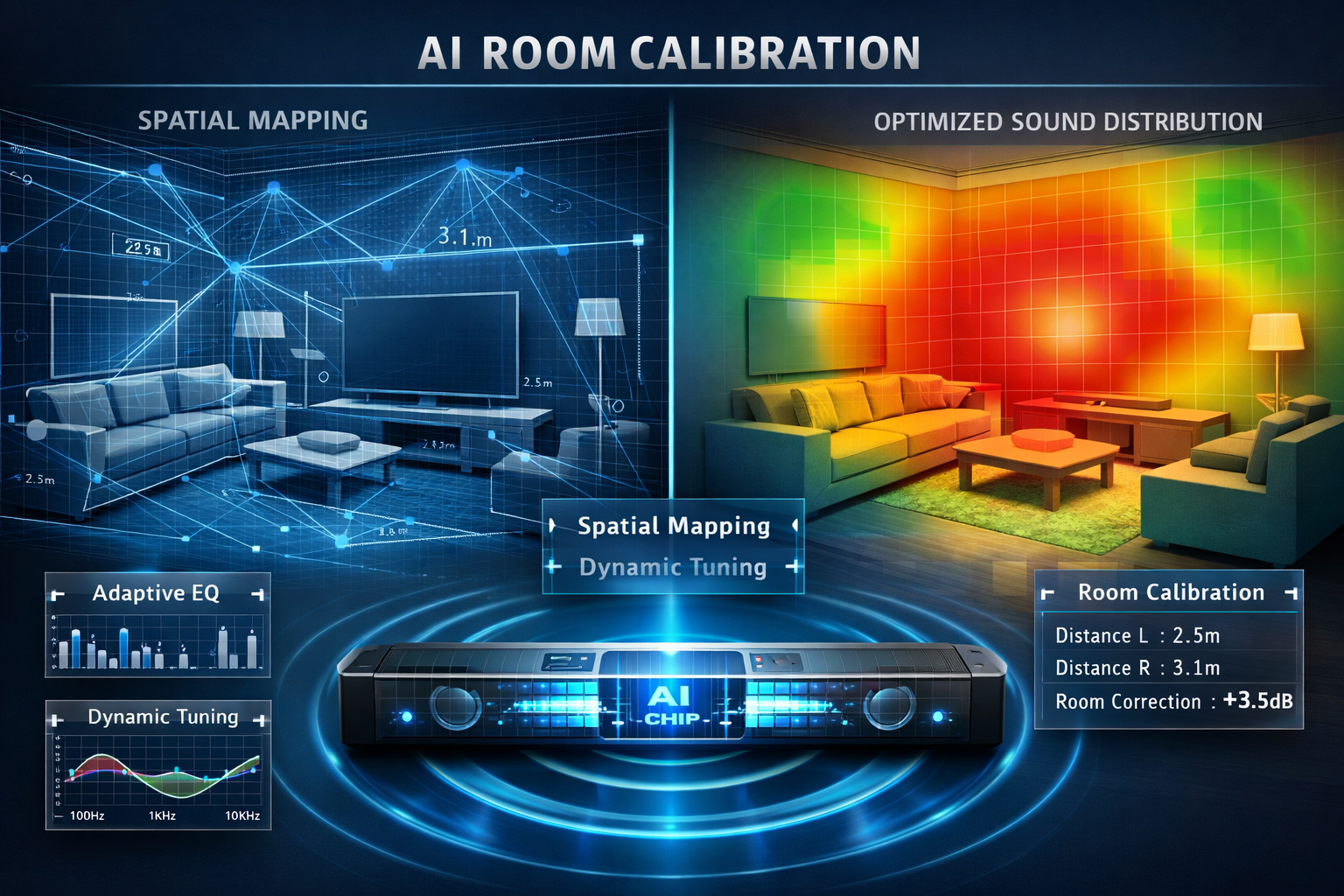
What Makes a Soundbar “AI-Powered”?
Traditional soundbars process audio using fixed digital signal processing (DSP) algorithms. These preset configurations apply the same audio adjustments regardless of your room size, speaker placement, or what you’re watching.
AI-powered soundbars take a fundamentally different approach by employing machine learning algorithms and dedicated neural processing units.
These intelligent systems analyze multiple data streams simultaneously:
- Room acoustic signatures detected through built-in microphones and sensors
- Content metadata identifying whether you’re watching dialogue-heavy dramas or action-packed blockbusters
- Real-time audio characteristics including frequency distribution, dynamic range, and spatial information
- User behavior patterns learning your volume preferences and listening habits over time
The AI processor synthesizes this information to make instantaneous adjustments that would be impossible through manual tuning. Think of it as having a professional audio engineer constantly optimizing your sound system, but operating at millisecond speeds.
The Core AI Features Transforming Audio Quality
Modern AI soundbars incorporate several breakthrough technologies that work together to deliver superior audio:
Adaptive Room Calibration 🏠
LG’s innovative FlexConnect system, powered by the Alpha 11 AI processor Gen 3, exemplifies next-generation room optimization[1].
The system uses advanced DSP and AI sound processing to tune performance based on room acoustics and content type in real-time[1].
Unlike older calibration systems that required test tones and manual measurements, AI-driven calibration happens automatically and continuously adapts as you move furniture or change your seating position.
Content-Aware Audio Processing
Sony’s Bravia Theater system demonstrates the power of intelligent content analysis. The system uses advanced AI to analyze content in real-time, dynamically adjusting dialogue clarity, spatial placement, and bass response[2].
The AI keeps dialogue laser-focused and locked to the center of the screen[2], ensuring you never miss important conversations even during explosive action sequences.
Dynamic Sound Elevation
Samsung’s flagship HW-Q990H model (11.1.4-channel system) introduced Sound Elevation technology, which uses AI to lift dialogue toward the center of the screen for more natural sound positioning[3].
This creates the illusion that voices are coming directly from actors’ mouths rather than from a speaker bar below the screen.
Auto Volume Management
One of the most practical AI features addresses a common frustration: inconsistent volume levels between streaming services, commercials, and different content types.
Samsung’s Auto Volume feature maintains consistent levels across channels and content types[3], eliminating the need to constantly adjust your remote control.
For those interested in exploring the best wireless soundbar options for 2026, understanding these AI capabilities helps identify which features deliver genuine value versus marketing hype.
How AI-Powered Soundbars Improve Real-World Audio Performance
Movie Watching: Immersive Cinema at Home
The difference between traditional and AI-powered soundbars becomes immediately apparent when watching movies. Consider a typical action sequence with dialogue, background music, explosions, and ambient environmental sounds all competing for attention.
Traditional soundbars apply fixed EQ curves and surround processing, often resulting in:
- Dialogue getting buried under sound effects
- Inconsistent volume requiring constant remote adjustments
- Flat, unconvincing surround effects
- Boomy or muddy bass that lacks precision
AI-powered soundbars analyze the audio mix in real-time and make intelligent decisions:
| Audio Element | AI Optimization |
|---|---|
| Dialogue | Isolated and enhanced, positioned precisely at screen center, maintained at consistent intelligibility regardless of background noise |
| Surround Effects | Dynamically placed in 3D space using object-based audio processing, adapted to room boundaries and reflective surfaces |
| Bass Response | Adjusted for room size and time of day (reduced during night mode), optimized to avoid muddy overlap with dialogue frequencies |
| Overall Balance | Continuously monitored and adjusted to maintain optimal mix regardless of scene transitions or content switches |
The Dolby Atmos format has become the baseline for modern soundbars[1], and AI processing makes these immersive audio formats truly shine.
Compact systems now deliver real surround and object-based audio at affordable price points[1], bringing cinema-quality sound to average living rooms.
Music Listening: Studio-Quality Sound Reproduction
AI optimization extends beyond movies to transform music listening. Samsung’s Music Studio 7 (LS70H model) delivers 3.1.1-channel spatial audio with Hi-Resolution Audio processing up to 24-bit/96kHz, enhanced by AI Dynamic Bass Control that delivers deep bass with minimal distortion[3].
When playing music, AI soundbars:
✅ Detect music genre and apply appropriate EQ profiles
✅ Expand stereo imaging to create wider soundstage without artificial processing artifacts
✅ Preserve dynamic range maintaining the contrast between quiet and loud passages that makes music emotionally engaging
✅ Optimize for room acoustics compensating for bass buildup in corners or high-frequency absorption by furniture
CES 2026 models support high-resolution audio streaming alongside dedicated music listening modes[1], ensuring audiophile-quality reproduction from streaming services like Tidal, Qobuz, and Amazon Music HD.
For music enthusiasts seeking the best soundbar for music reproduction, AI-driven optimization represents a significant upgrade over traditional systems.
Gaming: Competitive Advantage Through Spatial Audio
The gaming community has embraced AI soundbars for their ability to deliver competitive advantages through precise spatial audio.
New soundbars offer ultra-low latency spatial gaming presets, directional audio cues, and console-specific support for variable refresh rate (VRR) and auto low-latency mode (ALLM)[1].
Directional audio cues powered by AI help gamers:
- Detect enemy footsteps and pinpoint their direction with precision
- Identify gunfire location in first-person shooters
- Hear subtle environmental audio hints in adventure games
- Experience immersive soundscapes in open-world titles
The AI processor reduces latency to imperceptible levels (often under 20ms) while maintaining full surround processing, ensuring audio stays perfectly synchronized with on-screen action. This matters tremendously in competitive gaming where split-second reactions determine victory or defeat.
Gamers looking for the best wireless soundbars for gaming should prioritize models with dedicated gaming modes and HDMI 2.1 connectivity supporting the latest console features.
Leading AI Soundbar Models and Their Innovations in 2026
Samsung’s AI Audio Ecosystem
Samsung has positioned itself as the AI soundbar leader with an expanded 2026 lineup featuring unprecedented smart capabilities.
The company introduced the HW-QS90H All-in-One Soundbar with a built-in gyro sensor that automatically adapts channel distribution based on orientation[3].
This means the soundbar intelligently reconfigures its audio output whether placed horizontally below your TV or vertically on a shelf.
Key Samsung AI Features:
🔹 Sound Elevation Technology – Lifts dialogue to screen center using AI-driven psychoacoustic processing
🔹 Auto Volume – Maintains consistent loudness across all content sources
🔹 Q-Symphony – Coordinates soundbar and Samsung TV speakers for enhanced output
🔹 SpaceFit Sound Pro – Advanced room calibration using TV camera and AI analysis
🔹 Wireless Multi-Room – Wi-Fi speaker options allowing expansion into surround ecosystems without wiring[1]
Samsung’s integration with smart home ecosystems extends beyond audio. The soundbars feature integrated voice control capabilities via Alexa and Google Assistant, with seamless integration into smart home ecosystems and other smart devices[4]. This allows unified control and automation across multiple devices.
For those comparing options, our guide to choosing the right Samsung soundbar breaks down the differences between Samsung’s extensive model range.
Sony’s Bravia Theater AI Analysis
Sony’s approach emphasizes content-aware intelligence. The Bravia Theater system continuously analyzes what you’re watching and makes real-time adjustments to optimize the experience.
The unified AI layer coordinates wireless rears, subwoofers, and multi-room speakers, continuously optimizing timing, balance, and spatial placement across all components[2].
This ecosystem approach ensures that adding rear speakers or a subwoofer doesn’t require manual configuration. The AI automatically detects new components, measures their acoustic contribution, and integrates them seamlessly into the soundfield.
Sony’s AI excels particularly at dialogue enhancement – a critical feature given that unclear dialogue is the number one complaint about TV audio.
The system isolates voice frequencies, applies intelligent compression to maintain intelligibility during loud scenes, and positions dialogue precisely at screen center regardless of where you’re sitting.
Readers interested in Sony’s ecosystem should explore our guide to Sony Bravia soundbar features for detailed setup and optimization tips.
LG’s FlexConnect Revolution
LG’s Dolby Atmos FlexConnect System represents perhaps the most innovative approach to AI-powered audio in 2026. The system removes traditional speaker placement constraints by using modular components with height modules and flexible surround options[1].
The Alpha 11 AI processor Gen 3 serves as the brain, using advanced DSP and AI sound processing to tune performance based on room acoustics and content type in real-time[1]. What makes this revolutionary is the freedom it provides:
- Place surround speakers wherever convenient – the AI adapts
- Add or remove components – automatic reconfiguration
- Change room layout – continuous re-optimization
- Switch between content types – instant profile adjustments
This flexibility addresses one of the biggest barriers to home theater adoption: the requirement for precise speaker placement. LG’s AI makes optimal sound achievable regardless of room constraints or furniture arrangement.
For comprehensive comparisons of premium systems, check our analysis of Dolby Atmos soundbars featuring the latest AI-enhanced models.
The Technology Behind AI Room Calibration and Optimization
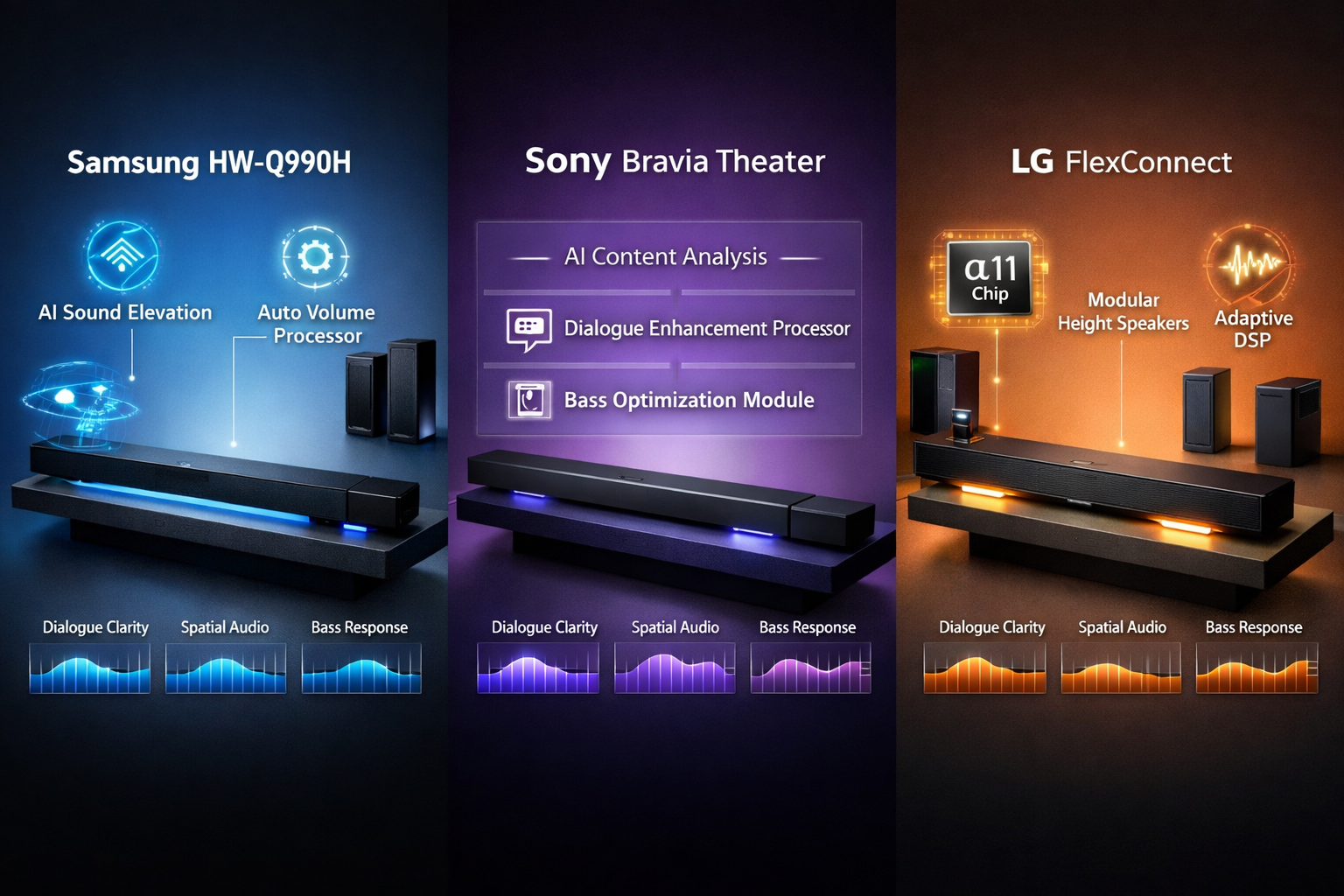
How AI Maps Your Listening Environment
Modern AI soundbars employ sophisticated acoustic mapping that would have required professional equipment just a few years ago. The process typically involves:
Phase 1: Initial Room Scan
Built-in microphones emit test signals (often inaudible to humans) and measure how sound reflects off walls, ceilings, furniture, and other surfaces. The AI processor analyzes:
- Room dimensions and geometry
- Surface materials (hard walls vs. soft curtains)
- Furniture placement and density
- Listening position relative to speakers
2: Acoustic Analysis
The AI identifies problematic acoustic issues:
- Standing waves – resonant frequencies that cause bass buildup
- Flutter echoes – reflections between parallel walls
- Absorption patterns – how different frequencies decay
- Sweet spot location – optimal listening position
Phase 3: Correction Profile Generation
Based on the analysis, the AI creates a custom EQ and timing profile that:
- Reduces room mode resonances
- Compensates for asymmetric speaker placement
- Adjusts delay timing for optimal phase coherence
- Balances frequency response for flat, accurate sound
Phase 4: Continuous Adaptation
Unlike one-time calibration, AI systems continuously monitor and adjust. If you move furniture, add wall decorations, or even change seating positions, the AI detects these changes and updates its correction profile automatically.
Real-Time Content Detection and Adaptive Processing
Content-aware processing represents one of AI’s most impressive capabilities. The system analyzes incoming audio streams to identify content characteristics and apply appropriate optimization.
AI-driven dialogue control, content-aware tuning, and room-adaptive spatial audio have transitioned from experimental features reserved for concept demos to foundational elements of premium audio design[2].
The AI examines:
📊 Spectral Content – Frequency distribution indicating music vs. dialogue vs. effects
📊 Dynamic Range – Compression levels suggesting broadcast TV vs. cinema content
📊 Spatial Information – Surround encoding indicating stereo, 5.1, or Atmos sources
📊 Metadata Tags – Dolby, DTS, or other format identifiers
Based on this analysis, the soundbar applies optimized processing profiles. For example:
- News programs – Enhanced dialogue clarity, reduced bass, centered imaging
- Action movies – Expanded dynamics, aggressive surround processing, impactful bass
- Music concerts – Wide stereo imaging, minimal processing, high-fidelity reproduction
- Sports broadcasts – Stadium ambience enhancement, crowd noise management, commentary clarity
This intelligent adaptation happens seamlessly without requiring manual sound mode selection, though users can override AI choices if desired. Those troubleshooting audio issues should consult our guide to fixing soundbar audio delay for solutions to common synchronization problems.
Smart Home Integration and Voice Control Features
Seamless Ecosystem Connectivity
The 2026 generation of AI soundbars extends far beyond standalone audio devices. They function as central hubs within broader smart home ecosystems, offering integration that previous generations couldn’t match.
Voice Assistant Integration 🎤
Soundbars now feature integrated voice control capabilities via Alexa and Google Assistant, with seamless integration into smart home ecosystems and other smart devices[4]. This enables:
- Hands-free volume control and source switching
- Smart home automation triggers (“Alexa, movie time” dims lights and starts soundbar)
- Multi-room audio coordination across compatible speakers
- Information queries without interrupting content playback
Wireless Multi-Room Expansion
Samsung introduced Wi-Fi speaker options allowing soundbar users to expand into multi-room or surround ecosystems without wiring or complex installation[1]. This wireless expansion has become a defining trend across the 2026 soundbar market[1].
The AI coordinates audio across multiple rooms, ensuring:
- Synchronized playback when streaming to multiple zones
- Seamless handoff when moving between rooms
- Individual room optimization maintaining quality everywhere
- Unified control through single app interface
App-Based Control and Customization
Manufacturer apps have evolved from basic remote control replacements to comprehensive audio management platforms. These apps provide:
✨ Visual EQ Editors – Customize sound profiles with graphical frequency adjustments
✨ Room Correction Visualization – See how AI has optimized for your space
✨ Listening Mode Libraries – Save and share custom presets
✨ Firmware Updates – Continuous AI improvements and new features
✨ Multi-Device Management – Control entire audio ecosystem from one interface
For Samsung soundbar owners, our guide to discovering Samsung soundbar apps provides detailed setup and feature explanations.
Market Trends and Future Developments
Industry Growth and Consumer Adoption
The wireless soundbar market demonstrates remarkable growth trajectory. Valued at USD 5.7 billion in 2025, projections indicate growth at a compound annual growth rate (CAGR) of 7% between 2026 and 2035[7]. This expansion is driven largely by AI integration and improved connectivity features[7].
Several factors fuel this growth:
Declining TV Speaker Quality – As TVs become thinner, built-in speakers worsen, driving soundbar adoption
Streaming Content Explosion – Premium audio formats on Netflix, Disney+, and Apple TV+ demand better playback systems
Gaming Console Capabilities – PS5 and Xbox Series X support advanced audio requiring capable soundbars
Smart Home Integration – Voice assistants and automation make soundbars central entertainment hubs
AI Democratization – Advanced features once reserved for expensive systems now appear in mid-range models
Emerging AI Capabilities on the Horizon
The AI revolution in soundbars continues accelerating. Industry experts anticipate several breakthrough capabilities arriving soon:
Personalized Sound Profiles 👤
Future AI systems will recognize individual users and apply personalized EQ preferences automatically. The soundbar will detect who’s watching based on viewing patterns, time of day, or even voice recognition, then optimize accordingly.
Predictive Audio Optimization
Machine learning models will anticipate content changes before they occur, pre-loading appropriate processing profiles for seamless transitions. This eliminates the brief adjustment period currently noticeable when switching between content types.
Advanced Spatial Audio Rendering
Next-generation AI will create convincing surround sound from just two speakers by precisely modeling room acoustics and using psychoacoustic principles. This could eliminate the need for physical surround speakers entirely for many listeners.
Health-Conscious Audio
AI systems may incorporate hearing health features, automatically limiting exposure to harmful volume levels while maintaining perceived loudness through intelligent compression and EQ adjustments.
Environmental Awareness
Future soundbars might detect ambient noise (traffic, appliances, conversations) and dynamically adjust audio to maintain intelligibility without excessive volume increases.
For those exploring current options, our comprehensive guide to discovering the perfect soundbar helps navigate the expanding market.
Choosing the Right AI Soundbar for Your Needs
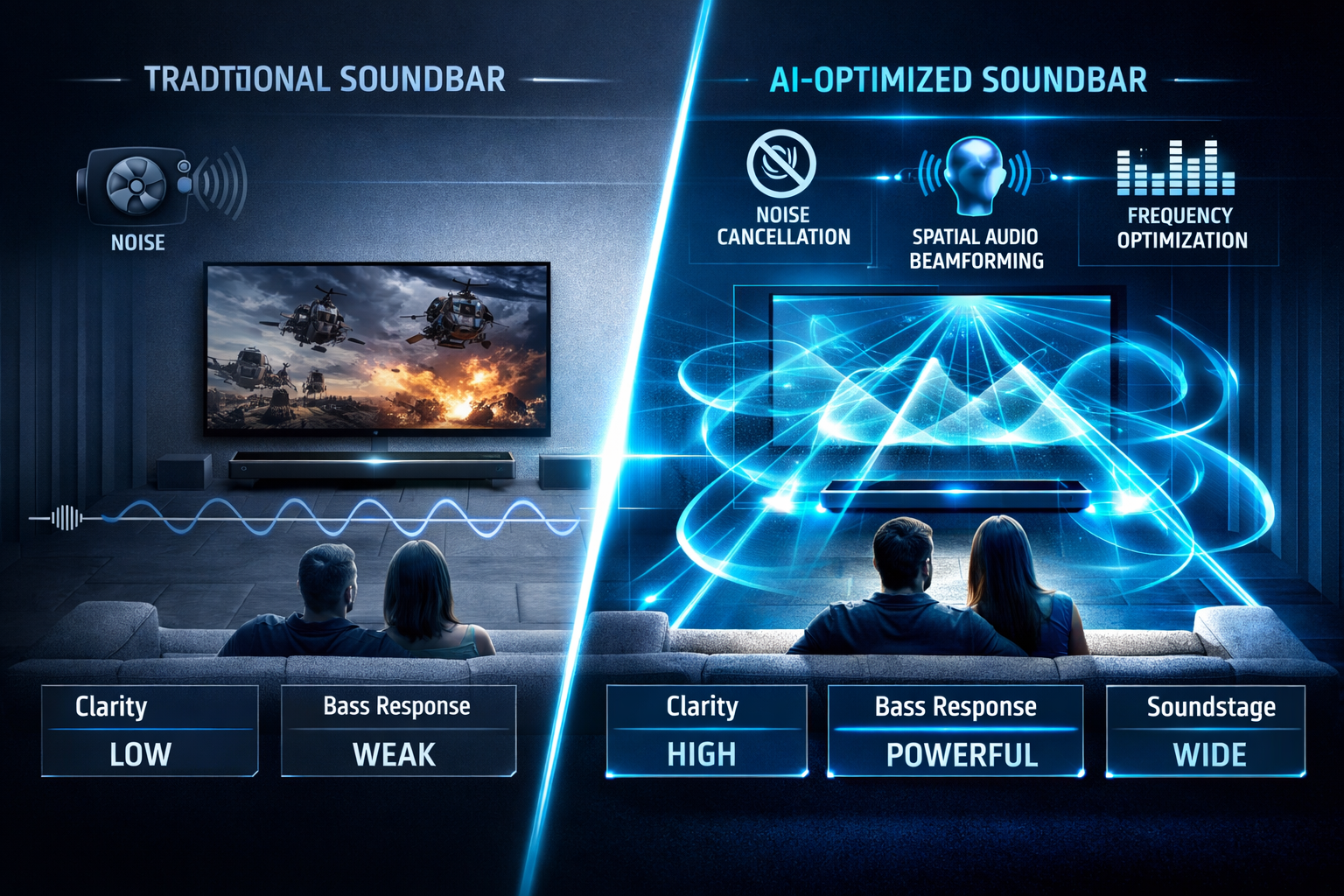
Key Considerations When Shopping
Not all AI implementations are equal. When evaluating AI-powered soundbars, consider these critical factors:
1. Room Size and Layout
Larger rooms benefit from soundbars with more powerful amplification and wireless subwoofer options. AI room correction can compensate for many acoustic issues, but it can’t overcome fundamental power limitations. Match soundbar capabilities to your space dimensions.
2. Primary Use Case
Identify your dominant usage:
- Movie enthusiasts – Prioritize Dolby Atmos, strong bass, and surround expansion capabilities
- Music listeners – Focus on high-resolution audio support and stereo imaging quality
- Gamers – Emphasize low latency, HDMI 2.1 features, and directional audio accuracy
- Mixed usage – Choose versatile models with strong AI content detection
3. Ecosystem Compatibility
If you already own Samsung TVs, Samsung soundbars offer enhanced integration through Q-Symphony and other proprietary features. Similarly, Sony TV owners benefit from Sony soundbar pairing. Consider ecosystem advantages when comparing models.
4. Expansion Potential
Even if you’re starting with just a soundbar, consider whether you might add wireless rear speakers or additional subwoofers later. Systems with robust wireless expansion capabilities provide upgrade paths without replacing the main unit.
5. Budget Allocation
AI features have trickled down to mid-range models, but premium systems still offer superior processing power and component quality. Determine which AI capabilities matter most and allocate budget accordingly.
For budget-conscious shoppers, our best budget soundbar with subwoofer guide identifies affordable options with impressive AI features.
Installation and Setup Best Practices
Maximizing AI soundbar performance requires proper installation:
Physical Placement 📍
- Position soundbar centered below TV at equal height from floor
- Maintain clear line-of-sight between soundbar and primary listening position
- Avoid enclosed cabinets that restrict sound dispersion
- Place wireless subwoofer in corner for maximum bass output (AI will compensate for placement)
Connection Configuration
- Use HDMI ARC/eARC for best audio quality and control integration
- Enable CEC (Consumer Electronics Control) for unified remote operation
- Connect directly to TV rather than through receivers when possible
- Update firmware before running AI calibration
Calibration Process
- Ensure room is quiet during initial AI room scan
- Sit in primary listening position during calibration
- Remove temporary obstacles (people, pets) that might affect measurements
- Run calibration multiple times if results seem inconsistent
Optimization Tips
- Test AI settings with various content types
- Fine-tune AI recommendations using manual EQ if needed
- Disable AI temporarily to hear difference and verify it’s working
- Recalibrate after significant room changes (furniture moves, rug additions)
For specific connection guidance, see our step-by-step HDMI connection guide with troubleshooting tips.
Troubleshooting Common AI Soundbar Issues
Addressing Calibration Problems
Sometimes AI room calibration doesn’t produce expected results. Common issues and solutions:
Problem: Dialogue Still Unclear After Calibration
- Solution: Manually boost center channel level in soundbar settings, enable dedicated dialogue enhancement mode, verify TV audio output is set to pass-through rather than processing audio internally
Issue: Bass Sounds Muddy or Overwhelming
- Solution: Reduce subwoofer level manually (AI might overcompensate for small rooms), move subwoofer away from corners, enable night mode which tightens bass response
Problem: Surround Effects Sound Artificial
- Solution: Reduce surround processing intensity, verify content actually contains surround audio (stereo content can’t create true surround), check that virtual surround isn’t conflicting with physical rear speakers
Issue: AI Calibration Fails or Produces Errors
- Solution: Eliminate background noise during calibration, ensure microphones aren’t obstructed, try calibration with room lights on (some systems use cameras), reset soundbar to factory defaults and recalibrate
For comprehensive troubleshooting, consult our soundbar connection troubleshooting guide covering common setup challenges.
Connectivity and Smart Home Integration Issues
Smart features sometimes present challenges:
Voice Assistant Not Responding
- Verify soundbar is connected to Wi-Fi network
- Check that voice assistant is enabled in soundbar app
- Ensure microphones aren’t muted
- Re-link soundbar in Alexa or Google Home app
Multi-Room Audio Dropouts
- Confirm all speakers are on same Wi-Fi network
- Move router closer or add mesh network nodes
- Update firmware on all audio devices
- Reduce wireless interference from other devices
App Won’t Connect to Soundbar
- Verify phone and soundbar are on same network
- Disable VPN on phone if active
- Clear app cache and restart
- Check for app updates in app store
Conclusion: The Future of Home Audio is Intelligent
AI-Powered Soundbars: How Artificial Intelligence is Revolutionizing Audio in 2026 represents more than incremental improvement – it’s a fundamental transformation in how we experience sound at home.
The integration of machine learning, advanced room calibration, content-aware processing, and smart home connectivity has elevated soundbars from simple TV accessories to sophisticated audio systems rivaling traditional home theater setups.
The real-world benefits are undeniable: crystal-clear dialogue that remains intelligible during explosive action scenes, immersive spatial audio that adapts to your specific room layout, consistent volume levels across all content sources, and seamless ecosystem integration that makes control effortless.
These aren’t futuristic promises – they’re available features in 2026 soundbars at various price points.
Major manufacturers like Samsung, Sony, and LG continue pushing boundaries with innovations like gyroscopic orientation detection, unified multi-component AI coordination, and modular speaker systems that eliminate placement constraints.
The 7% annual market growth projected through 2035[7] signals that both manufacturers and consumers recognize AI as essential rather than optional.
Next Steps: Finding Your Perfect AI Soundbar
Ready to upgrade your home audio experience? Follow these actionable steps:
- Assess Your Space – Measure your room, identify acoustic challenges, and determine primary listening positions
- Define Your Priorities – Rank importance of movies, music, gaming, and smart home integration
- Set Your Budget – Determine total investment including potential future expansion components
- Research Specific Models – Compare AI features across Samsung, Sony, LG, and other manufacturers using detailed reviews
- Verify Compatibility – Ensure chosen soundbar works with your TV, streaming devices, and smart home ecosystem
- Plan Installation – Decide on placement, connection methods, and whether professional installation is needed
- Optimize After Setup – Run AI calibration, test various content types, and fine-tune settings to your preferences
The soundbar landscape has never been more exciting or accessible. AI technology has democratized premium audio experiences, bringing capabilities once reserved for expensive custom installations to mainstream consumers.
Whether you’re a movie enthusiast seeking cinema-quality sound, a music lover demanding high-fidelity reproduction, or a gamer wanting competitive advantages through spatial audio, there’s an AI Powered Soundbars designed for your specific needs.
The revolution isn’t coming – it’s here. The only question is which AI soundbar will transform your entertainment experience. 🎬🎵🎮
References
[1] Watch – https://www.youtube.com/watch?v=FdmpZxEIyo0
[2] Watch – https://www.youtube.com/watch?v=0Dmak5IFpT0
[3] Samsung Expands Its Audio Ecosystem For 2026 With Smarter Multi Device Sound And Immersive New Designs – https://news.samsung.com/global/samsung-expands-its-audio-ecosystem-for-2026-with-smarter-multi-device-sound-and-immersive-new-designs
[4] Sound Bars 1663922 – https://www.datainsightsmarket.com/reports/sound-bars-1663922
[5] Best New Soundbars Wireless Audio Systems Ces 2026
[6] Ces 2026 Hearables Outlook – https://counterpointresearch.com/en/insights/CES-2026-Hearables-Outlook
[7] Wireless Soundbar Market – https://www.gminsights.com/industry-analysis/wireless-soundbar-market
[8] The Future Of Audio Technology 3 Defining Trends From Ces 2026 – https://trocglobal.com/blog/the-future-of-audio-technology-3-defining-trends-from-ces-2026/

Pingback: Soundbar Not Turning on With TV?: Fix It Now 2026 Guide