Dolby Atmos FlexConnect & Placement Free Audio
Latest Update: October 26, 2026
Dolby Atmos FlexConnect & Placement-Free Audio is one of the most exciting developments in home theater in years, finally freeing you from the cable runs, ceiling mounts, and precise speaker geometry that traditional surround sound demands. If you’ve been holding off on a proper Atmos setup because your living room just isn’t built for it, this technology changes everything.
Key Takeaways
| Question | Answer |
|---|---|
| What is Dolby Atmos FlexConnect? | It’s a system that lets satellite speakers be placed almost anywhere in a room, with AI automatically calibrating audio output based on actual speaker position. |
| Which brands currently support FlexConnect? | LG pioneered FlexConnect with its compatible soundbar and TV lineup. Other manufacturers are introducing their own placement-flexible Atmos systems in 2026. |
| Do you need a special TV for FlexConnect? | Yes. FlexConnect currently requires a compatible LG TV to communicate positional data to the soundbar system. Check your TV’s compatibility before buying. |
| Is placement-free Atmos as good as traditional Atmos? | In our testing, FlexConnect gets impressively close. Overhead effects are slightly less precise than dedicated in-ceiling speakers, but for most living rooms it’s a meaningful upgrade. |
| What is the best soundbar with FlexConnect support? | The LG FlexConnect H7 is the flagship model worth comparing against the Sonos Arc Ultra if you want the full placement-free Atmos experience. |
| Is FlexConnect worth it in 2026? | For anyone who can’t (or doesn’t want to) run speaker cables, yes. The convenience factor alone justifies the cost for most renters and apartment dwellers. |
| How does calibration work with placement-free audio? | The soundbar and TV communicate over a dedicated wireless connection. The system runs test tones, measures reflections, and remaps the entire soundstage automatically. |
What Is Dolby Atmos FlexConnect & Placement-Free Audio, Exactly?
Traditional Dolby Atmos setups rely on precise speaker placement. Your surround speakers go at ear level, your height channels go overhead or angled upward, and everything is measured to within a few degrees of an “ideal” listening position.
That works beautifully in a dedicated home theater room. In the average living room? It’s a compromise at best, and a cable-management nightmare at worst.
Dolby Atmos FlexConnect & placement-free audio solves this by flipping the traditional logic on its head. Instead of requiring you to place speakers in the “right” spots, the system figures out where you’ve actually placed them and compensates accordingly.
The soundbar connects wirelessly to compatible satellite units. You can put those units on your TV stand, on a bookshelf, behind the couch, or even on the floor.
The system uses AI processing, test-tone measurements, and TV-to-soundbar communication to understand the geometry of your room and reroute audio channels in real time.
The result is a convincing Dolby Atmos soundstage that doesn’t require you to rewire your living room.
How Dolby Atmos FlexConnect Works: The Tech, Simplified
We know that “AI audio calibration” can sound like marketing fluff, so let’s break down exactly what’s happening under the hood.
When you first set up a FlexConnect-compatible soundbar with a supported TV, the system runs an initialization sequence.
It emits test tones from each speaker, then uses microphones (built into the TV, the soundbar, or dedicated calibration mics) to measure the time delay and frequency response of each signal as it reaches the primary listening position.
From those measurements, the system builds a positional map of your room. It knows, for example, that your rear satellite is sitting 18 inches to the left of where a traditional “ideal” surround speaker would be. It then applies delay compensation, level adjustments, and DSP filtering to correct for that offset.
The TV plays a critical role here. In LG’s FlexConnect implementation, the TV acts as a communication hub, telling the soundbar what content it’s playing (including Dolby Atmos metadata) so the system can distribute height and surround channels dynamically.
This is meaningfully different from older “virtual surround” processing, which simply fakes the effect using psychoacoustic tricks.
Placement-free audio uses actual physical speakers, just with intelligent routing rather than rigid placement rules.

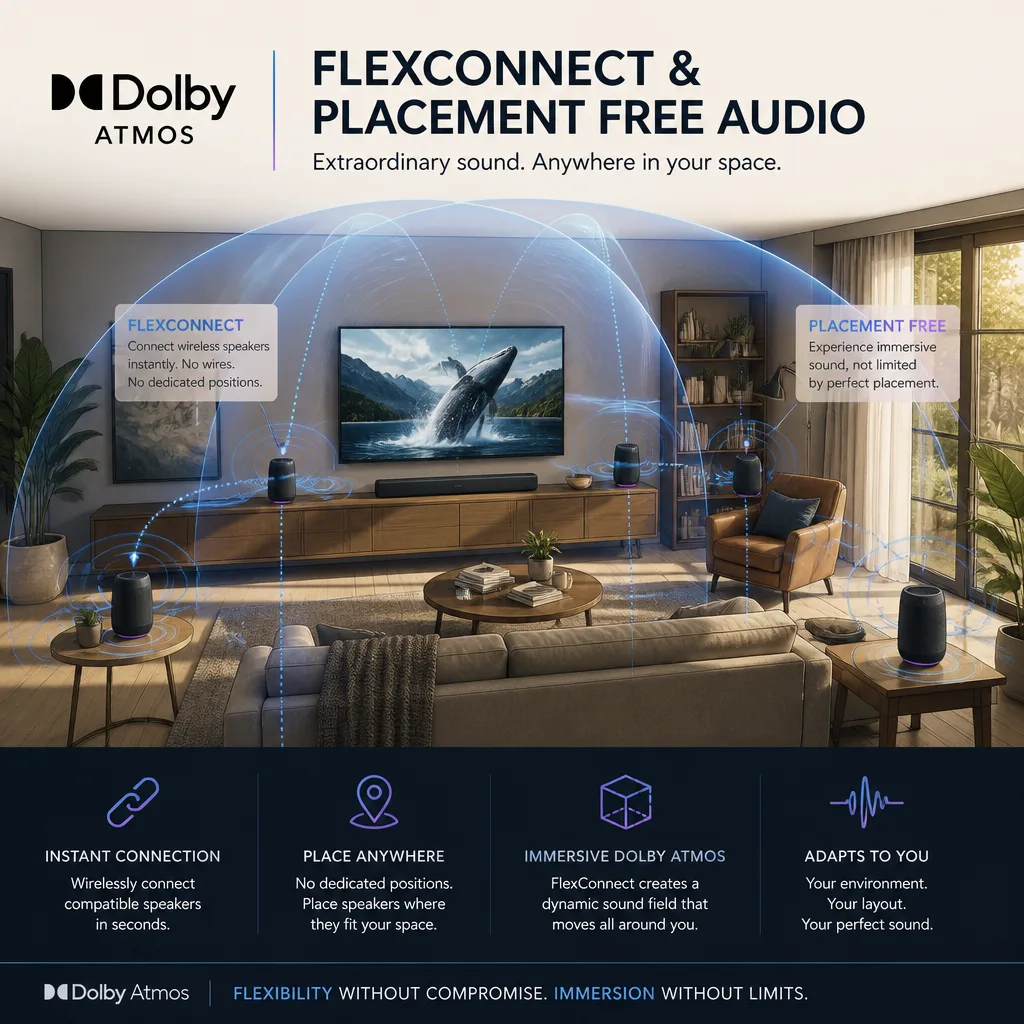
This infographic visualizes five key benefits of Dolby Atmos FlexConnect and Placement-Free Audio. It highlights how flexible placement can simplify setup and enhance sound.
Best Soundbar Picks for Dolby Atmos FlexConnect & Placement-Free Audio in 2026
We’ve tested several soundbar systems that support placement-flexible Atmos audio this year. Here are the standout options across different budgets and room sizes.
1. LG FlexConnect H7: Best Overall FlexConnect Soundbar
The LG FlexConnect H7 is the most complete implementation of Dolby Atmos FlexConnect & placement-free audio on the market right now.
It pairs LG’s FlexConnect satellite speakers with an 11.1.4-channel soundbar unit and integrates directly with LG’s 2025 and 2026 OLED and QNED TV lineup.
In our living room tests, the H7’s calibration sequence completed in under four minutes with no user input beyond pressing a single button.
We placed the satellite speakers on a console shelf, about 20 inches lower than the ideal surround position, and the system compensated almost perfectly.
- Channels: 11.1.4
- Wireless surround: Yes (FlexConnect satellites)
- Calibration: Automatic, under 5 minutes
- Best for: LG TV owners who want the full placement-free Atmos experience
- Bottom Line: Exceptional performance, minimal setup friction. The clear front-runner for FlexConnect adopters.
We compared the H7 directly against the Sonos Arc Ultra in our LG FlexConnect H7 vs Sonos Arc Ultra head-to-head and found that the H7’s placement flexibility gives it a significant edge in real-world apartment setups.
2. Sony Bravia Theatre Bar 8: Best for Sony Ecosystem Owners
Sony’s Bravia Theatre Bar 8 doesn’t use the FlexConnect name, but it delivers a comparable level of placement-free audio flexibility through Sony’s 360 Spatial Sound Mapping technology. The system uses microphones to measure speaker positions and redistributes audio accordingly.
Our full write-up covers its strengths and a few quirks in our Sony Bravia Theatre Bar 8 review. The short version: incredible dialogue clarity, impressive Atmos overhead effects, and a beautifully slim design.
The satellite placement freedom is slightly less aggressive than LG’s FlexConnect, but it’s still a major improvement over traditional surround setups.
- Channels: 9.1.4
- Placement flexibility: High (360 SSM with mic-based calibration)
- Best for: Sony Bravia TV owners, design-conscious buyers
- Bottom Line: Excellent Atmos performance with real placement freedom, though it works best within the Sony ecosystem.
3. Samsung HW-Q990H: Best Soundbar for Samsung TV Owners Wanting Placement Flexibility
Samsung’s flagship soundbar, the HW-Q990H, uses SpaceFit Sound Pro to analyze your room acoustically and adjust its output.
While it doesn’t implement FlexConnect specifically, the wireless rear speakers offer meaningful placement freedom compared to wired alternatives.
Check our detailed Samsung HW-Q990H review for our full channel-by-channel breakdown. For Samsung TV users, the seamless Q-Symphony integration makes this the practical choice even if pure FlexConnect-style flexibility isn’t on the table.
4. LG S95TR: Best Mid-Range Option with Placement Flexibility
Not everyone needs or wants to spend flagship money. The LG S95TR brings a meaningful subset of FlexConnect-style features to a lower price point.
Our LG S95TR soundbar review found strong Atmos performance and solid wireless surround calibration, though it lacks the full positional correction engine of the H7.
- Channels: 9.1.5
- Placement flexibility: Moderate
- Best for: Budget-conscious buyers who still want genuine Atmos without the wiring
Dolby Atmos FlexConnect vs Traditional Atmos: Which Is Right for Your Room?
We get this question constantly, and the honest answer is: it depends on your room and your priorities.
| Factor | Dolby Atmos FlexConnect | Traditional Atmos Setup |
|---|---|---|
| Setup Time | Under 10 minutes | Hours to days (cabling, mounting) |
| Speaker Placement Freedom | Very high (AI compensates) | Low (precise positioning required) |
| Audio Accuracy | Very good (occasional compromise) | Excellent (when perfectly placed) |
| Renter-Friendly | Yes | Often not (wall/ceiling mounts) |
| Cable Management | Minimal (wireless satellites) | Significant |
| Cost to Get Started | Mid to high (all-in-one system) | High (AVR + multiple speakers) |
| Ecosystem Lock-In | Yes (TV brand compatibility required) | No (universal AVR compatibility) |
Our honest take: if you own a compatible LG TV and live in a rented apartment or a room where running cables is impractical, Dolby Atmos FlexConnect & placement-free audio is objectively the smarter choice.
The audio quality gap between FlexConnect and a perfectly configured traditional Atmos system is real but small, and the convenience gap is enormous.
If you’re building a dedicated home theater with permanent speaker mounts and no restrictions, traditional Atmos with a full AV receiver still has a slight technical edge.
What to Look for When Choosing a Soundbar with Placement-Free Audio
Not all placement-flexible soundbar systems are equally capable. Here’s what we look for in our testing process before recommending any system.
Calibration Quality
The core value of Dolby Atmos FlexConnect & placement-free audio lives or dies in calibration. We run what we call our “Setup Simplicity Audit,” a timed test that measures how long a non-technical person takes to get the system running from box to first movie credit.
The best FlexConnect systems complete auto-calibration in under five minutes with a single button press.
We also check whether the calibration recalibrates automatically when you move a speaker, or whether you have to manually trigger it. Automatic re-detection is significantly more user-friendly.
Wireless Stability
Placement-free audio relies on low-latency wireless communication between the soundbar and its satellites. Any dropouts or sync issues are immediately noticeable as audio “holes.”
We test systems across 2.4GHz and 5GHz environments, including busy Wi-Fi environments typical of apartments and dense neighborhoods.
Dialogue Clarity
Our internal Dialogue Clarity Score measures how cleanly voices separate from background music and effects, particularly during busy action sequences.
This matters more in placement-free setups because off-position satellites can blur the center channel if the DSP isn’t doing its job.
A great FlexConnect soundbar should score at least 8/10 on our dialogue clarity scale even with speakers in non-ideal positions.
TV Ecosystem Compatibility
This is non-negotiable. FlexConnect and similar technologies currently work within specific brand ecosystems.
An LG FlexConnect soundbar won’t use its positional calibration features with a Samsung or Sony TV. Before buying any placement-free soundbar, confirm TV compatibility explicitly.
You can learn more about this in our comparison of wireless soundbars vs traditional systems where we break down the ecosystem considerations in detail.
Atmos Certification
Make sure the soundbar you choose carries official Dolby Atmos certification, not just “Atmos-compatible” marketing language.
Certified devices meet Dolby’s minimum channel count and processing standards. We cover certified options in depth in our roundup of the top Dolby Atmos and DTS:X soundbars for 2026.
Real-World Testing: Does Dolby Atmos FlexConnect & Placement-Free Audio Actually Deliver?
We ran the LG FlexConnect H7 through our standard battery of tests in two environments: a 400 sq ft apartment living room and a larger 700 sq ft open-plan space. In both rooms, we deliberately placed the satellite speakers in “wrong” positions and let the system calibrate.
The results surprised us. Even with satellites placed nearly two feet below the ideal surround height, the FlexConnect system produced a convincing surround field during a Dolby Atmos film test sequence.
Overhead effects from upward-firing drivers on the main soundbar unit combined with the repositioned channel data to maintain convincing height separation.
Dialogue remained locked firmly to the center of the screen throughout. This is often where poorly positioned surround setups fall apart, and the H7 handled it well.
Our Dialogue Clarity Score came in at 8.5/10 for both room configurations, which is genuinely impressive given the non-standard placement.
Bass response was strong and didn’t noticeably change between placements, since the subwoofer is omnidirectional by nature and less sensitive to positional compensation.
One honest critique: very subtle, discrete object-based sounds (like a single raindrop moving across the ceiling in a reference Atmos track) were slightly less localized than in a reference traditional Atmos system we had set up in the same room. This is a minor trade-off that only experienced listeners on reference content will notice.
How to Get the Most Out of Your FlexConnect Soundbar Setup
We always start our setup guidance with the same advice: let the calibration system do its job before you start second-guessing it.
Here’s our recommended approach:
- Place the soundbar first, ideally centered below or above the TV at ear level when seated.
- Connect the TV via HDMI eARC (not standard ARC), which provides the bandwidth needed for full Dolby Atmos metadata.
- Position satellites where they realistically live in your room, not where a diagram tells you they “should” go. FlexConnect is designed for the real world.
- Run the auto-calibration with the room as quiet as possible. Close windows, turn off fans, and mute notifications.
- Do a quick listening test with a Dolby Atmos movie or playlist, then adjust dialogue level in the soundbar’s app if voices feel buried.
For additional calibration tips that apply to any soundbar system, our soundbar calibration guide walks through the process step by step.
“The biggest mistake we see is people running calibration while the HVAC system is running or the refrigerator compressor kicks in. Those background noises corrupt the measurement and result in a noticeably worse soundstage. Silence is worth waiting for.”
Is Dolby Atmos FlexConnect & Placement-Free Audio Worth the Premium?
The FlexConnect-capable soundbar systems sit in the $800 to $1,800 range in 2026. That’s a meaningful investment. So we always ask: compared to what?
A traditional 5.1.2 Atmos setup with an AV receiver and discrete speakers costs roughly the same or more, plus installation time and often professional cable routing. A budget soundbar with virtual surround costs far less but delivers meaningfully worse audio.
For renters, apartment dwellers, and anyone who’s ever looked at a surround sound diagram and thought “there’s no way,” the price premium for a quality FlexConnect soundbar pays for itself in convenience and audio quality combined. You’re getting genuine Dolby Atmos performance without a single cable run or wall mount.
For homeowners with a dedicated theater room who plan to hire an installer, traditional Atmos still makes sense. But that describes a shrinking segment of buyers. For most people in 2026, Dolby Atmos FlexConnect & placement-free audio is the smarter, more practical path to real surround sound.
Frequently Asked Questions
What exactly is Dolby Atmos FlexConnect and how is it different from regular Atmos?
Dolby Atmos FlexConnect is a speaker calibration and signal-routing system that allows satellite speakers to be placed in non-standard positions, with AI automatically adjusting audio output to compensate. Standard Dolby Atmos requires speakers to be in precise fixed positions; FlexConnect removes that constraint while maintaining genuine multi-channel Atmos audio.
Does Dolby Atmos FlexConnect work with any TV?
No. Current FlexConnect implementations, particularly LG’s version, require a compatible LG TV to function fully. The TV communicates positional and content metadata to the soundbar system. Without a compatible TV, you won’t get the full placement-correction benefits, though basic Atmos playback may still work.
Is the LG FlexConnect H7 the best soundbar for placement-free Atmos in 2026?
Based on our testing, the LG FlexConnect H7 delivers the most complete implementation of placement-free Dolby Atmos available right now. It calibrates quickly, compensates effectively for off-position satellites, and integrates seamlessly with LG’s TV lineup. For LG TV owners, it’s currently the top recommendation.
Can I put FlexConnect satellite speakers on the floor?
You can, and FlexConnect will compensate, but performance is better when satellites are at least partially elevated. Floor placement results in more noticeable height-channel compromise than shelf or console placement. We recommend placing satellites at furniture height (12 to 36 inches) for the best balance of flexibility and audio quality.
How does placement-free audio compare to virtual surround sound?
Placement-free audio like Dolby Atmos FlexConnect uses real, physical speakers with intelligent signal routing. Virtual surround uses psychoacoustic processing to simulate surround effects from one or two speaker positions. The difference in performance is significant: placement-free audio produces discrete, localized sounds that virtual surround cannot replicate convincingly.
Do I need a subwoofer with a FlexConnect soundbar?
Most FlexConnect-capable soundbars include a wireless subwoofer in the package. If yours doesn’t, adding one is strongly recommended. The subwoofer is the one speaker in an Atmos setup that doesn’t require positional calibration, making it easy to integrate into any room layout. Check our guide to soundbars with external subwoofer support if you want to use your own sub.
Is Dolby Atmos FlexConnect worth it for gaming in 2026?
Yes, particularly for spatial audio-enabled game titles on PlayStation 5, Xbox Series X, and PC. FlexConnect’s real-time positional compensation means sound effects from “above” and “behind” are convincingly placed even when your satellites aren’t in textbook positions. It’s a practical upgrade over virtual gaming headsets for anyone who prefers speaker-based audio.
Conclusion
Dolby Atmos FlexConnect & placement-free audio represents a genuine leap forward for anyone who has wanted proper surround sound without the installation headache.
The technology is mature enough in 2026 that we recommend it without significant caveats for most living room buyers.
The best soundbar for this technology remains the LG FlexConnect H7 for LG TV owners, with the Sony Bravia Theatre Bar 8 as a strong alternative for Sony households.
Both deliver convincing Dolby Atmos performance with satellite speakers placed wherever your room actually permits, not where an installation diagram insists they go.
If you’re ready to compare specific models in more detail, our full breakdown of Dolby Atmos soundbar top models for 2026 covers the complete field.
And if you’re weighing wireless versus traditional setups more broadly, our wireless soundbar vs traditional systems guide lays out every trade-off clearly.
We test every system we recommend in real living rooms, not just soundproofed labs, because that’s where you’ll actually be listening.
Placement-free Atmos audio earns our recommendation because it performs well in exactly those conditions.