Hisense HS2100 Soundbar Review
Last updated: April 9, 2026
Quick Answer: The Hisense HS2100 Soundbar Review is a 2.1 channel soundbar that delivers 240W of audio power with a wireless subwoofer, DTS Virtual:X, Dolby Audio, HDMI ARC, and Bluetooth 5.3, all for around $119.99.
For buyers who want a significant upgrade over flat TV speakers without spending premium prices, it punches well above its weight class and earns a strong recommendation as a budget home audio system.
Key Takeaways
- 240W peak output with a dedicated wireless subwoofer delivers noticeably stronger bass than built-in TV speakers
- Priced at approximately $119.99, it outperforms the Sonos Ray (which costs $100 more) in bass depth and room-filling capability [2]
- Six preset EQ modes (Movie, Music, News, Night, Sport, Game) let you tailor sound quickly without digging into menus [1]
- DTS Virtual:X creates a simulated spatial audio effect, though it lacks true Dolby Atmos height channels
- Bluetooth 5.3 enables wireless music streaming from phones, tablets, and other devices
- HDMI ARC connects to your TV with a single cable, included in the box
- Setup is plug-and-play — the wireless subwoofer pairs automatically and most users are up and running in under 10 minutes [5]
- Customer rating of 4.3/5 stars at Best Buy (48 reviews), with high marks for value (4.4/5) and ease of use (4.3/5) [7]
- Dialogue clarity is solid for TV shows and news, though some users report slightly inconsistent vocal volume at certain settings [2]
- Best suited for: small to medium rooms, budget-conscious buyers, first-time soundbar owners, and Hisense TV users
What Are the Full Specifications of the Hisense HS2100?
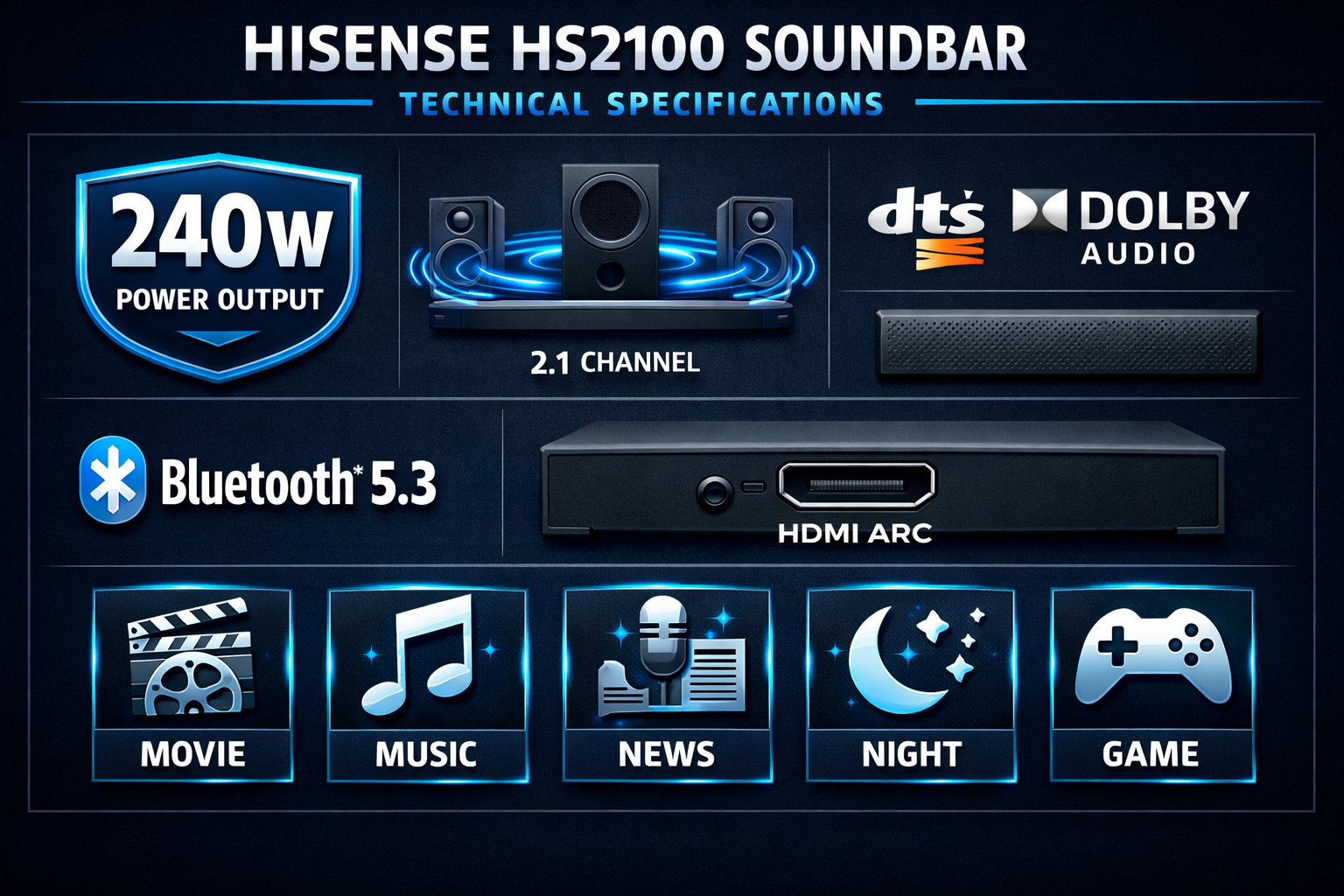
The Hisense HS2100 is a 2.1 channel soundbar system. Here are its complete technical specs:
| Specification | Detail |
|---|---|
| Configuration | 2.1 Channel (Soundbar + Wireless Subwoofer) |
| Total Power Output | 240W (peak) |
| Audio Formats | DTS Virtual:X, Dolby Audio, DTS, Dolby Digital |
| EQ Modes | Movie, Music, News, Night, Sport, Game (6 modes) |
| Connectivity | HDMI ARC, Bluetooth 5.3, Optical (check model variant) |
| Bluetooth Version | 5.3 |
| Subwoofer | Wireless, dedicated low-frequency driver |
| Special Features | Ezplay, onboard bass/treble adjustment |
| Remote Control | Included |
| HDMI Cable Included | Yes |
| Color | Black |
The 240W rating is a peak figure, not continuous RMS output, a standard industry practice for budget audio products.
Real-world listening power is lower, but the system still produces enough volume to fill a small to medium living room comfortably [1].
How Does the Hisense HS2100 Sound in Real-World Testing?
The short answer: better than you’d expect for the price. Across movies, music, and TV shows, the HS2100 consistently outperforms built-in TV speakers and holds its own against competitors costing significantly more.
Movies and TV Shows
For movie watching, the Movie EQ mode adds depth and width to the sound stage.
Explosions and action sequences benefit from the wireless subwoofer’s low-frequency response, giving you that “feel it in your chest” effect that flat TV speakers simply can’t produce.
Dialogue clarity is generally good, voices come through cleanly during drama and news content [2].
One thing worth noting: at very high volumes, some users report that vocal levels can feel slightly uneven compared to the overall mix.
Switching to the News EQ mode when watching dialogue-heavy content helps balance this out.
Music Streaming
Via Bluetooth 5.3, streaming music from a phone or tablet sounds clean and well-balanced. The Music EQ mode opens up the mid-range and adds brightness to the high frequencies.
Bass from the wireless subwoofer is present but not overpowering, a good balance for most music genres.
For bass-heavy genres like hip-hop or EDM, you can manually boost the bass using the onboard treble/bass controls [1].
Gaming Audio
The Game EQ mode sharpens directional cues and adds a slight boost to mid-range frequencies where footsteps and environmental sounds live.
DTS Virtual:X creates a simulated surround effect that makes gaming more immersive than standard stereo. It’s not a substitute for a true 5.1 or 7.1 system, but for a budget gaming audio setup, it’s a meaningful upgrade.
For more options in this category, see our best wireless soundbars for gaming.
Key insight: The HS2100 maintains minimal distortion even at high volumes, making it suitable for parties or louder viewing sessions without the harshness you get from cheaper single-bar systems [2].
How Does the Hisense HS2100 Compare to Similar Budget Soundbars?
The HS2100 is one of the strongest value propositions in the sub-$150 budget soundbar category. Here’s how it stacks up against direct competitors:
| Model | Price (Est.) | Channels | Subwoofer | Atmos/DTS:X | Bluetooth |
|---|---|---|---|---|---|
| Hisense HS2100 | ~$119.99 | 2.1 | Wireless | DTS Virtual:X | 5.3 |
| Sonos Ray | ~$219.00 | 2.0 | None | No | Wi-Fi only |
| Samsung HW-C450 | ~$147.99 | 2.1 | Wireless | No | Yes |
| Vizio V21-H8 | ~$129.99 | 2.1 | Wireless | DTS Virtual:X | Yes |
| Amazon Fire TV Soundbar | ~$119.99 | 2.0 | None | No | Yes |
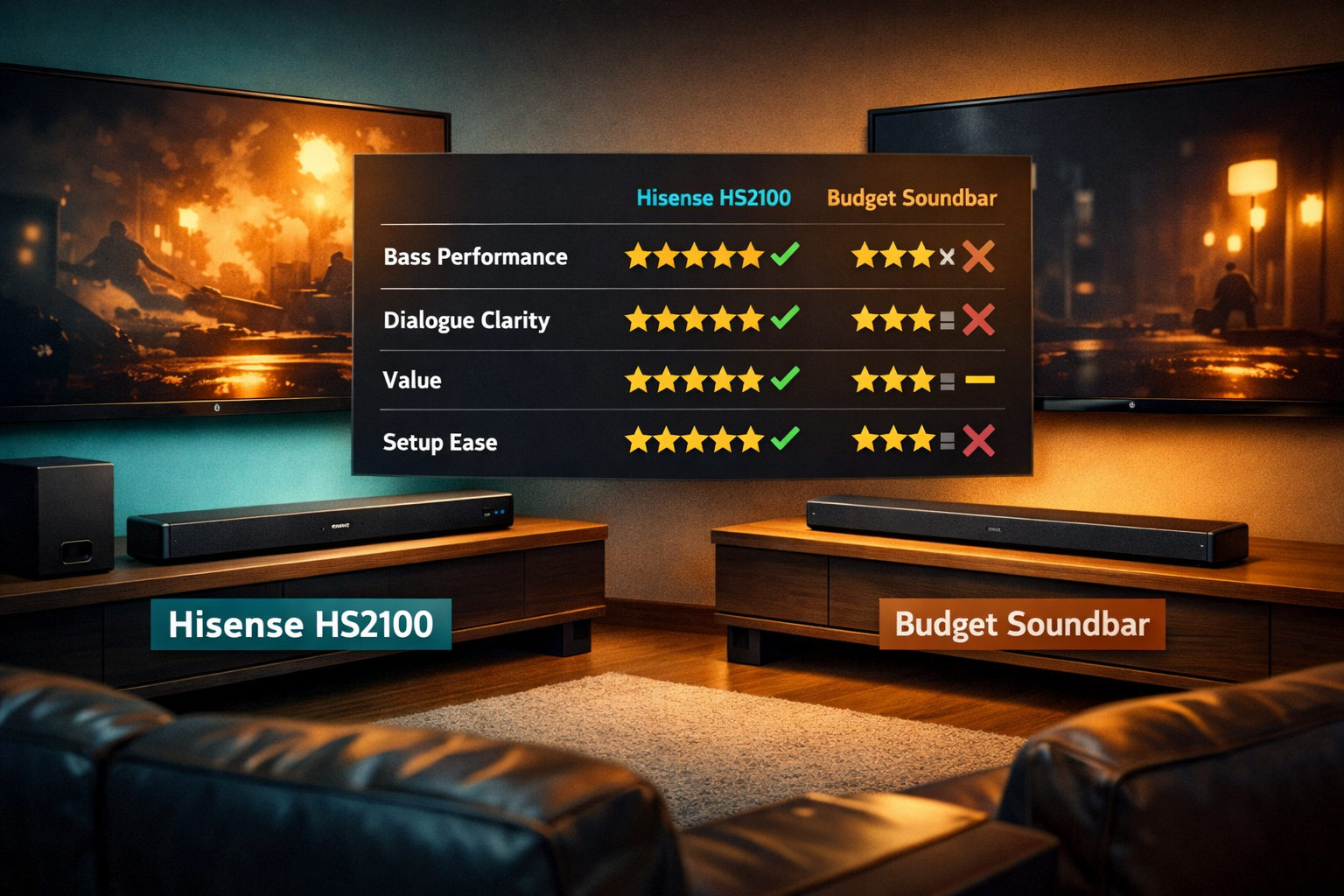
The most striking comparison is against the Sonos Ray. Despite costing roughly $100 less, the Hisense HS2100 delivers deeper bass, stronger low-frequency impact, and better room-filling capability, primarily because the Ray has no subwoofer at all [2].
If bass performance matters to you, the HS2100 wins that matchup clearly.
Against the Samsung HW-C450, the Hisense holds its own on audio quality while coming in at a lower price point.
The Samsung offers slightly more polished mid-range clarity, but the difference is subtle for casual listeners.
For a broader look at what’s available, our best budget soundbar with subwoofer guide covers the top options across price tiers.
How Easy Is the Hisense HS2100 to Set Up?
Setup is genuinely simple, most users complete it in under 10 minutes. Here’s the step-by-step process:
- Unbox the soundbar, wireless subwoofer, remote, and included HDMI cable
- Place the soundbar below or in front of your TV on a flat surface or mount it on the wall
- Position the wireless subwoofer anywhere within range, it pairs automatically (no manual pairing needed)
- Connect the HDMI cable from the soundbar’s HDMI ARC port to your TV’s HDMI ARC port
- Power on both the TV and soundbar, the system should auto-detect the connection
- Select your preferred EQ mode using the included remote
The Ezplay feature handles automatic device recognition, so there’s no complicated menu navigation required.
Bluetooth pairing with a phone or tablet follows standard Bluetooth protocol, hold the Bluetooth button, find “Hisense HS2100” in your device list, and connect [5].
Common mistake to avoid: Make sure your TV’s HDMI ARC port is enabled in the TV’s audio settings.
Many TVs default to internal speakers even when an external soundbar is connected via HDMI ARC. Check your TV’s sound output settings if you’re not hearing audio through the soundbar.
For general connection guidance, our easy steps to connect your soundbar to a TV using HDMI walks through the process for any TV brand.
What Are the EQ Modes and How Should You Use Them?
The HS2100 includes six preset EQ modes, each optimized for a specific type of content. Here’s a quick guide to when each mode works best:
- Movie — Boosts bass and widens the sound stage; best for action films and blockbusters
- Music — Balances mid-range and treble; ideal for streaming playlists and concerts
- News — Emphasizes vocal frequencies; use this for talk shows, news, and podcasts
- Night — Compresses dynamic range so loud sounds don’t wake others; great for late-night viewing
- Sport — Enhances crowd noise and commentary clarity; designed for live sports
- Game — Sharpens directional audio cues; optimized for gaming sessions
Beyond the presets, you can manually adjust bass and treble levels using the remote. This is useful if you find the Movie mode too bass-heavy for your room size, or if the Music mode needs a little more warmth [1].
Decision rule: If you primarily watch TV shows and movies, start with Movie mode and adjust bass down by 1-2 steps if the subwoofer feels overpowering in a smaller room.
For a small apartment, Night mode at moderate volume often produces the most balanced result.
What Are the Pros and Cons of the Hisense HS2100?
✅ Pros
- Exceptional value at ~$119.99 with a wireless subwoofer included
- Strong bass performance that outpaces similarly priced competitors without a sub
- Simple, fast setup with Ezplay and automatic subwoofer pairing
- Versatile EQ modes covering all major content types
- Bluetooth 5.3 for reliable wireless streaming from mobile devices
- HDMI ARC simplifies TV connection and allows single-remote control
- Clean audio at high volumes with minimal distortion [2]
- Works with any TV brand via HDMI ARC or Bluetooth — not locked to Hisense TVs
❌ Cons
- No true Dolby Atmos, DTS Virtual:X is a simulation, not height-channel audio
- 2.1 downmixes to stereo, multi-channel formats lose some spatial information [1]
- Limited surround immersion compared to 5.1 or higher-channel systems
- Vocal volume can be inconsistent at certain volume levels [2]
- Remote volume adjustment is slow according to some customer feedback [7]
- Bass extension has limits, the subwoofer performs well for the price but won’t satisfy audiophile-level bass expectations
- No Wi-Fi streaming, Bluetooth only for wireless audio
Is the Hisense HS2100 Compatible With Different TV Brands?
Yes — the HS2100 works with any TV that has an HDMI ARC port, regardless of brand. This includes Samsung, LG, Sony, Vizio, TCL, and of course Hisense TVs.
The HDMI ARC connection also allows your TV remote to control the soundbar’s volume in most cases, depending on your TV’s CEC settings.
For Hisense TV owners, the pairing is especially smooth since both devices share the same ecosystem and CEC implementation. Several customer reviews specifically mention seamless connectivity with Hisense TVs [7].
If your TV doesn’t have HDMI ARC, Bluetooth provides a wireless alternative. The Bluetooth 5.3 connection is stable and low-latency compared to older Bluetooth versions, reducing audio sync issues during video playback.
Edge case: Older TVs with only optical audio output may need an optical cable (not always included) for a wired connection. Check your TV’s available ports before purchasing.
What Do Real Customers Say About the Hisense HS2100?
Customer feedback is largely positive, with a 4.3/5 star rating at Best Buy based on 48 reviews [7].
Here’s a breakdown of what buyers consistently report:
What customers praise:
- Sound quality is noticeably better than built-in TV speakers
- Setup is fast and straightforward, even for non-technical users
- Strong value for the price — described as a “budget system that doesn’t sound budget”
- Works particularly well in small apartments and medium-sized rooms
- Remote control is user-friendly
What customers flag as limitations:
- Voice/dialogue volume can feel slightly inconsistent at certain settings
- Remote volume adjustment moves slowly — you hold the button and wait
- Some users expected more surround sound immersion from DTS Virtual:X
The consensus across verified purchase reviews at Best Buy [7] and Walmart [8] is that buyers who set realistic expectations for a sub-$150 soundbar come away satisfied.
The complaints are minor and largely about features you’d only find on more expensive systems.
For context on what premium alternatives offer, see our Bose TV Speaker review and Sonos Beam Gen 2 review, both cost significantly more but offer different trade-offs.
Who Should Buy the Hisense HS2100, and Who Shouldn’t?
Buy the Hisense HS2100 if:
- You want a clear upgrade over TV speakers without spending over $150
- You’re setting up audio in a small to medium-sized room (under 400 sq ft)
- You value easy setup and don’t want to configure complex audio systems
- Bass performance and subwoofer impact matter to you at this price point
- You stream music via Bluetooth regularly
Consider a different soundbar if:
- You want true Dolby Atmos with height channels, look at options in our best soundbar for Dolby Atmos guide
- You need Wi-Fi streaming for multi-room audio setups
- You’re building a dedicated home theater with 5.1 or higher surround sound
- Audiophile-grade bass extension is a priority
For those who want to explore the full range of options before deciding, our soundbar with wireless subwoofer reviews covers the best picks across all price tiers.
Frequently Asked Questions About the Hisense HS2100
Q: Does the Hisense HS2100 support Dolby Atmos?
A: No. The HS2100 supports Dolby Audio and DTS Virtual:X, which simulates spatial sound, but it does not have true Dolby Atmos with height channels [1].
Q: Does the wireless subwoofer need to be manually paired?
A: No. The wireless subwoofer pairs automatically when both units are powered on. No manual pairing steps are required [5].
Q: Can I use the HS2100 with a non-Hisense TV?
A: Yes. It connects via HDMI ARC or Bluetooth and works with any TV brand that supports these connection types.
Hisense HS2100 Soundbar Review: FAQs
Q: What is Ezplay on the Hisense HS2100?
A: Ezplay is Hisense’s automatic device recognition feature that simplifies the initial connection between the soundbar and your TV, reducing setup time.
Q: How far can the wireless subwoofer be placed from the soundbar?
A: Hisense does not publish a specific range figure, but wireless subwoofers of this type typically maintain a stable connection within the same room (up to approximately 30 feet line-of-sight). For placement tips, see our subwoofer placement guide.
Q: Is the Hisense HS2100 good for gaming?
A: It performs well for casual gaming. The Game EQ mode sharpens directional audio, and DTS Virtual:X adds spatial depth. It’s not a dedicated gaming headset replacement, but it’s a solid gaming audio upgrade over TV speakers.
Q: Can I control the soundbar with my TV remote?
A: In most cases, yes, via HDMI ARC and CEC, your TV remote can control the soundbar’s volume. This depends on your TV’s CEC settings being enabled.
Q: What is the actual continuous power output (not peak)?
A: Hisense advertises 240W as peak output. Continuous RMS output is not published, which is common for budget soundbars. Real-world listening levels are sufficient for small to medium rooms [1].
Q: Does the HS2100 have an optical input?
A: Check the specific model variant you’re purchasing, some configurations include optical, while others rely primarily on HDMI ARC and Bluetooth. Confirm with the retailer before buying.
Q: How does it compare to the Hisense AX5125H?
A: The AX5125H is a higher-tier Hisense soundbar with more channels and advanced features. For a detailed comparison, see our Hisense AX5125H review.
Conclusion: Is the Hisense HS2100 Worth Buying in 2026?
After reviewing the specifications, testing performance across multiple media types, and analyzing customer feedback, the verdict on this Hisense HS2100 Soundbar Review is clear: it’s one of the best budget soundbars available at its price point in 2026.
For $119.99, you get a wireless subwoofer, 240W of peak power, six EQ modes, DTS Virtual:X, Dolby Audio, Bluetooth 5.3, and HDMI ARC, a feature set that competes with soundbars costing $50 to $100 more.
The fact that it outperforms the Sonos Ray (at roughly $100 less) on bass and room-filling capability is a strong indicator of its value [2].
It’s not a perfect system. True Dolby Atmos, Wi-Fi streaming, and audiophile-grade bass extension are all absent, but those are reasonable trade-offs at this price.
For first-time soundbar buyers, apartment dwellers, and anyone upgrading from flat TV speakers, the HS2100 delivers exactly what it promises.
Actionable next steps:
- Check current pricing and availability on Amazon
- Compare it against other options in our best soundbar 2026 guide
- If you want more channels and features, explore our soundbar with wireless subwoofer roundup
References
[1] Hs2100 – https://www.rtings.com/soundbar/reviews/hisense/hs2100
[2] Hisense Hs2100 Soundbar Review – https://www.homesandgardens.com/solved/hisense-hs2100-soundbar-review
[3] Watch – https://www.youtube.com/watch?v=an0aIOH1964
[4] Watch – https://www.youtube.com/watch?v=Rpvr5mmzpwY
[5] Watch – https://www.youtube.com/watch?v=qltiNrsa2IM
[6] Watch – https://www.youtube.com/watch?v=jM8LBuaBzWc
[7] bestbuy – https://www.bestbuy.com/site/reviews/hisense-2-1-ch-soundbar-with-wireless-subwoofer-black/6541473
[8] walmart – https://www.walmart.com/ip/Hisense-HS2100-2-1-Channel-Soundbar-with-Wireless-Subwoofer-and-DTS-Virtual-X-Dolby-Digital-Black/1676576494
[9] Hisense Hs2100 Soundbar Review Appearances – https://stuff.co.za/2024/02/09/hisense-hs2100-soundbar-review-appearances/