Philips Soundbar Remote
Latest Update: April 06, 2026
You’re settling in for movie night, snacks ready, lights dimmed, but your Philips Soundbar Remote won’t respond. Frustrating, right?
Whether you’ve lost your remote, it’s stopped working, or you’re simply trying to understand all those mysterious buttons, you’re not alone.
The Philips Soundbar Remote is an essential piece of your home entertainment puzzle, and understanding how it works can transform your audio experience from frustrating to fantastic.
In 2026, as soundbars continue to dominate the home audio landscape, mastering your remote control has never been more important.
This comprehensive guide will walk you through everything you need to know about your Philips Soundbar Remote, from basic functions to advanced troubleshooting.
Key Takeaways
- Universal compatibility: Most Philips soundbar remotes work across multiple models, but specific button functions may vary by soundbar series
- Multiple control options: You can control your Philips soundbar through the original remote, universal remotes, smartphone apps, or TV remotes via HDMI-CEC
- Common issues are fixable: Battery problems, pairing issues, and signal interference account for 90% of remote malfunctions and can usually be resolved at home
- Replacement is affordable: Official Philips replacement remotes cost $15-$30, while universal alternatives offer budget-friendly options starting around $10
- Smart features enhance control: Many 2026 Philips soundbar models support voice control and app-based management for added convenience
Understanding Your Philips Soundbar Remote
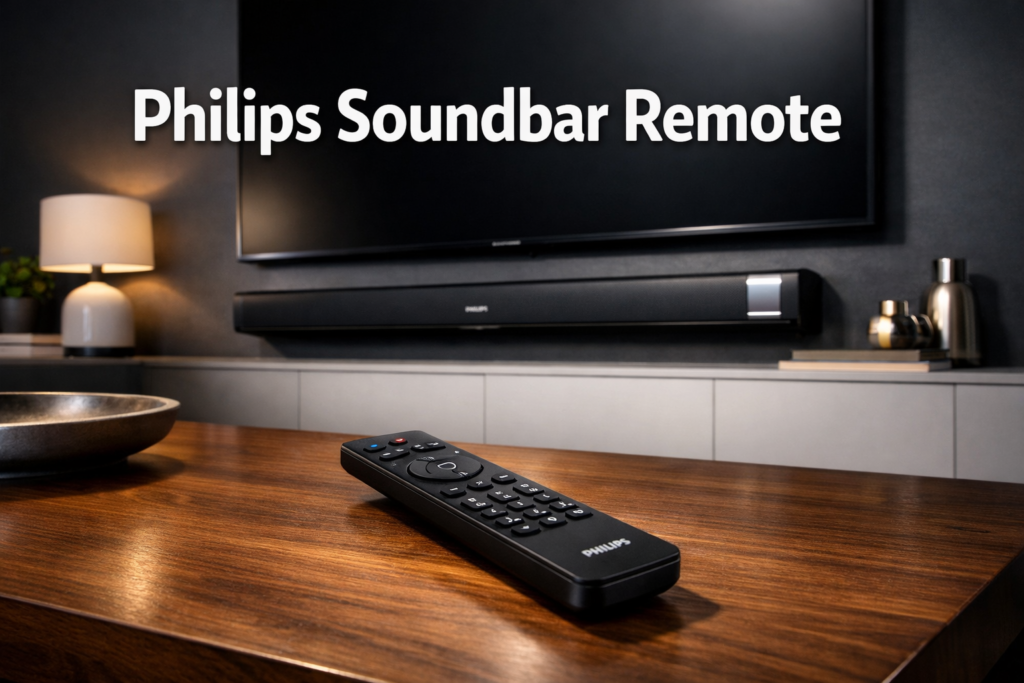
The Philips Soundbar Remote serves as your command center for premium audio control. Unlike basic TV remotes, soundbar remotes are specifically designed to manage sophisticated audio features that enhance your listening experience.
Key Features and Button Functions
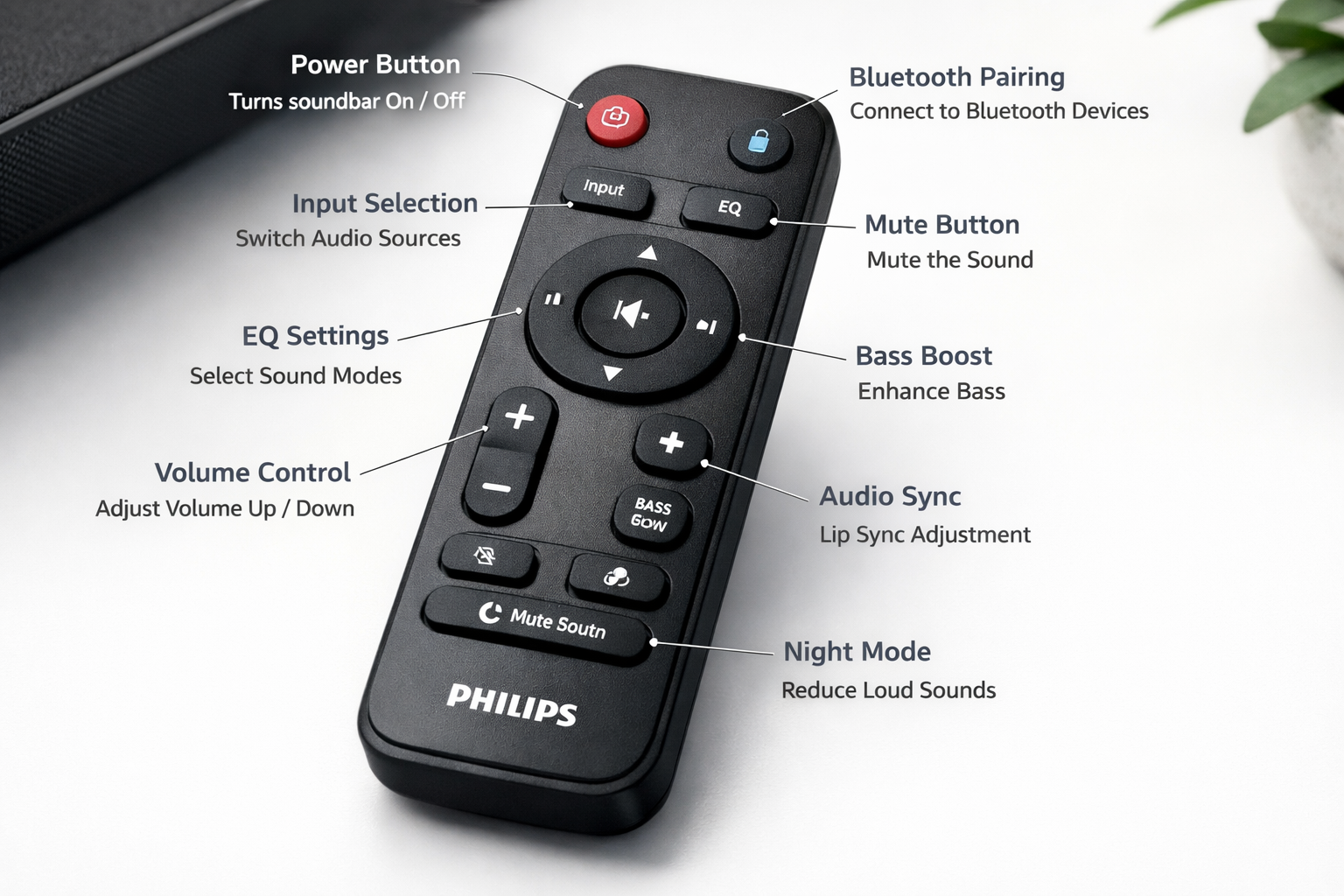
Most Philips soundbar remotes share common design elements, though specific models may vary. Here’s what you’ll typically find:
Power and Basic Controls ⚡
- Power button: Turns your soundbar on or off (usually located at the top)
- Volume up/down: Adjusts sound levels incrementally
- Mute: Instantly silences audio without turning off the device
Input and Source Selection 🎵
- Source/Input button: Cycles through connection options (HDMI, Optical, Bluetooth, AUX)
- Bluetooth pairing: Dedicated button for wireless device connections
- TV input: Quick switch to TV audio
Sound Enhancement Features 🎭
- Sound modes: Preset equalizer settings (Movie, Music, News/Voice, Sports)
- Bass/Treble controls: Fine-tune low and high frequencies
- Surround sound toggle: Activate virtual surround effects
- Night mode: Reduces dynamic range for late-night viewing
Advanced Functions 🔧
- Dialogue enhancement: Boosts voice clarity for better speech intelligibility
- Subwoofer level: Adjusts bass intensity when using external subwoofers
- Setup/Settings: Access configuration menus
Remote Control Technology
Philips soundbar remotes typically use infrared (IR) technology, which requires a clear line of sight between the remote and the soundbar’s sensor. Some newer 2026 models incorporate RF (radio frequency) or Bluetooth connectivity, allowing control without direct line of sight.
The IR sensor on your soundbar is usually located on the front panel, often indicated by a small dark window. Understanding this helps when troubleshooting common soundbar remote control issues.
Troubleshooting Your Philips Soundbar Remote
When your Philips Soundbar Remote stops working properly, don’t panic. Most issues have simple solutions that don’t require professional help or expensive replacements.
Common Problems and Quick Fixes
Problem 1: Remote Not Responding at All 🔋
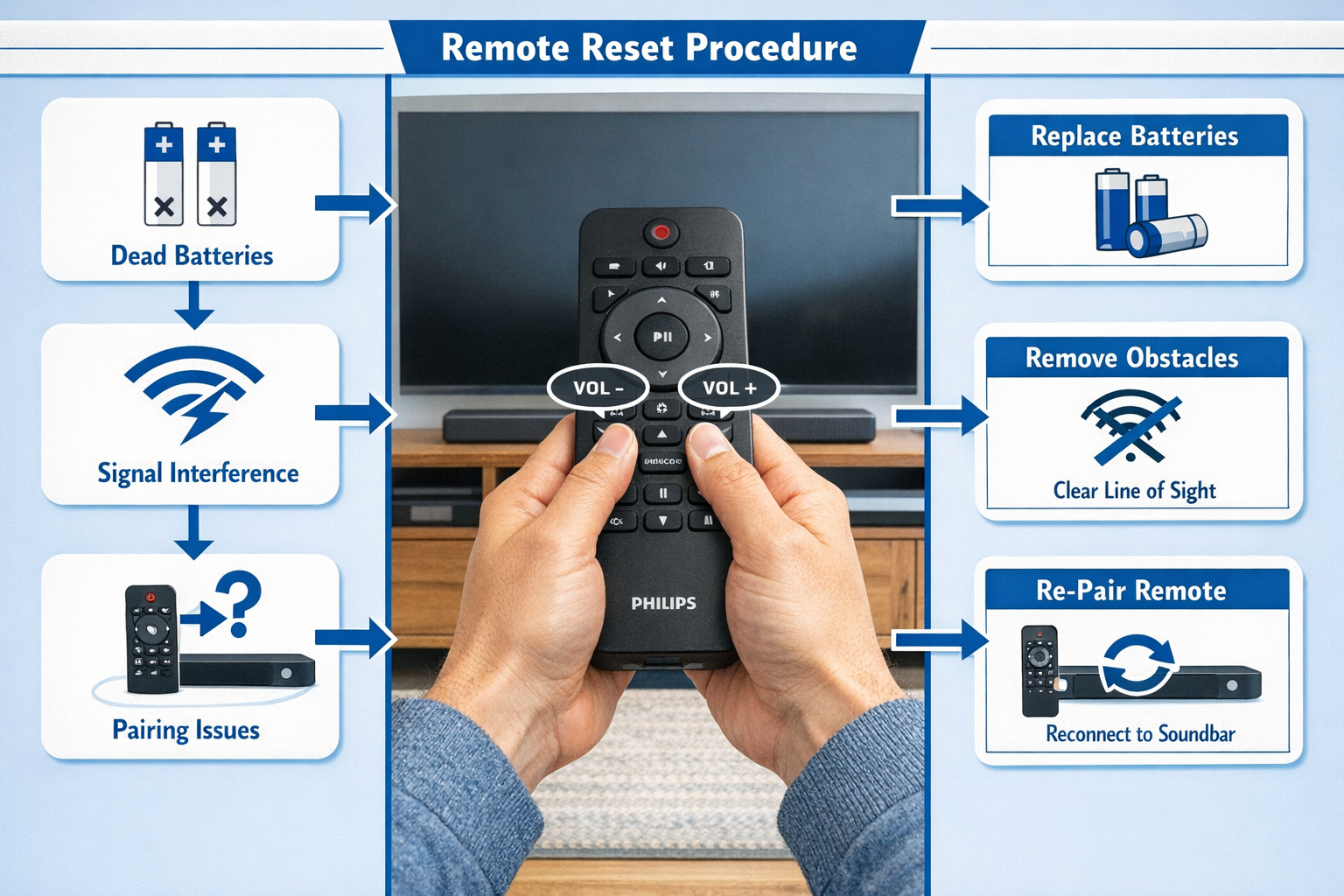
This is the most frequent complaint, and batteries are usually the culprit.
Solutions:
- Replace batteries with fresh ones (most Philips remotes use AAA batteries)
- Check battery orientation—incorrect placement prevents operation
- Clean battery contacts with a cotton swab and rubbing alcohol
- Remove batteries, press all buttons for 30 seconds to discharge residual power, then reinstall
Problem 2: Intermittent Response or Delayed Commands ⏱️
If your remote works sometimes but not others, consider these factors:
Solutions:
- Clear the line of sight between remote and soundbar sensor
- Remove obstacles blocking the IR sensor
- Reduce ambient light interference (bright sunlight can affect IR signals)
- Move closer to the soundbar (optimal range is typically 15-20 feet)
- Check for interference from other IR devices
Problem 3: Specific Buttons Not Working 🔘
When only certain buttons fail while others function normally:
Solutions:
- Clean the remote: Dirt and debris under buttons cause malfunctions
- Remove batteries first
- Use isopropyl alcohol (70% or higher) on a cotton swab
- Gently clean around unresponsive buttons
- Let dry completely before reinserting batteries
- Check if buttons are physically stuck or damaged
- Test if the issue persists with a replacement remote to rule out soundbar problems
Problem 4: Remote Won’t Pair with Soundbar 📡
For Bluetooth-enabled remotes or after replacing batteries:
Solutions:
- Reset the pairing:
- Turn off the soundbar
- Remove remote batteries for 60 seconds
- Press and hold the power button for 10 seconds
- Reinsert batteries
- Turn on soundbar and test
- Perform a factory reset on your soundbar (consult your model’s manual)
- Ensure no other devices are interfering with the pairing process
Advanced Troubleshooting Techniques
If basic fixes don’t work, try these more comprehensive approaches:
Test with Your Smartphone Camera 📱
This clever trick helps determine if your remote is sending IR signals:
- Point the remote at your smartphone camera
- Press any button while viewing the camera screen
- You should see a purple/white light flash from the remote’s IR LED
- No flash? The remote is faulty and needs replacement
Check HDMI-CEC Settings 🔌
If you’re trying to control your soundbar with your TV remote, verify HDMI-CEC is enabled:
- Access your TV’s settings menu
- Look for HDMI-CEC (may be called Anynet+, Bravia Sync, or similar)
- Enable the feature on both TV and soundbar
- This allows your TV remote to control basic soundbar functions
For more comprehensive troubleshooting guidance, explore our detailed resource on troubleshooting soundbar remote problems.
Replacement Options for Your Philips Soundbar Remote
Lost your remote? Don’t worry—you have several excellent replacement options in 2026, ranging from official Philips products to versatile universal alternatives.
Official Philips Replacement Remotes
Where to Buy:
- Philips official website (direct from manufacturer)
- Amazon and major online retailers
- Electronics stores (Best Buy, Target)
- Authorized Philips service centers
Pricing: Typically $15-$30 depending on model
Advantages:
✅ Guaranteed compatibility with your specific soundbar model
✅ All original functions preserved
✅ Same ergonomic design you’re familiar with
✅ Official warranty coverage
How to Order:
- Locate your soundbar’s model number (usually on the back or bottom)
- Search for “[Your Model Number] remote replacement”
- Verify compatibility before purchasing
- Common Philips soundbar model numbers include HTL, CSS, and TAB series
Universal Remote Alternatives
Universal remotes offer flexibility and often cost less than original replacements. In 2026, several excellent options work seamlessly with Philips soundbars.
Top Universal Remote Recommendations:
| Remote Type | Price Range | Best For | Key Features |
|---|---|---|---|
| Basic Universal | $10-$20 | Simple replacement needs | Pre-programmed codes, easy setup |
| Learning Remotes | $25-$40 | Multiple device control | Learns from original remote, customizable |
| Smart Remotes | $40-$100 | Tech enthusiasts | App control, voice commands, activity-based |
Popular Universal Remotes Compatible with Philips Soundbars:
🎯 GE Universal Remote ($12-$18)
- Simple programming with code entry
- Controls up to 4 devices
- Affordable and reliable
🎯 Logitech Harmony ($50-$300)
- Advanced smart home integration
- Smartphone app control
- Activity-based programming (e.g., “Watch Movie” activates multiple devices)
🎯 Sofabaton ($40-$60)
- Modern design with smartphone app
- One-touch activities
- Regular firmware updates
Programming Tips:
- Find Philips soundbar codes in the universal remote manual (common codes: 0199, 0200, 1234)
- Follow the step-by-step programming instructions
- Test all essential functions before discarding packaging
- Keep a backup of working codes
Smartphone Apps as Remote Alternatives
Many 2026 Philips soundbar models support smartphone control through dedicated apps, offering a modern alternative to physical remotes.
Philips Sound App Features:
- Full remote control functionality
- Firmware updates
- Advanced EQ customization
- Multi-room audio management (compatible models)
- Preset saving and sharing
Download: Available for iOS and Android devices
Setup Process:
- Download the Philips Sound app from your device’s app store
- Ensure your soundbar and smartphone are on the same Wi-Fi network
- Follow in-app pairing instructions
- Grant necessary permissions for full functionality
This digital solution works particularly well if you’re considering upgrading to a more connected audio system, similar to soundbars with built-in Alexa.
Alternative Control Methods for Your Philips Soundbar
Beyond the traditional Philips Soundbar Remote, you have several convenient control options that can simplify your entertainment setup in 2026.
HDMI-CEC Control (TV Remote Integration)
What is HDMI-CEC? 🔗
HDMI-CEC (Consumer Electronics Control) is a feature that allows devices connected via HDMI to communicate and control each other. When properly configured, you can control your Philips soundbar using your TV’s remote—eliminating the need for multiple remotes.
Benefits:
- Single remote controls both TV and soundbar
- Automatic power on/off synchronization
- Seamless volume control
- Simplified user experience
Setup Instructions:
- Connect your soundbar to TV using an HDMI cable (preferably to the HDMI ARC/eARC port)
- Enable HDMI-CEC on your TV (check settings menu—terminology varies by brand)
- Enable HDMI-CEC on your Philips soundbar (usually in audio settings)
- Test volume control and power functions
Note: HDMI-CEC goes by different names depending on TV manufacturer:
- Samsung: Anynet+
- LG: SimpLink
- Sony: Bravia Sync
- Vizio: CEC
- Panasonic: HDAVI Control
This integration works similarly to how you would connect a soundbar to any TV, creating a unified control experience.
Voice Control Integration
Modern Philips soundbars increasingly support voice assistant integration, allowing hands-free control through:
Amazon Alexa 🗣️
- “Alexa, turn on the soundbar”
- “Alexa, increase soundbar volume to 50%”
- “Alexa, switch soundbar to Bluetooth mode”
Google Assistant 🎙️
- “Hey Google, play music on the soundbar”
- “Hey Google, mute the soundbar”
Setup Requirements:
- Compatible Philips soundbar model
- Smart speaker or voice assistant device
- Philips Sound app for initial configuration
- Same Wi-Fi network for all devices
Physical Controls on the Soundbar
Don’t overlook the buttons on your soundbar itself! Most Philips soundbars feature basic controls directly on the unit:
Typical Physical Controls:
- Power button
- Volume up/down
- Input/Source selection
- Bluetooth pairing
Location: Usually on top or right side of the soundbar
These controls serve as an excellent backup when your remote is unavailable, similar to the approach needed when troubleshooting other soundbar brands.
View on AmazonMaintaining Your Philips Soundbar Remote for Longevity
Proper care extends your remote’s lifespan and prevents many common issues. Here are my top maintenance tips from years of experience with audio equipment:
Daily Care Practices
Keep It Clean 🧼
- Wipe down weekly with a slightly damp microfiber cloth
- Avoid harsh chemicals that can damage button labels
- Clean between buttons using compressed air
- Remove sticky residues immediately
Proper Storage 📦
- Designate a specific spot for your remote
- Use a remote caddy or organizer
- Keep away from liquids and food
- Avoid extreme temperatures
Battery Management 🔋
- Use quality alkaline or rechargeable batteries
- Replace both batteries simultaneously
- Remove batteries if not using the soundbar for extended periods
- Check for corrosion monthly
Preventive Measures
Protect from Physical Damage 🛡️
- Use a silicone protective cover (available for $5-$10)
- Avoid dropping or throwing the remote
- Keep away from pets and small children
- Don’t place heavy objects on top
Minimize Interference 📡
- Keep the IR sensor path clear
- Position soundbar away from direct sunlight
- Reduce clutter near the soundbar
- Maintain reasonable distance (under 20 feet for optimal performance)
When to Consider Replacement
Even with excellent care, remotes eventually wear out. Consider replacement when:
- Multiple buttons consistently fail despite cleaning
- Physical damage affects functionality
- Battery contacts show severe corrosion
- The remote no longer holds a charge (rechargeable models)
- Repair costs exceed replacement costs
Comparing Philips Soundbar Remote Features Across Models
Not all Philips Soundbar Remote controls are created equal. Understanding the differences helps you maximize your specific model’s capabilities.
Entry-Level Models (HTL Series)
Typical Features:
- Basic IR remote
- Essential controls (power, volume, input)
- 2-3 sound modes
- Simple button layout
- AAA battery powered
Best For: Budget-conscious buyers seeking straightforward audio enhancement
Mid-Range Models (TAB Series)
Enhanced Features:
- Improved ergonomic design
- Additional sound customization
- Dedicated bass/treble controls
- Bluetooth pairing button
- Night mode function
- More responsive IR sensor
Best For: Home theater enthusiasts wanting balanced features and value
Premium Models (Fidelio Series)
Advanced Features:
- Backlit buttons for low-light use
- RF or Bluetooth connectivity (no line-of-sight required)
- Extensive sound mode options
- Dedicated app support
- Voice control compatibility
- Rechargeable battery option
- Premium materials and build quality
Best For: Audiophiles and smart home integrators
This tiered approach mirrors the variety you’ll find when exploring options like best wireless soundbars or soundbars with wireless subwoofers.
Maximizing Your Philips Soundbar Experience
Your Philips Soundbar Remote is more than just a controller—it’s the key to unlocking your soundbar’s full potential. Here’s how to get the most from your system:
Optimize Sound Settings
Experiment with Sound Modes 🎬
- Movie mode: Enhanced bass and surround effects for cinematic experience
- Music mode: Balanced audio with emphasis on clarity and detail
- Voice/News mode: Boosted dialogue for clear speech
- Sports mode: Amplified crowd noise and commentary
Tip: Save your favorite settings for different content types and switch between them using your remote.
Fine-Tune Audio Levels 🎚️
- Adjust bass for your room size (smaller rooms need less bass)
- Increase treble for better dialogue clarity
- Use night mode to prevent disturbing others
- Enable dialogue enhancement for movies with heavy soundtracks
Create Custom Presets
Many Philips soundbars allow you to save customized sound profiles:
- Adjust settings to your preference
- Hold the designated preset button (consult your manual)
- The soundbar confirms with a beep or light flash
- Recall instantly with a single button press
Integration with Smart Home Systems
If you’re building a connected home, your Philips soundbar can integrate seamlessly:
Compatible Ecosystems:
- Amazon Alexa routines
- Google Home automation
- IFTTT (If This Then That) commands
- Smart home hubs (Samsung SmartThings, Apple HomeKit via workarounds)
Example Automation:
“When I say ‘Movie Time,’ dim the lights, turn on the TV, switch soundbar to HDMI input, and set volume to 40%”
This level of integration rivals what you’d find in comprehensive guides about connecting soundbars to TVs or choosing the right soundbar.
View on AmazonFrequently Asked Questions About Philips Soundbar Remotes
Q: Can I use my TV remote to control my Philips soundbar?
Yes! If your TV and soundbar are connected via HDMI with HDMI-CEC enabled, your TV remote can control basic soundbar functions like volume and power. Check both devices’ settings menus to enable this feature.
Q: How do I know which replacement remote to buy?
Check your soundbar’s model number (located on the back or bottom panel) and search for that specific model’s compatible remote. Alternatively, universal remotes with Philips soundbar codes work with most models.
Q: Why does my remote work only when I’m very close to the soundbar?
This typically indicates weak batteries or a dirty IR sensor. Replace the batteries first, then clean the soundbar’s IR receiver window with a soft cloth. If problems persist, the remote’s IR LED may be failing.
Q: Can I control multiple Philips soundbars with one remote?
Standard IR remotes will control any Philips soundbar in range, which can be problematic if you have multiple units. Consider using the Philips Sound app for individual device control or position soundbars in separate rooms.
Q: What should I do if I spilled liquid on my remote?
Immediately remove batteries, shake out excess liquid, and disassemble if possible. Clean with isopropyl alcohol (90%+ concentration), let dry completely for 24-48 hours, then reassemble and test. If it doesn’t work, replacement is necessary.
Q: Are universal remotes as good as original Philips remotes?
Quality universal remotes function well for basic operations, but may lack access to advanced features specific to your soundbar model. For full functionality, original Philips remotes are recommended.
Conclusion
Your Philips Soundbar Remote is the gateway to exceptional home audio experiences. Whether you’re troubleshooting a malfunctioning remote, searching for a replacement, or exploring alternative control methods, this guide has equipped you with the knowledge to take control of your sound system.
Remember these key points:
- Most remote issues stem from simple problems with straightforward solutions
- Multiple control options exist beyond the physical remote
- Regular maintenance prevents many common problems
- Replacement remotes are affordable and readily available
Your Next Steps:
- If your remote isn’t working: Start with battery replacement and basic troubleshooting before considering replacement
- If you need a replacement: Determine your soundbar model number and choose between official Philips remotes or quality universal alternatives
- To enhance convenience: Set up HDMI-CEC control or download the Philips Sound app for smartphone control
- For ongoing care: Implement the maintenance practices outlined above to extend your remote’s lifespan
Don’t let remote control issues diminish your entertainment experience. With the information in this guide, you’re now prepared to handle any Philips Soundbar Remote challenge that comes your way.
For additional support with soundbar setup and optimization, explore our comprehensive resources on soundbar troubleshooting and audio system configuration.
Take action today, whether that’s fixing your current remote, ordering a replacement, or setting up alternative control methods.
Your perfect home theater experience is just a button press away! 🎬🔊
View on Amazon