Dolby Atmos and DTS X Soundbars
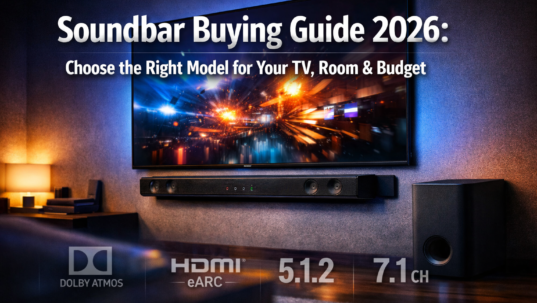
The home theater landscape has transformed dramatically. In 2026, Dolby Atmos and DTS:X soundbars deliver cinematic immersion that once required complex multi-speaker installations with ceiling-mounted hardware.
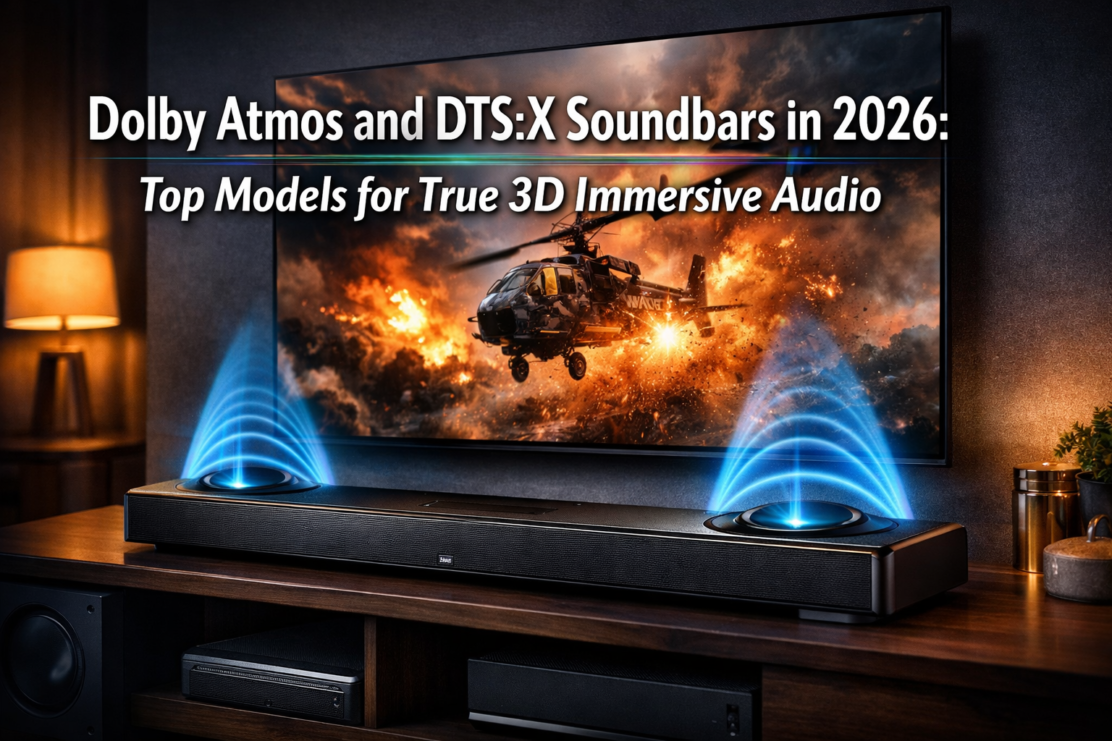
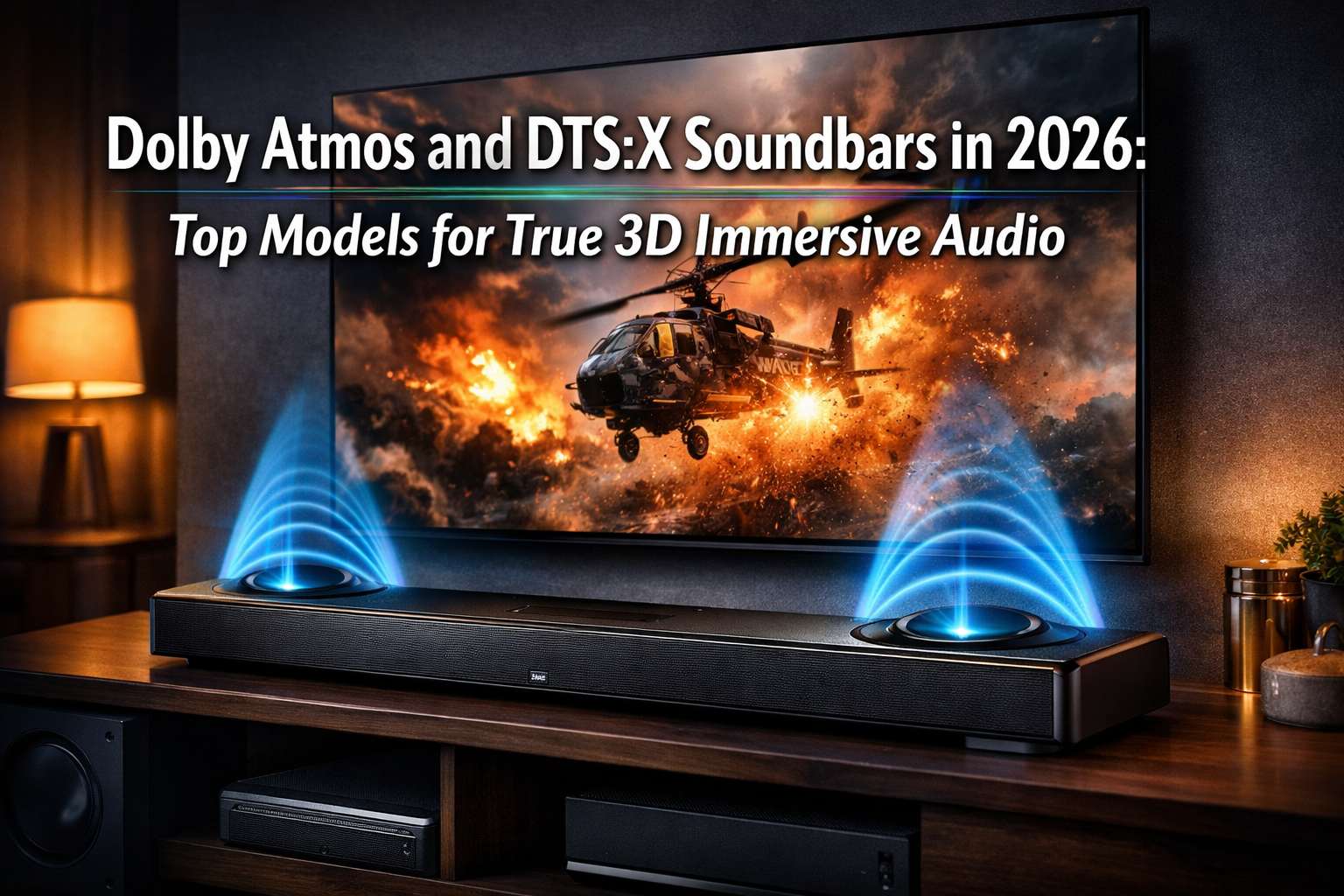
Modern soundbars now create three-dimensional audio experiences through upward-firing drivers and advanced object-based audio rendering—without drilling holes or running wires through walls.
This comprehensive guide explores the Dolby Atmos and DTS X soundbars: 2026 top models for true 3D immersive audio, comparing their height channel performance across movies, music, and gaming scenarios to help you choose the perfect system for your space.
Key Takeaways
✅ Premium soundbars with 11.1.4 configurations now rival traditional surround systems, featuring discrete satellite speakers and multiple upward-firing drivers for authentic 3D audio [1]
✅ DTS:X streaming availability expanded significantly in 2024-2025, with Disney+ launching support branded as “IMAX signature sound by DTS” for Marvel content and concert films [3]
✅ HDMI 2.1 connectivity has become standard in 2026 flagship models, enabling 4K/120Hz pass-through for PS5 and Xbox Series X gaming with minimal latency
✅ Compact premium options like Sonos Beam Gen 2 prove that even smaller soundbars can deliver impressive Dolby Atmos performance with clear dialogue and multi-room integration [4]
✅ Budget-friendly models under $300 now include DTS Virtual:X technology for simulated surround sound, making immersive audio accessible without premium pricing
Understanding Dolby Atmos and DTS:X Technology in 2026
Object-based audio represents the fundamental shift that separates Dolby Atmos and DTS:X from traditional channel-based surround sound.
Instead of mixing audio into fixed channels (like 5.1 or 7.1), these formats treat sounds as individual objects that can be precisely positioned anywhere in three-dimensional space—including above the listener.
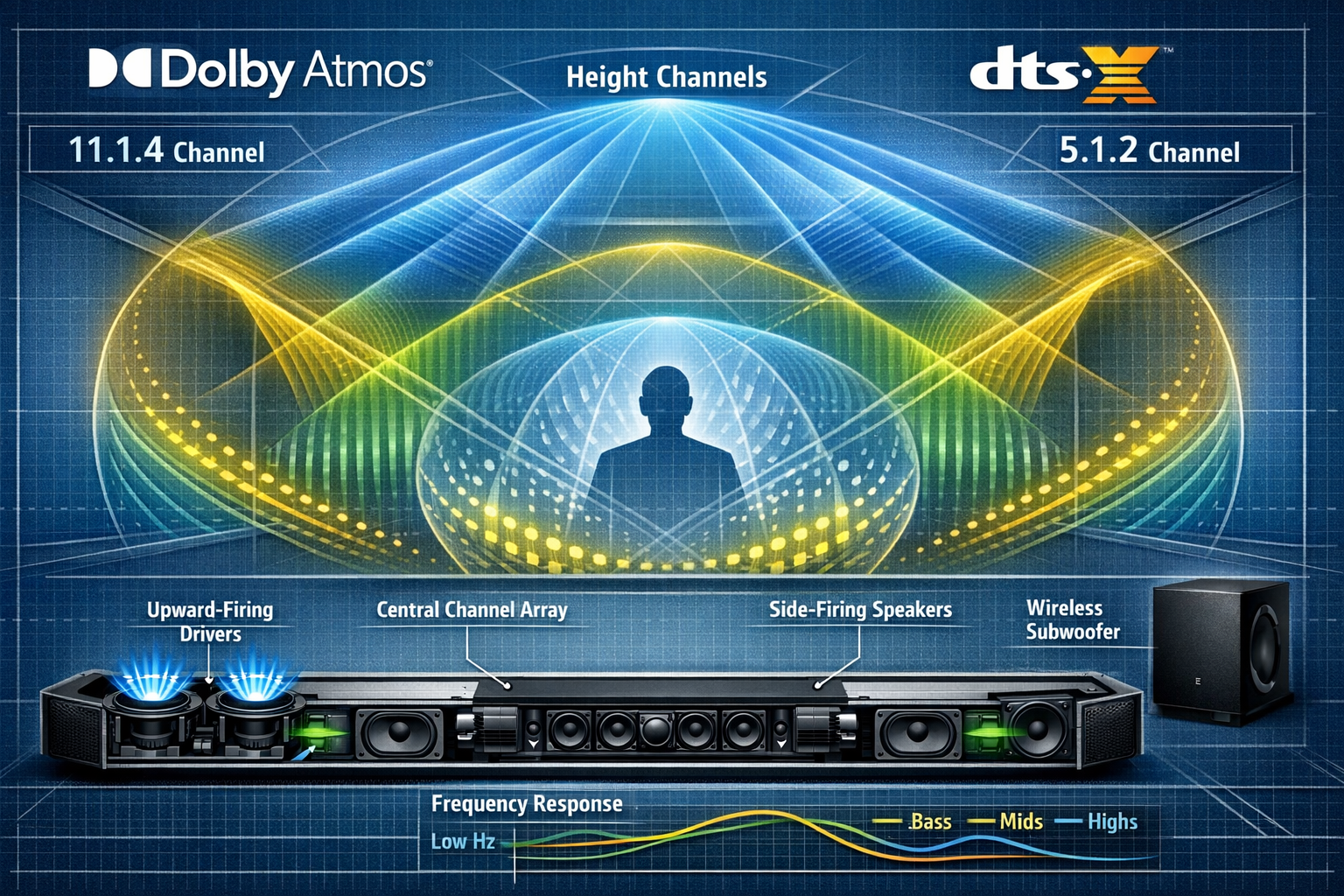
How Upward-Firing Drivers Create Height Channels 🎵
Modern soundbars achieve overhead audio through upward-firing drivers that bounce sound off ceilings to create the illusion of height channels. The effectiveness depends on several factors:
- Ceiling height and material: Flat ceilings between 7-10 feet with reflective surfaces work best
- Driver angle and power: Premium models use precisely angled drivers with dedicated amplification
- Room acoustics: Open floor plans benefit more than heavily furnished spaces with sound-absorbing materials
The Samsung HW-Q990F leads the premium market with an impressive 11.1.4 channel configuration featuring discrete satellite speakers and four upward-firing drivers for exceptional three-dimensional audio [1].
This setup supports both Dolby Atmos and DTS:X formats with dual HDMI 2.1 inputs offering 4K/120Hz pass-through and gaming optimization for PS5 and Xbox Series X [1].
DTS:X vs. Dolby Atmos: Format Availability in 2026
While both formats deliver object-based audio, their content availability differs significantly:
Dolby Atmos dominates streaming platforms including Netflix, Disney+, Apple TV+, Amazon Prime Video, and HBO Max. Virtually every major streaming service now offers Atmos content for premium subscribers.
DTS:X expanded considerably in 2024-2025, with Disney+ launching DTS:X support (branded as “IMAX signature sound by DTS”) in May 2024 for Marvel Cinematic Universe titles and concert movies [3]. However, the format remains primarily confined to Blu-ray discs compared to Dolby Atmos’s broader streaming availability [3].
For those exploring soundbars with Dolby Atmos, understanding these format differences helps determine which features matter most for your viewing habits.
Top Dolby Atmos and DTS:X Soundbars in 2026: Premium Models
Samsung HW-Q990F: Best Overall for Movies and Gaming 🏆
The Samsung HW-Q990F consistently ranks as the best-tested Dolby Atmos soundbar with its 11.1.4 channel configuration delivering truly immersive audio [1]. This flagship system includes:
- Discrete satellite speakers for authentic surround sound without virtual processing
- Four dedicated upward-firing drivers creating convincing height effects
- Dual HDMI 2.1 inputs with 4K/120Hz pass-through for next-gen gaming consoles
- Both Dolby Atmos and DTS:X support for maximum content compatibility
- Adaptive sound technology that automatically adjusts EQ based on content type
Real-world testing reveals exceptional performance in action movies, where explosions and overhead aircraft create genuinely immersive experiences.
Gaming performance particularly impresses with low latency and spatial accuracy that enhances competitive titles.
Sonos Arc Ultra: Best Single-Piece Solution
The Sonos Arc Ultra delivers the best single-piece Dolby Atmos solution with improved deep low-end response compared to its predecessor and exceptional dialogue clarity [3]. Key advantages include:
- No separate subwoofer required for most room sizes (though one can be added)
- Seamless integration into the Sonos multi-room ecosystem
- Premium build quality with sleek design suitable for wall mounting
- Trueplay tuning (iOS only) that optimizes sound for your specific room
The main limitation: no DTS:X support and requires an additional adapter for optical connections [3]. For those prioritizing streaming content over physical media, this rarely poses problems since most streaming services favor Dolby Atmos.
Our best soundbar for Dolby Atmos guide provides additional comparisons across different price points.
Sony BRAVIA Theater System: Best for DTS:X Enthusiasts
The Sony BRAVIA Theater System series features true 5.1 surround sound with both Dolby Atmos and DTS:X support, wireless subwoofers for deep bass, and rear speakers for immersive action scenes [4]. This system stands out as a top contender for movies and gaming with:
- Dual format support ensuring compatibility with all content sources
- Wireless rear speakers eliminating cable runs while maintaining authentic surround effects
- HDMI 2.1 connectivity with eARC support for lossless audio formats
- 360 Spatial Sound Mapping technology that analyzes room acoustics
The Sony system particularly excels with physical media collections featuring DTS:X soundtracks. For smaller spaces, consider the Sony Bravia soundbar options for compact rooms.
Sonos Beam Gen 2: Best Compact Premium Option
The Sonos Beam Gen 2 ranks among the top compact premium options with Dolby Atmos support, balanced sound quality with clear dialogue, and integration into the Sonos multi-room ecosystem [4]. Additional features include:
- Built-in voice assistants (Alexa and Google Assistant) for hands-free control
- Wi-Fi streaming from Spotify, Apple Music, and other services
- Compact footprint ideal for bedrooms, apartments, or smaller living rooms
- HDMI eARC connection for high-quality audio pass-through
Despite its smaller size, the Beam Gen 2 creates surprisingly convincing height effects for Atmos content. It represents an excellent entry point for those wanting premium features without flagship pricing. Check our Sonos Beam Gen 2 review for detailed performance analysis.
Budget-Friendly Options and Mid-Range Alternatives
Samsung HW-S50B: Best Budget Virtual Surround
The Samsung HW-S50B offers a budget-friendly 3.0 channel all-in-one soundbar with DTS Virtual:X for simulated surround sound, adaptive sound technology that adjusts settings based on content, and Bluetooth multiconnection for multiple device compatibility [4].
At under $300, this soundbar delivers:
- Virtual height and surround effects without physical upward-firing drivers
- Adaptive Sound technology that optimizes audio for dialogue, movies, or music
- Slim profile suitable for wall mounting or placement in tight spaces
- Bluetooth multiconnection allowing two devices to stay paired simultaneously
While it lacks true Dolby Atmos processing, DTS Virtual:X creates a surprisingly spacious soundstage for the price. This makes it an excellent choice for apartment dwellers or those testing whether a soundbar upgrade suits their needs.
Sony BRAVIA Theater Quad: Innovative Wireless Design
The Sony BRAVIA Theater Quad provides a slim four-speaker wireless audio system with Dolby Atmos and DTS:X support, includes an HDMI 2.1 control box with 4K/120Hz pass-through, and delivers immersive surround sound [3]. The unique design features:
- Four independent wireless speakers that can be positioned around the room
- Flexible placement options without traditional soundbar constraints
- Dual format support for both Atmos and DTS:X content
- Integrated control box handling all HDMI switching and processing
The trade-off involves comparatively deeper bass limitations compared to traditional soundbar-plus-subwoofer combinations [3]. Adding Sony’s optional wireless subwoofer addresses this limitation for bass enthusiasts.
For those comparing wireless options, our best wireless soundbar 2026 guide examines Samsung, Sonos, and LG alternatives.
Power Output and Room Size Considerations
Power output specifications standardized between 300-500+ watts across premium models in 2026 [4]. For example:
| Room Size | Recommended Power | Example Models |
|---|---|---|
| Small (< 150 sq ft) | 200-300W | Sonos Beam Gen 2, Samsung HW-S50B |
| Medium (150-300 sq ft) | 300-400W | Sonos Arc Ultra, Sony HT-A5000 |
| Large (300+ sq ft) | 400-500W+ | Samsung HW-Q990F, Sony BRAVIA Theater |
Systems like Ultamea deliver 300 watts total output with Bass MX technology for deeper low-frequency performance, suitable for medium to large room fills [4].
However, wattage alone doesn’t determine quality—driver configuration, DSP processing, and room acoustics equally impact performance.
Real-World Performance: Movies, Music, and Gaming
Movie Performance: Height Channel Effectiveness
Premium soundbars with advanced speaker configurations reaching 13+ drivers now feature upfiring drivers and beam tweeters creating wide, spacious sound stages [5].
These high-end models support both Dolby Atmos and DTS:X with HDMI 2.1 connectivity for 4K pass-through and gaming optimization [5].
Testing reveals that discrete upward-firing drivers outperform virtual height processing significantly. In action sequences with overhead helicopters or rain effects, systems like the Samsung HW-Q990F create genuinely convincing height dimension.
Mid-range models with fewer drivers still improve over traditional soundbars but with less dramatic vertical separation.
Music Listening: Stereo vs. Spatial Audio
Most premium soundbars include dedicated music modes that prioritize stereo imaging over surround processing. The Sonos Arc Ultra particularly excels with music, delivering:
- Balanced frequency response without excessive bass boost
- Clear midrange that preserves vocal detail and instrument separation
- Wide soundstage that extends beyond the physical speaker dimensions
For music enthusiasts, our best soundbar for music guide explores models optimized for two-channel content.
Gaming Performance: Latency and Spatial Accuracy
HDMI 2.1 connectivity became essential in 2026 for serious gamers. Features to prioritize include:
- 4K/120Hz pass-through for PS5 and Xbox Series X compatibility
- Variable Refresh Rate (VRR) support preventing screen tearing
- Auto Low Latency Mode (ALLM) automatically switching to game mode
- Spatial audio processing for competitive advantage in multiplayer games
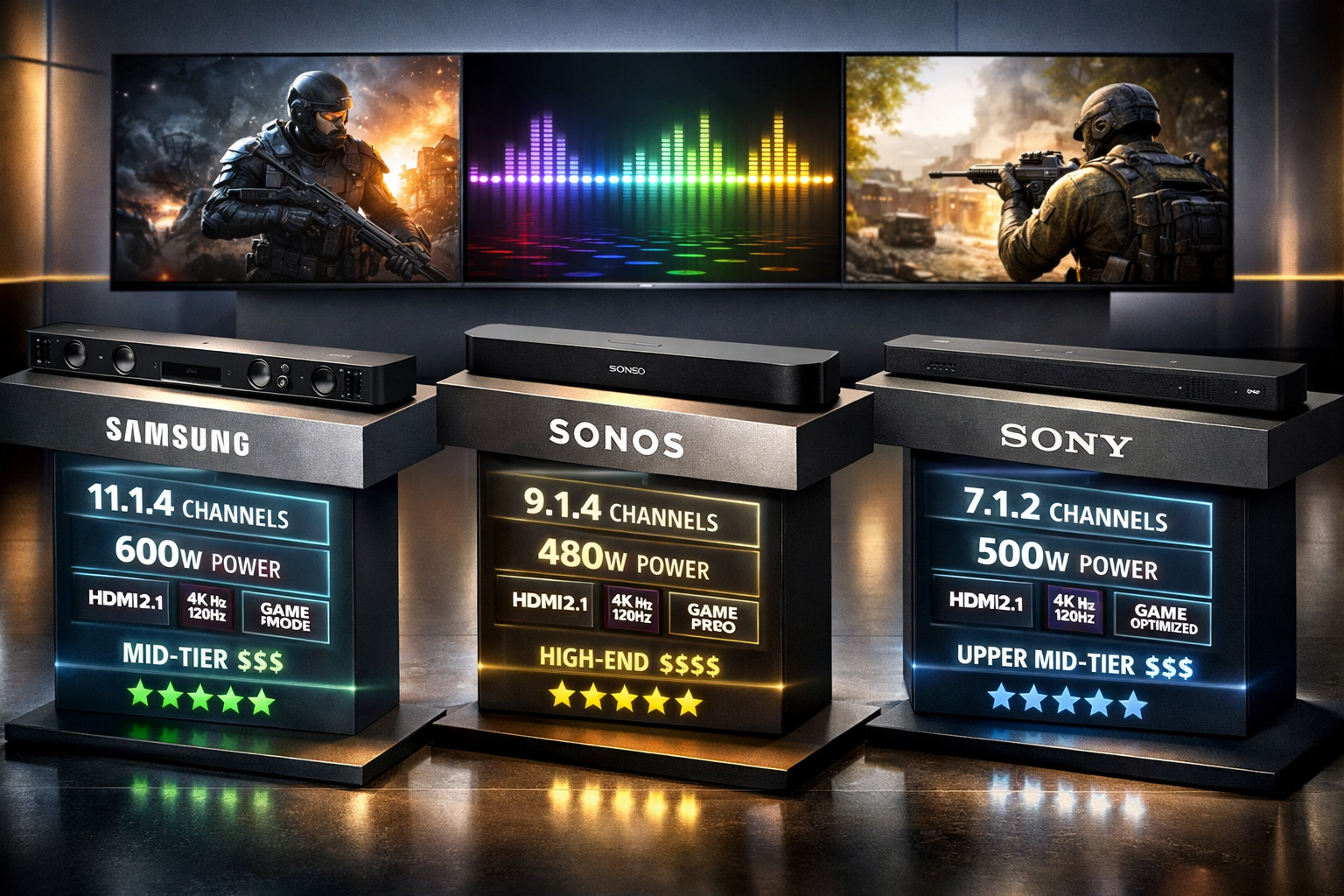
The Samsung HW-Q990F and Sony BRAVIA Theater systems both excel with gaming, offering sub-20ms latency in game mode while maintaining Atmos processing. This combination delivers immersive audio without compromising competitive performance.
Gamers should also explore our best wireless soundbars for gaming for additional recommendations.
CES 2026 Innovations and Future Technologies
CES 2026 unveiled emerging technologies including the LG Sound Suite H7 soundbar and announcements of Dolby Atmos FlexConnect and Audio by Bang & Olufsen integration [6]. These innovations signal industry movement toward more flexible audio formats and brand partnerships [6].
Dolby Atmos FlexConnect: Flexible Speaker Placement
Dolby Atmos FlexConnect represents a breakthrough technology allowing:
- Non-traditional speaker placement without compromising spatial audio accuracy
- Automatic calibration that adapts to unusual room configurations
- Mixed speaker systems combining different brands and types
- Wireless connectivity reducing installation complexity
This technology addresses the primary limitation of traditional Atmos systems: the requirement for specific speaker positioning. FlexConnect uses advanced DSP processing to compensate for placement compromises, making immersive audio accessible in challenging spaces.
Mobile App Control and AI Optimization
Mobile app control has become standard in premium soundbars, allowing users to:
- Customize EQ settings with granular frequency adjustments
- Create room profiles for different listening positions
- Update firmware automatically for new features and improvements
- Access streaming services directly through the soundbar interface
AI-powered room optimization increasingly replaces manual calibration. Systems analyze room acoustics using built-in microphones, then automatically adjust timing, levels, and EQ for optimal performance at the primary listening position.
For those interested in premium comparisons, our Sonos Arc Ultra vs LG Flex Connect H7 comparison examines these cutting-edge technologies in detail.
Setup Tips for Maximum Immersive Audio Performance
Optimal Soundbar Placement
Achieving the best 3D audio requires attention to placement:
Soundbar positioning:
- Center the soundbar directly below or above the TV
- Ensure upward-firing drivers have clear ceiling access (no obstructions)
- Maintain 6-12 inches of clearance on sides for beam-forming speakers
- Wall mounting often improves performance by reducing surface reflections
Subwoofer placement:
- Corner placement maximizes bass output but may cause boominess
- Front wall placement (offset from center) balances output and control
- Experiment with the “subwoofer crawl” technique for optimal positioning
Our best subwoofer placement guide provides detailed room-specific recommendations.
Calibration and Room Correction
Most premium soundbars include automatic calibration:
- Place the calibration microphone at the primary listening position (ear height when seated)
- Minimize room noise during the calibration process
- Run calibration multiple times if the first attempt produces unsatisfactory results
- Fine-tune manually after automatic calibration if certain frequencies sound off
Systems with Trueplay (Sonos), 360 Spatial Sound Mapping (Sony), or SpaceFit Sound+ (Samsung) deliver the most sophisticated room correction.
Connectivity Best Practices
For optimal performance:
- Use HDMI eARC/ARC as the primary connection method for lossless audio
- Enable CEC control for unified remote operation
- Update TV firmware to ensure compatibility with latest audio formats
- Disable TV speakers to prevent phase cancellation and echo effects
If experiencing connection issues, consult our soundbar TV connection troubleshooting guide.
Choosing the Right System for Your Needs
Decision Framework: Questions to Ask
Before purchasing, consider:
Content sources:
- Do you primarily stream or watch physical media?
- Which streaming services do you use most frequently?
- Do you have a 4K Blu-ray collection with DTS:X soundtracks?
Room characteristics:
- What’s your room size and ceiling height?
- Can you accommodate rear speakers if needed?
- Is your ceiling flat and reflective?
Budget allocation:
- What’s your total budget including potential subwoofer additions?
- Are you willing to start with a soundbar and add components later?
- Do you value premium build quality and brand ecosystem integration?
Use cases:
- Is movie watching, music listening, or gaming your priority?
- Do multiple family members use the system with different preferences?
- Do you need voice assistant integration or multi-room audio?
Upgrade Path Considerations
Many manufacturers offer modular systems allowing gradual upgrades:
Sonos ecosystem:
- Start with Arc Ultra or Beam Gen 2
- Add Sub Mini or Sub Gen 3 for enhanced bass
- Include Era 300 speakers as surrounds for full 5.1.2 setup
Samsung ecosystem:
- Begin with standalone soundbar like HW-Q990F
- Samsung soundbars often include wireless subwoofers
- Add Samsung rear speaker kits for expanded configurations
Sony ecosystem:
- Start with HT-A5000 or HT-A7000 soundbar
- Add SA-RS5 or SA-RS3S wireless rear speakers
- Include SA-SW5 or SA-SW3 wireless subwoofer
This modular approach spreads costs while allowing experimentation with configurations. Our Discover the Best Dolby Atmos Soundbars comparison guide helps identify which ecosystem best suits your needs.
Conclusion: Achieving True 3D Audio in 2026
The Dolby Atmos and DTS:X soundbars have reached remarkable maturity.
Premium systems like the Samsung HW-Q990F with 11.1.4 configurations now rival traditional multi-speaker installations, delivering convincing height effects and spatial accuracy without ceiling-mounted speakers [1].
Meanwhile, compact options like the Sonos Beam Gen 2 prove that even smaller soundbars can create impressive immersive experiences in appropriately sized rooms [4].
The expansion of DTS:X streaming support through Disney+ and other platforms [3] combined with universal HDMI 2.1 adoption means 2026 soundbars offer unprecedented content compatibility and gaming performance.
Whether prioritizing movie immersion, music fidelity, or competitive gaming, modern soundbars deliver specialized performance previously requiring dedicated home theater installations.
Next Steps for Buyers
For immediate purchase:
- Identify your primary use case (movies, music, gaming) and room size
- Review our complete soundbar selection guide for personalized recommendations
- Consider starting with a quality soundbar and adding subwoofer/surrounds later
- Take advantage of in-home trial periods to test performance in your actual space
For future planning:
- Monitor CES announcements for emerging technologies like Dolby Atmos FlexConnect [6]
- Watch for firmware updates that add new features to existing hardware
- Consider ecosystem compatibility if you plan multi-room audio expansion
- Budget for room acoustic treatments if your space has challenging characteristics
The journey to cinematic home audio no longer requires complex installations or professional calibration. Modern Dolby Atmos and DTS:X soundbars deliver genuine 3D immersion through elegant, user-friendly designs that transform any living room into an immersive entertainment space. 🎬🎮🎵
References
[1] Dolby Atmos – https://www.rtings.com/soundbar/reviews/best/by-type/dolby-atmos
[2] Best Dolby Atmos Soundbars The Best Atmos Tv Speakers – https://www.whathifi.com/best-buys/best-dolby-atmos-soundbars-the-best-atmos-tv-speakers
[3] Best Dolby Atmos Soundbar – https://www.businessinsider.com/guides/tech/best-dolby-atmos-soundbar
[4] Watch – https://www.youtube.com/watch?v=iFP4icZmiGE
[5] Watch – https://www.youtube.com/watch?v=ycG2ndO3e-s
[6] The Best Soundbars Of Ces 2026 Dolby Atmos Flexconnect Audio By Bang And Olufsen And Icelandic Volcanoes – https://www.techradar.com/televisions/soundbars/the-best-soundbars-of-ces-2026-dolby-atmos-flexconnect-audio-by-bang-and-olufsen-and-icelandic-volcanoes