How to Calibrate a Soundbar
Latest Update: April 16, 2026
If you want to get the most out of your Dolby Atmos soundbar, knowing How to Calibrate a Soundbar for Dolby Atmos in Small Rooms is the single most important skill you can develop.
According to Focal’s Dolby Atmos installation guidelines, the minimum recommended room volume for Dolby Atmos is 50 cubic meters, which means many small living rooms and bedrooms sit right at or below that threshold, making proper calibration not just helpful but absolutely necessary for a convincing overhead sound experience.
Key Takeaways
| Question | Answer |
|---|---|
| What does calibrating a soundbar for Dolby Atmos mean? | It means adjusting EQ, speaker levels, and delay so that the soundbar’s height and surround channels work correctly in your specific room dimensions. |
| Is Dolby Atmos worth it in a small room? | Yes, but calibration is critical. Without it, reflections and standing waves in tight spaces muddy the height effects that make Atmos impressive. |
| Which soundbar features help most with small room calibration? | AI room calibration tools (like LG’s AI Room Calibration Pro or Samsung’s SpaceFit Sound) automatically measure your room and adjust output, making them ideal for tight spaces. |
| What is the best soundbar for Dolby Atmos in small rooms? | The LG SC9S soundbar (3.1.3-channel, $560.59) is our top pick for small rooms due to its compact build and AI Room Calibration Pro. |
| Do I need professional equipment to calibrate? | No. Modern soundbars with built-in room measurement do the heavy lifting. A smartphone SPL meter app and basic placement adjustments complete the process. |
| What three things does Dolby say must be calibrated for Atmos? | EQ (frequency balance), channel levels (volume matching), and delay (timing between channels) are the three mandatory calibration steps per Dolby’s own guidelines. |
| Where can I compare the best Dolby Atmos soundbars? | Our Dolby Atmos Soundbar Showdown breaks down the top performers side by side with room-specific guidance. |
Why Small Rooms Make Dolby Atmos Calibration Different
A small room is acoustically aggressive. Hard, parallel walls create early reflections and standing waves that arrive at your ears fractions of a second after the direct sound, smearing the precise height cues that Dolby Atmos relies on.
In a large room, those reflections decay before they cause confusion. In a small room, they stack on top of each other, which is why a soundbar that sounds spectacular in a showroom can sound hollow or congested in your apartment.
The physics change everything. Your listening position in a small room is typically much closer to the rear and side walls, which increases low-frequency buildup and makes the up-firing drivers in your soundbar work against reflected ceiling energy instead of with it.
This is not a reason to give up on Dolby Atmos. It is a reason to calibrate properly. A well-calibrated soundbar in a small room will consistently outperform an uncalibrated one in a larger space.
How to Calibrate Your Soundbar for Dolby Atmos in Small Rooms: Step-by-Step
The process to calibrate soundbar for Dolby Atmos in small rooms breaks down into three clear phases: physical placement, automatic room measurement, and manual fine-tuning. Work through them in order and you will notice a significant difference.
Step 1: Optimize Physical Placement Before Anything Else
Place the soundbar centered directly below or above your TV, flush with the front of your furniture. Do not recess it into a cabinet or push it behind the TV screen, as this blocks the up-firing drivers and kills height effects immediately.
Keep at least 6 to 8 inches of clearance above the soundbar so up-firing drivers can project sound toward the ceiling without obstruction. In a small room, this single step has more impact than any EQ adjustment.
- Avoid corners: Corner placement exaggerates bass and muddies the soundstage.
- Center your seating: Sit equidistant from both sides of the soundbar where possible.
- Ceiling height matters: Flat ceilings between 8 and 10 feet give up-firing channels the best reflective surface.
- No objects between soundbar and ceiling: Floating shelves or ceiling fans directly above the soundbar break the reflection path.
Step 2: Run the Built-In Auto-Calibration Tool
Every modern Dolby Atmos soundbar worth buying includes an automatic room calibration system. This is the single most effective calibration step available to you, and skipping it is the most common mistake we see.
Follow your soundbar’s instructions to run the measurement cycle. Most systems ask you to place a microphone (or hold your phone) at your primary listening position, then play a series of test tones.
The system measures frequency response, level matching, and acoustic delay, then automatically corrects for your room’s specific characteristics.
Step 3: Manually Adjust EQ, Levels, and Delay
After auto-calibration, review three settings manually in your soundbar’s app or menu.
- EQ: In a small room, the 80 to 150 Hz range often builds up excessively. Pull this range back by 2 to 3 dB if dialogue sounds boomy or indistinct.
- Height channel level: If overhead effects feel too subtle, raise the height channel level by 1 to 2 dB. If they feel harsh or artificial, lower by the same amount.
- Subwoofer level: Small rooms amplify bass. Start with the subwoofer 3 to 4 dB below the soundbar’s default and work upward until bass feels tight, not overwhelming.

A quick, visual guide to calibrating a Dolby Atmos soundbar in tight spaces. Learn the three essential steps to improve surround effects in small rooms.
Best Soundbar Models with Built-In Calibration for Small Rooms
Choosing the right soundbar is just as important as knowing how to calibrate it. We specifically look for models with built-in room measurement tools, compact form factors, and up-firing channel configurations that work within small room geometry.
Best for Small Rooms Overall: LG SC9S Soundbar (from $560.59)
The LG SC9S is our top recommendation for small rooms. Its 3.1.3-channel layout uses triple up-firing drivers, including a dedicated up-firing center channel that ensures dialogue stays anchored even when height effects are active.
AI Room Calibration Pro automatically analyzes the acoustic signature of your specific room and adjusts the output to compensate. In a small room, this is the closest thing to professional acoustic treatment that money can buy at this price point.
- Channels: 3.1.3
- Price: from $560.59
- Best for: Bedrooms, small apartments, compact living rooms
- Calibration tool: AI Room Calibration Pro
Best Flagship with Auto-Calibration: LG S95TR Soundbar ($1,599.99)
The LG S95TR is a 9.1.5-channel system with 17 individual speaker drivers and 810 watts of total power. While it is designed for medium-to-large rooms primarily, its AI Room Calibration feature can tame the output for tighter spaces more effectively than most competitors.
It is the safest bet for buyers who want a single soundbar that will scale if they ever move to a larger room, without sacrificing performance in a smaller one right now.
Best Samsung Option with SpaceFit Sound: Samsung HW-Q990F ($1,697.99)
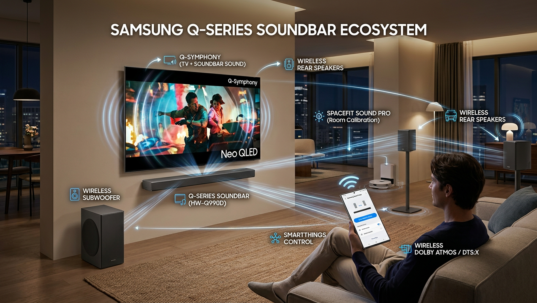
Samsung’s SpaceFit Sound Pro is one of the most sophisticated auto-calibration systems on the market in 2026.
It actively listens to your room and adjusts its 11.1.4-channel output in real time based on what the microphones detect, making it a strong option if your small room has unusual dimensions or acoustic challenges.
The HW-Q990F pairs this with Q-Symphony, which merges the soundbar’s output with your Samsung TV’s built-in speakers for a wider, more enveloping soundstage even in rooms where space limits speaker spread.
How to Use Auto-Calibration Tools Correctly When You Calibrate Soundbar for Dolby Atmos in Small Rooms
Running auto-calibration incorrectly is surprisingly common, and it produces results that are worse than no calibration at all. Here is the right approach for small rooms specifically.
Where to Hold the Microphone
Always position the measurement microphone or your phone at your actual listening position, at ear height when seated. Do not hold it at standing height or at the TV position. In a small room, the reflection behavior at your seated ear level is dramatically different from anywhere else in the room.
Silence During Measurement
Any background noise during a measurement sweep corrupts the results. Turn off fans, air conditioning, and any appliances that hum. In a small room, even refrigerator vibration traveling through walls can interfere with the low-frequency sweep.
Repeat the Measurement After Rearranging Furniture
Adding a rug, moving a couch, or hanging curtains all change your room’s acoustic profile. Re-run auto-calibration any time you make significant changes to your room’s layout or soft furnishings.
Treating Your Small Room to Support Dolby Atmos Calibration
No soundbar calibration process works optimally in a completely bare room. Small acoustic treatments cost very little and multiply the effectiveness of any calibration you do.
- Add a rug: A large area rug under your seating area absorbs floor reflections that muddy bass response and smear surround imaging.
- Use curtains or drapes: Heavy drapes on windows reduce flutter echo, which is especially pronounced in small rectangular rooms.
- Bookshelves with varied-size items: Irregular surfaces diffuse sound energy rather than reflecting it as a coherent wave back at you.
- Sofa placement: Avoid placing your sofa flush against the rear wall. Pulling it forward even 12 inches reduces the bass buildup that accumulates at room boundaries.
- Ceiling angle or texture: A textured or angled ceiling scatters the up-firing reflection, which reduces hotspots and makes overhead effects sound more diffuse and natural.
Common Calibration Mistakes When Setting Up Dolby Atmos in a Small Room
We consistently see the same errors when people try to calibrate soundbar for Dolby Atmos in small rooms. Avoiding these gets you 80% of the way to great sound before you even touch an EQ slider.
| Mistake | Why It Hurts | The Fix |
|---|---|---|
| Skipping auto-calibration | Room modes and reflections go uncorrected | Always run the built-in measurement tool first |
| Subwoofer too loud | Bass builds up in corners, masking all other effects | Start -3 to -4 dB below default, adjust up slowly |
| Soundbar recessed in furniture | Up-firing drivers are blocked, height effects disappear | Ensure 6+ inches of clear space above the soundbar |
| Using “Movie” preset instead of Dolby Atmos mode | Adds artificial processing that conflicts with Atmos metadata | Set the soundbar to pass-through or native Atmos mode |
| Calibrating with the TV volume up | TV speakers interfere with the measurement sweep | Mute the TV’s internal speakers during calibration |
| Wrong eARC/HDMI settings | Atmos metadata is stripped before it reaches the soundbar | Connect via HDMI eARC and enable Dolby Atmos passthrough in TV settings |
Choosing the Best Soundbar for Dolby Atmos in Small Rooms: What to Look For
Not every Dolby Atmos soundbar is equally suited to small rooms. When we curate our recommendations, we filter specifically for models that include built-in room measurement, compact or scalable form factors, and channel configurations that use up-firing drivers effectively at close listening distances.
Our core criteria for the best soundbar for small-room Dolby Atmos performance in 2026 are:
- Built-in auto-calibration: Non-negotiable. AI Room Calibration (LG) or SpaceFit Sound (Samsung) are the current best-in-class options.
- Up-firing driver quality: More dedicated up-firing channels equal more convincing height in tight spaces where virtualization alone falls short.
- eARC connectivity: Ensures full Dolby Atmos bitstream passes from your TV without degradation or downmixing.
- App-based manual EQ: Fine-tuning after auto-calibration requires granular EQ control from a companion app.
- Dialogue enhancement mode: Small rooms often compress the soundstage; a dedicated clear voice or dialogue mode keeps speech intelligible during loud scenes.
For a broader comparison of how today’s top Atmos bars perform across room types, our best soundbar for Dolby Atmos guide breaks down the full market with specific room-size guidance attached to every recommendation.
Samsung HW-Q990H: A Flagship Option for Small Room Calibration
The Samsung HW-Q990H is Samsung’s 2026 flagship 11.1.4 Dolby Atmos system. Its Adaptive Sound mode analyzes incoming content in real time and adjusts processing to match, which is particularly useful in small rooms where the same physical space sounds different during action sequences versus quiet dialogue scenes.
SpaceFit Sound actively measures and corrects for your room’s signature on an ongoing basis rather than as a one-time setup step. For small rooms with irregular shapes or hard surfaces, this continuous adaptation produces noticeably more stable Atmos imaging than static calibration alone.
Wireless vs. Wired Connections: What Changes Your Calibration in a Small Room
Connection type directly affects whether your soundbar receives full Dolby Atmos data or a downmixed version. This is especially relevant in small rooms because you are already managing reduced acoustic headroom, and losing the Atmos metadata on top of that leaves very little for calibration to work with.
- HDMI eARC: The correct connection for full Dolby Atmos bitstream. Always use this if your TV and soundbar both support eARC.
- Optical cable: Cannot carry Dolby Atmos. It will downmix to Dolby Digital 5.1 at best.
- Bluetooth/Wi-Fi streaming: Most streaming protocols compress or strip Atmos metadata. Use HDMI for Atmos content, Wi-Fi streaming for music.
- ARC (standard): Older, lower-bandwidth version of eARC. It can pass Dolby Atmos in some implementations but is unreliable. Upgrade to eARC where possible.
For a deeper look at how wireless soundbar technology has matured and when it is genuinely competitive with wired setups, our wireless soundbars vs traditional systems comparison walks through the current state of the technology in 2026.
Conclusion
Knowing How to Calibrate a Soundbar for Dolby Atmos in Small Rooms is what separates a genuinely immersive home cinema experience from one that sounds flat and congested.
The process comes down to three fundamentals: getting physical placement right before you measure, running built-in auto-calibration tools correctly at your actual listening position, and making targeted manual adjustments to EQ, level, and subwoofer output based on what your specific room adds to the sound.
The best soundbar for this job in 2026 is one with a sophisticated built-in room measurement system.
The LG SC9S leads for small rooms at a mid-range price point, while the Samsung HW-Q990F and HW-Q990H offer continuous adaptive calibration for those who want flagship-level precision.
Any of these soundbars, properly calibrated using the steps in this guide, will deliver convincing Dolby Atmos height effects even in rooms that technically sit right at the minimum acoustic threshold for the format.
For a complete breakdown of which Atmos soundbar fits your exact situation, including room size, TV brand compatibility, and budget, visit our dedicated guide on enhancing small spaces with Dolby Atmos.
Frequently Asked Questions
Can you really get good Dolby Atmos in a small room?
Yes, but you need to calibrate soundbar for Dolby Atmos in small rooms carefully. With proper placement, auto-calibration, and minor EQ adjustments, small rooms can deliver convincing height effects, though the experience differs from a large dedicated home theater.
What is the minimum room size for Dolby Atmos to work properly?
Focal’s Dolby Atmos installation guidelines cite 50 cubic meters as the minimum recommended room volume. If your room is below that threshold, expectation management and thorough calibration are both essential.
How do I stop Dolby Atmos height effects from sounding fake or hollow in a small room?
The most common cause is up-firing drivers being blocked by furniture or a low ceiling. Ensure clear vertical space above the soundbar and re-run auto-calibration. Also confirm that your HDMI connection is eARC and that Dolby Atmos passthrough is enabled in your TV audio settings.
Is the LG SC9S a good soundbar for Dolby Atmos in a small bedroom?
The LG SC9S is our top recommendation for small bedrooms. Its 3.1.3-channel configuration and AI Room Calibration Pro are purpose-built for compact spaces, and the price point at $560.59 makes it the best value Atmos soundbar for tight rooms in 2026.
Do I need to re-calibrate my soundbar if I rearrange my furniture?
Yes. Any significant change to your room’s layout, including adding rugs, moving sofas, or hanging curtains, changes the acoustic profile that your auto-calibration measured. Re-run the calibration process after each meaningful room change for accurate results.
Does Dolby Atmos work through Bluetooth in a small room?
Standard Bluetooth does not carry Dolby Atmos metadata. For full Atmos performance in any room size, connect your soundbar via HDMI eARC and enable Dolby Atmos passthrough in both your TV and soundbar settings.
What SPL level should I calibrate my soundbar to in a small room?
For a small bedroom-sized room, targeting 76 to 82 dB SPL at the listening position with pink noise aligns with both Dolby’s calibration guidance and acoustic best practices. The cinema reference of 85 dB SPL is too loud for small residential rooms and amplifies the acoustic problems that careful calibration is trying to solve.