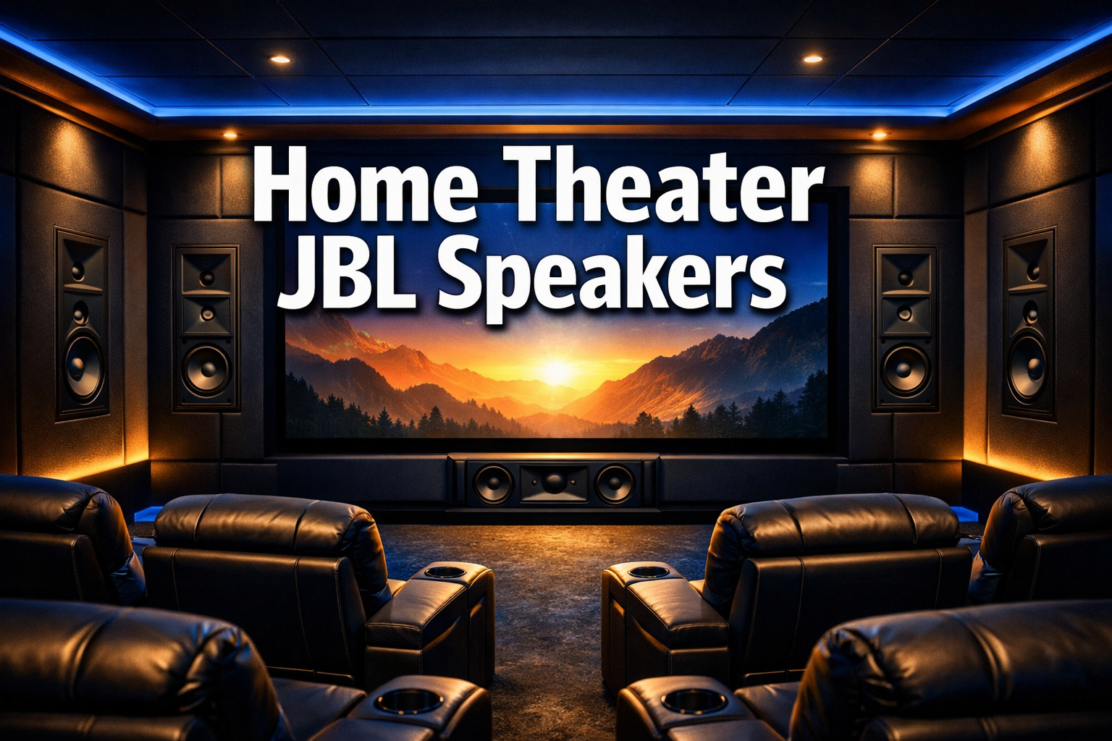
Home Theater JBL Speakers
Last updated: April 19, 2026
Quick Answer: Home theater JBL speakers deliver professional cinema-grade sound through a lineup that spans in-wall architectural models, powered subwoofers, and full AV processing systems.
In 2026, JBL Synthesis launched nine new speaker models and three next-generation AV processors at ISE 2026, making this the most significant product expansion the brand has seen in years.
Whether you’re building a dedicated screening room or upgrading an existing setup, JBL offers scalable options from entry-level configurations to full reference-level installations.
Key Takeaways
- JBL Synthesis unveiled 9 new speakers and 3 AV processors at ISE 2026 in February, with availability expected summer 2026 [1]
- The flagship SCL-2XL uses quadruple 8-inch woofers with a compression driver for reference-level LCR performance in large theaters [1]
- The new SDR-40 AV receiver offers 16-channel processing with nine channels of Class G amplification [1]
- All new JBL processors support Dolby Atmos, DTS:X Pro, IMAX Enhanced, and AURO-3D immersive formats [1]
- The 2026 lineup is designed to scale from small rooms to large dedicated cinemas, addressing more real-world scenarios than previous generations [2]
- Room acoustics and speaker placement are as important as the speakers themselves, even the best JBL system underperforms in an untreated room
- JBL’s HDI horn geometry provides wide, consistent coverage across multiple seating positions, a key advantage over conventional cone tweeters
- Budget-conscious buyers should consider the consumer-facing JBL Bar series before committing to the Synthesis professional line
For those ready to take the next step toward a home cinema sound—> Explore JBL Home Theater options on Amazon
What Makes Home Theater JBL Speakers Different From Standard Speakers?
Home Theater JBL Speakers are engineered to reproduce the full dynamic range of film soundtracks — not just music playback. The core difference comes down to transducer design, horn geometry, and system integration.
Standard consumer speakers are typically designed for stereo listening at moderate volumes. JBL’s Synthesis line, by contrast, uses compression drivers paired with precision HDI (High-Definition Imaging) horn geometry that controls sound dispersion across wide listening areas.
This matters in a home theater because multiple seats need consistent coverage, not just a sweet spot in the center [1][2].
Key technical differentiators:
- Compression drivers handle high frequencies more efficiently than dome tweeters, reducing distortion at high output levels
- HDI horn geometry shapes the sound wave so every seat in the room receives similar frequency response
- In-wall architectural design allows speakers to integrate invisibly while maintaining reference-level output
- Powered subwoofer integration (like the new SSW-5 with 1,000-watt amplification) delivers low-frequency extension that consumer soundbars cannot match [1]
Choose JBL Synthesis if you’re building a dedicated room with a custom integrator. Choose the JBL Bar series if you want a significant upgrade over your TV’s built-in audio without a full installation.
What Are the New JBL Synthesis Models Launched in 2026?
At ISE 2026 in February, HARMAN’s JBL Synthesis division launched nine new speaker models and three AV processors, described by industry observers as the brand’s “most comprehensive product evolution in years” [1][2].
Here’s a breakdown of the key new models:
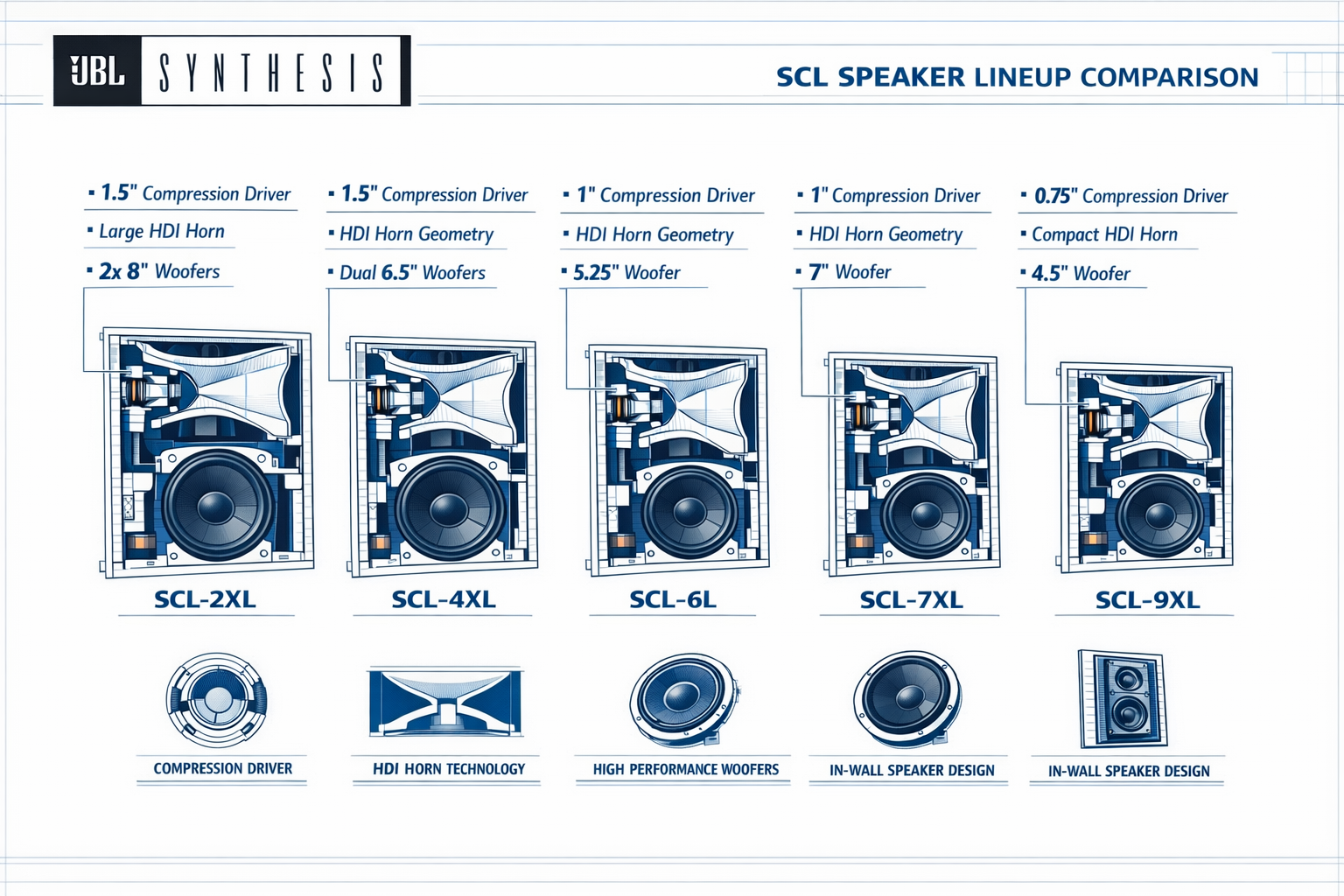
| Model | Configuration | Best For |
|---|---|---|
| SCL-2XL | Quad 8″ woofers + compression driver | Large/XL theaters, flagship LCR |
| SCL-4XL | Dual 8″ woofers + compression driver | Wide multi-seat coverage, LCR |
| SCL-6L | Quad 6.5″ woofers | Mid-size rooms, LCR duty |
| SCL-7XL | Dual 6.5″ + offset HDI horn | Surround and center-channel |
| SCL-9XL | Quad 5.25″ woofers | Large flat-panel display setups |
| SSW-5 | 12″ powered, 1,000W | Deep bass integration |
The SCL-2XL replaces the previous SCL-2 as the top in-wall model. Its quadruple 8-inch woofer array with a high-frequency compression driver is engineered specifically for reference-level LCR (Left, Center, Right) duty in large and extra-large theater spaces [1].
The SCL-4XL is the more accessible core model, using dual 8-inch woofers optimized for consistent coverage across multiple seating rows, a critical requirement in rooms wider than 14 feet [2].
New AV processing options include:
- SDR-40: 16-channel processing, nine channels of Class G amplification — the all-in-one solution for streamlined deployment [1]
- Full support for Dolby Atmos, DTS:X Pro, IMAX Enhanced, and AURO-3D [1]
Shipping is expected summer 2026, though no specific date has been confirmed as of April 2026 [3].
How Do You Set Up Home Theater JBL Speakers for Best Performance?
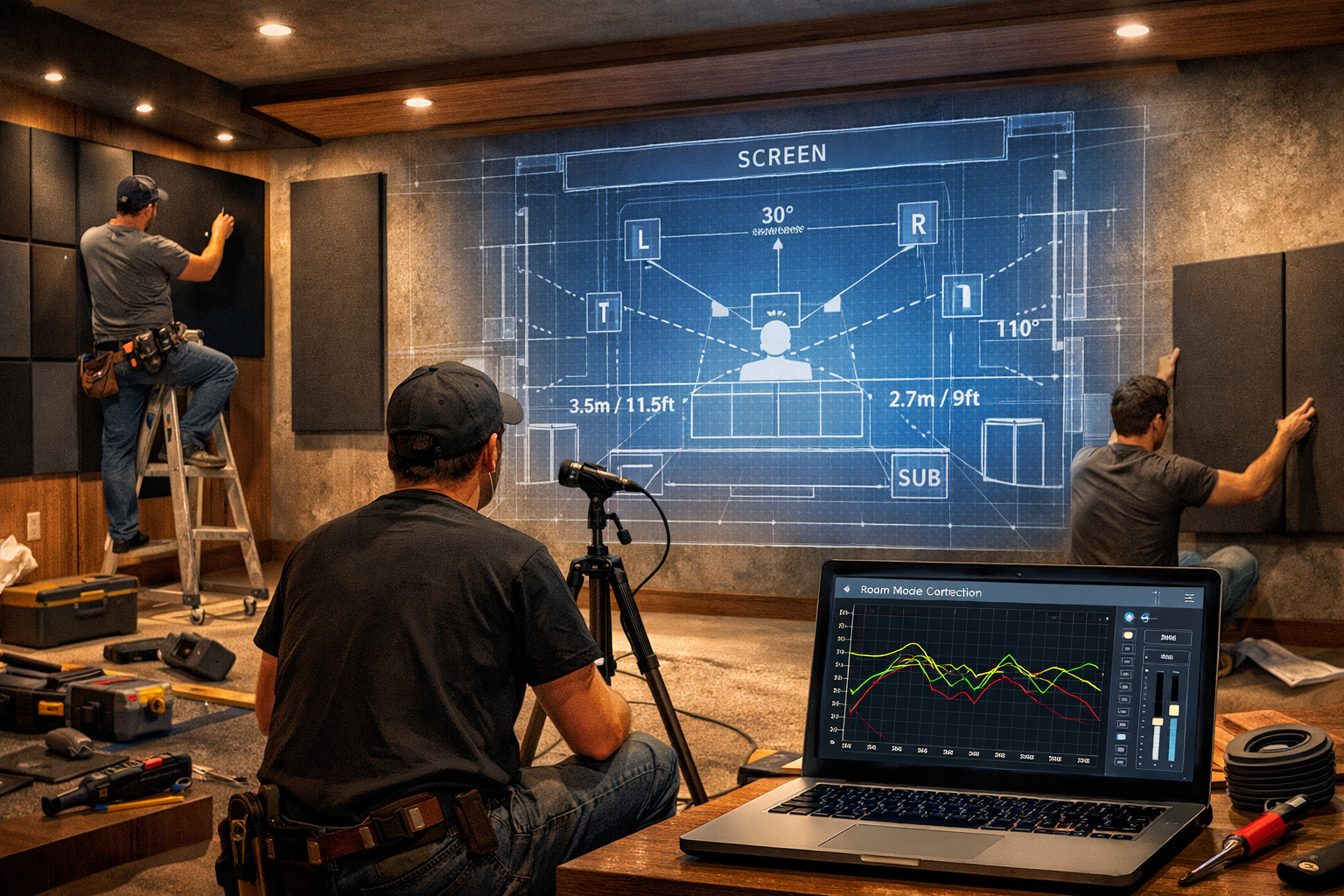
Proper setup is where most home theater installations succeed or fail. Even reference-quality JBL speakers will sound mediocre in an acoustically untreated room with poor placement.
For those ready to take the next step toward a home cinema sound—> Explore JBL Home Theater options on Amazon
Step-by-Step Setup Guide
1. Plan your speaker layout first
Before purchasing, map your room dimensions and seating positions. JBL’s Synthesis lineup is designed around specific room sizes:
- Small rooms (under 200 sq ft): SCL-9XL or consumer Bar series
- Mid-size rooms (200–400 sq ft): SCL-6L or SCL-7XL
- Large dedicated theaters (400+ sq ft): SCL-2XL or SCL-4XL [1][2]
2. Address room acoustics before calibration
Room modes, resonant frequencies caused by parallel walls, are the single biggest enemy of accurate bass reproduction.
What is room mode correction? Room mode correction is the process of identifying and reducing frequency peaks and nulls caused by standing waves in a room, using either acoustic treatment (bass traps, diffusers) or digital signal processing (DSP) built into the AV processor.
Basic acoustic treatment checklist:
- Bass traps in corners (floor-to-ceiling)
- Absorption panels at first reflection points (side walls, ceiling)
- Diffusion panels on the rear wall
- Thick area rug on hard floors
3. Use the built-in calibration system
JBL’s new SDR-40 processor includes advanced DSP calibration. Run the auto-calibration routine with a measurement microphone placed at your primary listening position. This corrects for:
- Speaker distance and level differences
- Room frequency response anomalies
- Time alignment between channels
4. Fine-tune manually after auto-calibration
Auto-calibration is a starting point, not a final answer. After running it, listen critically and adjust:
- Crossover frequency between main speakers and subwoofer (typically 80Hz for in-wall speakers)
- Subwoofer phase alignment
- Individual channel levels by ear
Common mistake: Placing the subwoofer in a corner for “more bass.” Corner placement amplifies room modes and creates boomy, inaccurate low frequencies.
For optimal subwoofer placement, start with the subwoofer at your listening position, play a bass-heavy track, then walk around the room perimeter to find where bass sounds most even, that’s where your subwoofer belongs.
How Do Home Theater JBL Speakers Compare to Consumer Soundbars?
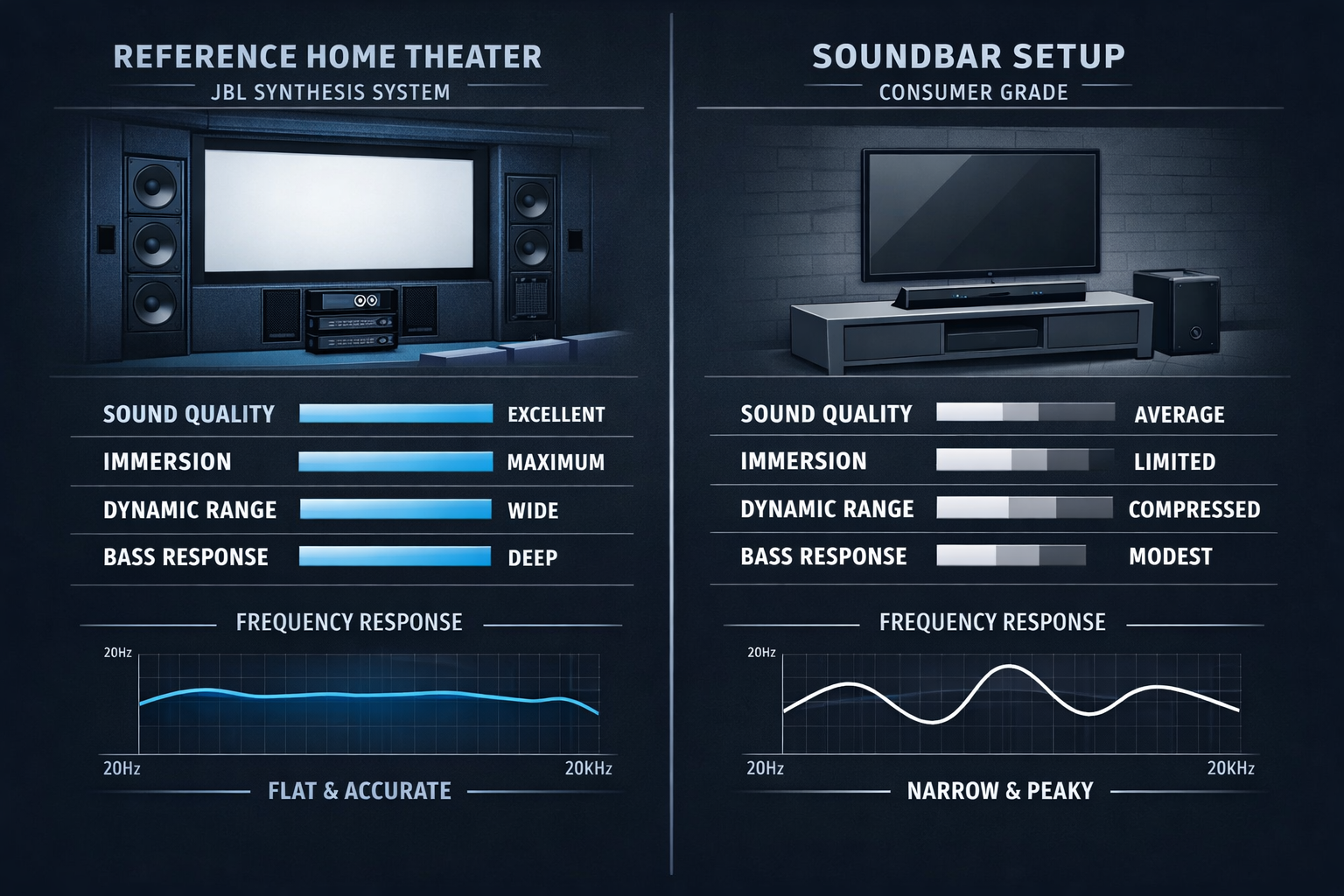
JBL makes both professional Synthesis speakers and consumer soundbar products. Understanding the difference helps you spend your budget where it actually matters.
For those ready to take the next step toward a home cinema sound—> explore JBL Home Theater options on Amazon
Professional JBL Synthesis vs. Consumer JBL Bar Series
| Factor | JBL Synthesis (SCL Series) | JBL Bar Series |
|---|---|---|
| Price range | $2,000–$15,000+ per speaker | $200–$1,500 complete system |
| Installation | Requires custom integrator | Self-install, plug-and-play |
| Sound output | Reference cinema level | Good for typical living rooms |
| Room coverage | Multi-seat, wide dispersion | Optimized for single sweet spot |
| Immersive audio | Full Atmos/DTS:X Pro/AURO-3D | Dolby Atmos (virtual or physical) |
| Scalability | Highly scalable, modular | Fixed configuration |
| Longevity | 15–20+ years with maintenance | 5–10 years typical |
Choose JBL Synthesis if: You’re building a dedicated home theater, working with a custom integrator, and want performance that genuinely matches commercial cinema standards.
Choose JBL Bar series if: You want a significant upgrade over TV speakers without construction work, and your budget is under $1,500. For a detailed look at one of JBL’s top soundbar offerings, our JBL Bar 1300X review covers the performance in depth.
The cost-benefit reality: A full JBL Synthesis 7.4.4 installation with in-wall speakers, subwoofers, and a new SDR-40 processor can run $30,000–$80,000 installed. For most homeowners, the JBL Bar series or a comparable Dolby Atmos soundbar delivers 80% of the experience at 10% of the cost.
What Room Acoustics Optimization Strategies Work Best With JBL Speakers?
Room acoustics are the most overlooked factor in home theater performance. JBL’s engineering team designs their speakers to perform in acoustically treated spaces, without treatment, even the SCL-2XL will sound muddy.
How to optimize home theater speaker performance:
- Calculate your room’s modal frequencies using the formula: f = 565 / room dimension (in feet). A 20-foot room has a primary mode at roughly 28Hz — right in the subwoofer range.
- Install bass traps rated for frequencies below 100Hz in all four floor-to-ceiling corners.
- Apply first-reflection absorption at the points where sound bounces from walls to your ears before reaching you directly. Use a mirror test: sit in your listening position and have someone slide a mirror along the side wall — wherever you can see a speaker in the mirror is a first reflection point.
- Use diffusion, not just absorption on the rear wall. Pure absorption creates a “dead” room that sounds unnatural. Diffusers scatter sound energy and maintain a sense of space.
- Run DSP room correction after physical treatment is complete. JBL’s SDR-40 processor handles this digitally, but DSP cannot fully compensate for an untreated room — it’s a complement, not a replacement.
For rooms where acoustic panels aren’t practical, consider furniture placement: bookshelves filled with books, thick curtains, and upholstered seating all absorb sound and reduce flutter echo.
What Immersive Audio Formats Do JBL Home Theater Systems Support?
JBL’s 2026 processor lineup supports every major immersive audio format currently available. This matters because streaming services, Blu-ray, and gaming platforms all use different formats.
Supported formats on new JBL processors [1]:
- Dolby Atmos — the most widely available object-based audio format, used by Netflix, Disney+, Apple TV+, and most 4K Blu-rays
- DTS:X Pro — DTS’s object-based format with up to 32 channels of audio, used on select Blu-rays and streaming content
- IMAX Enhanced — a certification program combining DTS:X Pro audio with IMAX-specific content mastering
- AURO-3D — a height-layer immersive format popular in European cinema and some audiophile recordings
What this means practically: You won’t need to upgrade your processor when a streaming service adds a new audio format, the SDR-40’s 16-channel architecture provides headroom for future format expansion [1].
If you’re comparing JBL’s immersive audio support against other premium soundbar systems, our guide to the best wireless soundbars in 2026 provides a useful reference point for what consumer-grade systems can deliver.
What Are the Best JBL Speaker Placement Strategies for Home Theaters?
Speaker placement directly determines whether your system sounds like a cinema or an expensive stereo. JBL’s HDI horn geometry gives their speakers more placement flexibility than conventional designs, but basic rules still apply.
LCR (Left, Center, Right) placement:
- The center channel should be aligned with the screen center, either above or below the display
- Left and right mains should be placed at 22–30 degrees off-axis from the primary listening position
- All three LCR speakers should be at the same height — ear level when seated
Surround speaker placement:
- Side surrounds: 90–110 degrees off-axis, slightly above ear level
- Rear surrounds: 135–150 degrees off-axis
- The SCL-7XL’s offset HDI horn geometry makes it particularly effective for surround placement where standard angles aren’t achievable [1]
Height/Atmos speaker placement:
- Front heights: 45 degrees above and in front of the listening position
- Rear heights: 45 degrees above and behind
- Minimum four height channels for convincing Atmos overhead effects
Subwoofer placement: Use the subwoofer crawl method described in the setup section above. For multi-subwoofer configurations (recommended for rooms over 300 sq ft), placing two subwoofers at the front and rear of the room reduces seat-to-seat bass variation significantly. See our subwoofer placement guide for more detail.
How Do You Choose Between JBL Synthesis Models for Different Room Sizes?
The right JBL Synthesis model depends on your room volume, seating configuration, and budget — not just personal preference.
Decision guide:
- Under 200 sq ft / single row of seating: SCL-9XL with SSW-5 subwoofer. The quad 5.25-inch configuration delivers strong output without over-engineering a small space [1].
- 200–350 sq ft / two rows of seating: SCL-6L or SCL-7XL for LCR, SCL-9XL for surrounds. The SCL-7XL’s offset horn geometry handles the wider coverage needed for two-row installations [1].
- 350–600 sq ft / dedicated theater: SCL-4XL for LCR, SCL-7XL for surrounds, SSW-5 for bass. The dual 8-inch SCL-4XL provides consistent output across multiple seating rows [2].
- 600+ sq ft / large dedicated cinema: SCL-2XL for LCR, SCL-4XL for surrounds, multiple SSW-5 subwoofers. The flagship quad 8-inch configuration is engineered specifically for this scale [1].
Edge case: If your room has unusual geometry, vaulted ceilings, open floor plans, or non-parallel walls — work with a certified JBL Synthesis integrator before selecting models. Unusual room geometry changes the acoustic calculations significantly.
For buyers who want professional-quality sound without a full Synthesis installation, comparing options like the Sonos Arc Ultra or Sony HT-A5000 can help establish a performance baseline before committing to a larger investment.
For those ready to take the next step toward a home cinema sound—> explore JBL Home Theater options on Amazon
Frequently Asked Questions About Home Theater JBL Speakers
Q: Are JBL Synthesis speakers worth the price for a home theater?
A: Yes, for dedicated rooms with controlled acoustics and professional installation. For living room setups, a high-quality soundbar system delivers better value.
Q: When will the new 2026 JBL Synthesis SCL speakers be available?
A: JBL has confirmed summer 2026 availability for the new SCL lineup and processors. No specific date has been announced as of April 2026 [3].
Q: Do JBL home theater speakers require a separate amplifier?
A: The Synthesis SCL series (passive in-wall speakers) requires a separate AV processor and amplification. The new SDR-40 receiver combines both in one unit. The SSW-5 subwoofer is self-powered with its own 1,000-watt amplifier [1].
Q: What is the difference between the SCL-2XL and SCL-4XL?
A: The SCL-2XL uses four 8-inch woofers and is designed for large and extra-large theaters. The SCL-4XL uses two 8-inch woofers optimized for wide coverage across multiple seating positions in mid-to-large rooms [1][2].
Q: Can JBL Synthesis speakers be installed in a regular living room?
A: Technically yes, but the performance advantage over consumer systems is reduced without acoustic treatment and controlled room geometry. A dedicated room is strongly recommended.
Home Theater JBL Speakers: FAQs
Q: What immersive audio formats do the new JBL processors support?
A: Dolby Atmos, DTS:X Pro, IMAX Enhanced, and AURO-3D — covering all major current formats [1].
Q: How many channels does the SDR-40 processor support?
A: The SDR-40 supports 16-channel processing with nine channels of Class G amplification built in [1].
Q: Is room acoustic treatment necessary with JBL Synthesis speakers?
A: Yes. JBL’s HDI horn geometry improves coverage consistency, but acoustic treatment is essential for accurate bass response and low-frequency clarity regardless of speaker quality.
Q: How does JBL’s HDI horn geometry improve sound quality?
A: HDI (High-Definition Imaging) horn geometry controls the dispersion pattern of high-frequency sound, ensuring consistent frequency response across a wide listening area rather than a narrow sweet spot.
Q: What’s a realistic budget for a complete JBL Synthesis home theater?
A: A modest Synthesis system (5.1 configuration, smaller room) starts around $15,000–$25,000 installed. Full immersive 7.4.4 configurations in large rooms typically run $40,000–$100,000+ with professional installation.
Q: Can I mix JBL Synthesis speakers with other brands?
A: Technically possible, but not recommended. JBL designs the Synthesis ecosystem to work as an integrated system. Mixing brands introduces tonal inconsistencies that are difficult to correct with DSP alone.
Q: Where can I hear the new 2026 JBL Synthesis speakers before buying?
A: ISE 2026 attendees experienced them at HARMAN’s stand (2F150). Contact a certified JBL Synthesis dealer for a local demonstration once the summer 2026 shipping window opens [1].
Conclusion: Building Your Ideal Home Theater With JBL
Home theater JBL speakers represent a genuine professional cinema standard that has become increasingly accessible to residential installations.
The 2026 Synthesis lineup, nine new speaker models, a new 1,000-watt subwoofer, and a 16-channel AV processor, gives custom integrators and serious enthusiasts more options than ever before, with a scalable architecture that fits rooms from modest media spaces to full dedicated cinemas [1][2].
Actionable next steps:
- Define your room first. Measure your space and identify seating positions before selecting any speaker model.
- Set a realistic budget that includes acoustic treatment and professional installation — not just speaker hardware.
- Match the model to the room. Use the decision guide above to narrow your SCL model selection based on square footage and seating rows.
- Plan for immersive audio from the start. The SDR-40’s 16-channel architecture supports full Atmos/AURO-3D — don’t under-build your channel count and regret it later.
- Audition before you commit. Contact a certified JBL Synthesis dealer to arrange a demonstration once the summer 2026 models ship.
If you’re not ready for a full Synthesis installation, start with a high-performance soundbar to understand what immersive audio sounds like in your space — our guide to choosing the right soundbar is a practical starting point.
For those ready to take the next step toward reference-level home cinema sound, explore JBL Home Theater options on Amazon to compare current availability and pricing.
References
[1] At ISE 2026 JBL Synthesis Launches 9 New Speakers 3 Advanced AV Processors – https://www.strata-gee.com/at-ise-2026-jbl-synthesis-launches-9-new-speakers-3-advanced-av-processors/
[2] JBL Synthesis 2026 – https://www.ecoustics.com/products/jbl-synthesis-2026/
[3] CE Pro: HARMAN Drops Nine New JBL SCL Speakers Plus Two Processors and a Receiver – https://www.cepro.com/news/harman-drops-nine-new-jbl-scl-speakers-plus-two-processors-and-a-receiver/625013/