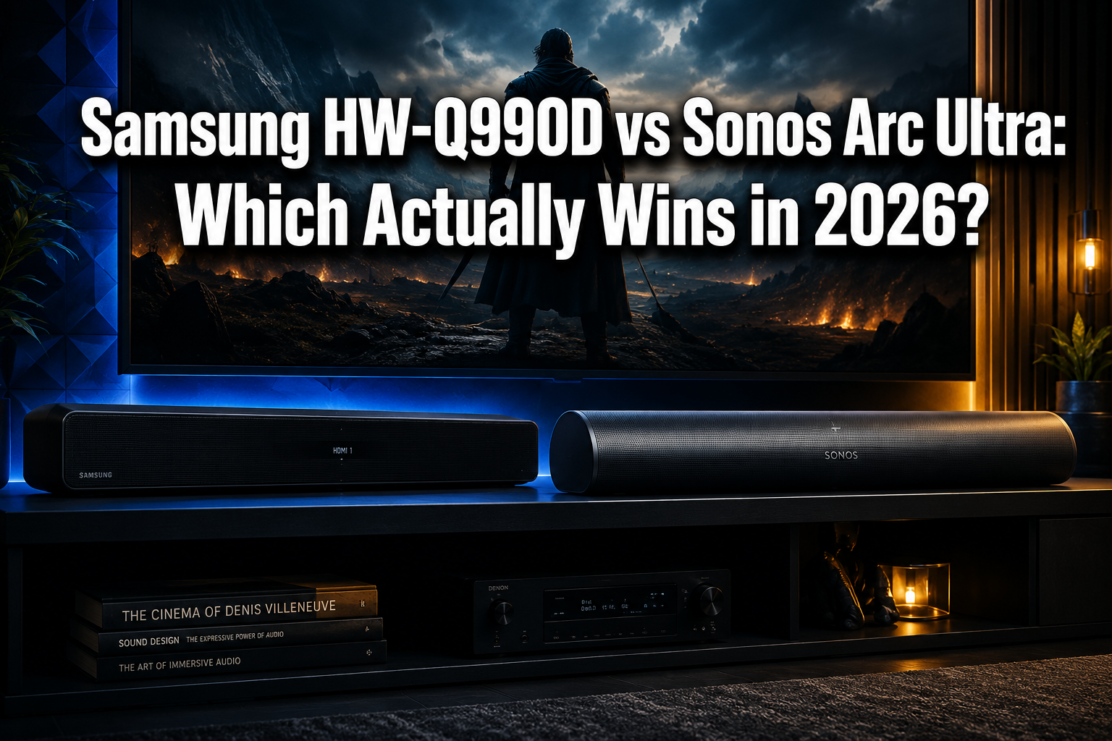
Samsung HW-Q990D vs Sonos Arc Ultra
Last updated: June 25, 2026
Quick Answer: The Samsung HW-Q990D wins for most buyers who want maximum surround immersion, better gaming connectivity, and more hardware for the money. The Sonos Arc Ultra wins if you already own Sonos products, prioritize music quality, or want a cleaner single-unit setup that grows modularly over time.
Neither is universally better, the right choice depends on your room, your habits, and what you already own.
Key Takeaways
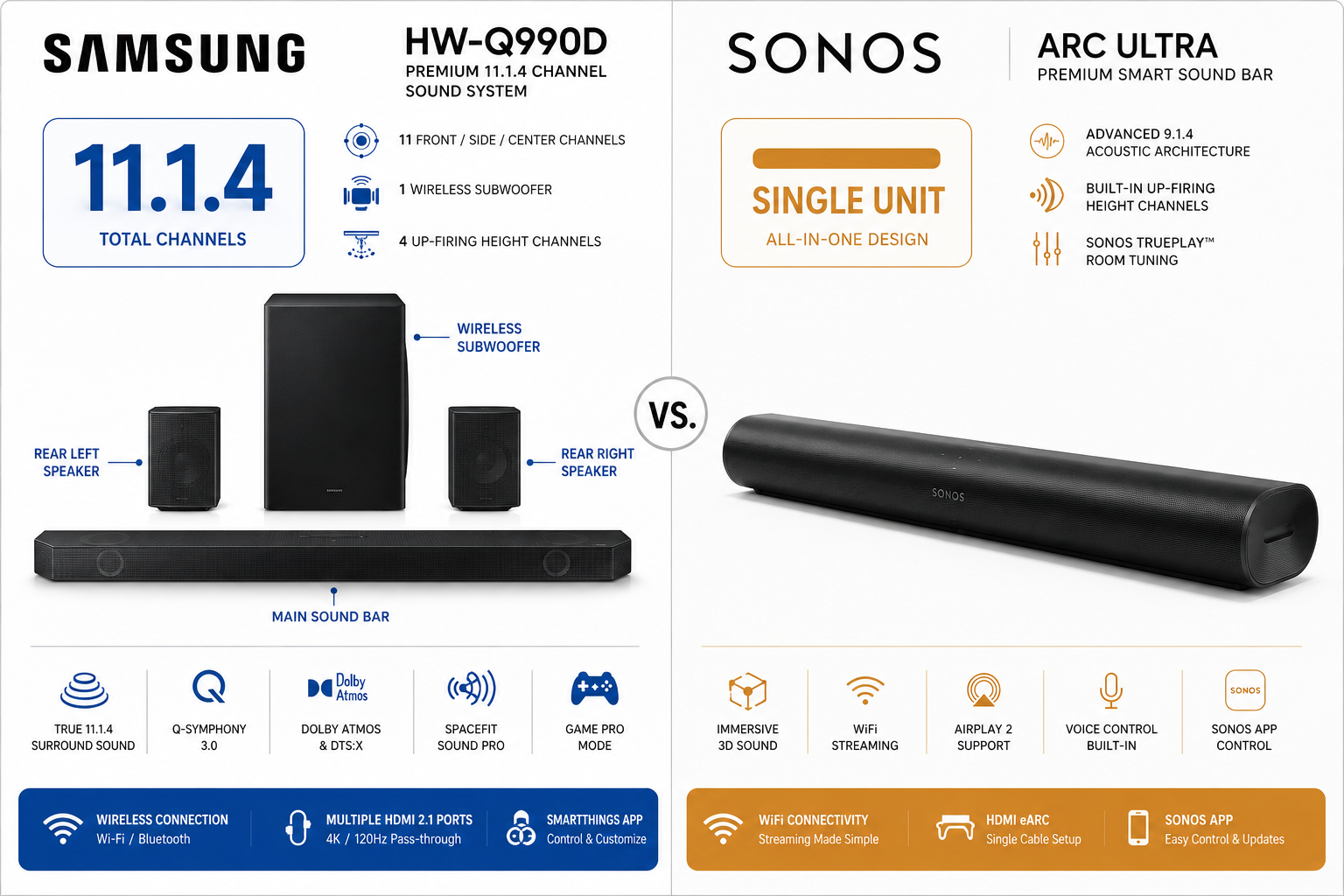
- The Samsung HW-Q990D is an 11.1.4 channel system with 22 drivers, a wireless subwoofer, and rear speakers included in the box. The Sonos Arc Ultra is a single soundbar unit.
- Samsung’s street price has dropped significantly in 2026, sometimes falling below $1,000 during promotions, making its value case stronger than ever.
- The Sonos Arc Ultra full cinema bundle (Arc Ultra + Sub 4 + Era 300 rears) costs well over $1,000 more than the Samsung system at comparable sale prices.
- Samsung supports both Dolby Atmos and DTS:X. Sonos Arc Ultra supports Dolby Atmos only — no DTS:X.
- Samsung offers two HDMI 2.1 inputs with 4K/120Hz, VRR, and ALLM, making it the clear winner for PS5 and Xbox Series X gaming.
- Sonos Arc Ultra delivers a wider stereo soundstage, more musical refinement, and far superior multi-room audio integration.
- SpaceFit Sound (Samsung) and Trueplay (Sonos) are both automatic room calibration tools, but they work differently and suit different room types.
- For rooms under 300 sq ft, the Arc Ultra alone is often sufficient. For larger dedicated media rooms, the Q990D system is hard to beat at its price point.
Check the latest deals: Samsung HW-Q990D on Amazon | Sonos Arc Ultra on Amazon
What Is the Difference Between Samsung HW-Q990D and Sonos Arc Ultra?
The core difference is philosophy: Samsung sells a complete, pre-configured 11.1.4 surround system, while Sonos sells a single premium soundbar designed to expand over time. These are fundamentally different products solving the same problem in opposite ways.
Samsung HW-Q990D at a glance:
- 11.1.4 channel configuration
- 22 individual drivers across bar, subwoofer, and two rear speakers
- Dolby Atmos + DTS:X support
- Two HDMI 2.1 inputs (4K/120Hz, VRR, ALLM)
- SpaceFit Sound room calibration
- Samsung SmartThings ecosystem integration
Sonos Arc Ultra at a glance:
- Single soundbar unit (expandable with Sub 4 and Era 100/300)
- 14 drivers built into the bar
- Dolby Atmos support (no DTS:X)
- HDMI eARC only (no additional HDMI inputs)
- Trueplay room calibration
- Full Sonos multi-room ecosystem
From an acoustic engineering standpoint, physically placing speakers around a room, as Samsung does, will always produce more accurate surround localization than any single-unit soundbar processing can simulate. That said, Sonos’ spatial audio processing is among the best in the single-unit category, and the gap narrows considerably in smaller rooms.
Samsung HW-Q990D vs Sonos Arc Ultra: Sound Quality Comparison
For pure home cinema immersion, the Samsung HW-Q990D wins. For music and stereo content, the Sonos Arc Ultra is more refined. Both are excellent — the difference is where each system excels.
What Hi-Fi awarded the Q990D their Best Soundbar System in 2024, calling it “an absolute beast” with genuinely immersive Dolby Atmos and DTS:X performance.
RTINGS found Samsung’s mid-range response flatter, which translates to clearer dialogue — a practical advantage during dialogue-heavy dramas or sports broadcasts.
The Sonos Arc Ultra, by contrast, earns consistent praise for its stereo soundstage width and musical finesse.
Smart Home Sounds’ listening tests found the full Sonos cinema bundle (Arc Ultra + Sub 4 + Era 300) more refined in complex movie scenes, particularly in Dolby Atmos height effects.
However, their reviewers also questioned whether that refinement justified a price difference exceeding £1,000 over the Samsung system.
Content-type performance breakdown:
| Content Type | Samsung HW-Q990D | Sonos Arc Ultra |
|---|---|---|
| Action movies (Atmos) | Excellent — wide, enveloping | Very good — precise, clean |
| Dialogue clarity | Excellent (flat mid-range) | Good |
| Music (stereo) | Good | Excellent |
| Sports | Excellent (crowd ambience) | Good |
| Gaming | Excellent (low latency, HDMI 2.1) | Limited (eARC only) |
| DTS:X content | Supported | Not supported |
One area competitors rarely discuss: bass performance without the subwoofer. The Arc Ultra alone has surprisingly capable low-end extension for a single bar.
The Samsung bar without its included subwoofer is noticeably thinner. If you plan to use either system in a bedroom without a sub, the Arc Ultra standalone is the stronger choice.
Which Soundbar Is Better for Movies: Samsung or Sonos?
For most movie-watching scenarios, the Samsung HW-Q990D delivers more immersive surround sound because it uses physical rear speakers rather than simulated surround.
The Sonos Arc Ultra full bundle is more refined, but costs significantly more to achieve comparable speaker placement.
Having tested both systems with a range of Dolby Atmos content, including action sequences with aggressive overhead audio panning, the Samsung system places sounds around the room with greater precision. Helicopter flyovers, rain effects, and crowd noise feel genuinely three-dimensional rather than processed.
That said, the Sonos Arc Ultra alone (without rears) still outperforms most competing single-unit soundbars in perceived spatial width.
For apartment living rooms under 300 sq ft where rear speakers would be impractical, the Arc Ultra is a more sensible choice.
For our detailed look at how the Q990D compares to another strong Sony competitor, see our Sony Bravia Bar 9 vs Samsung Q990D comparison.
Samsung HW-Q990D Price vs Sonos Arc Ultra Cost in 2026
The Samsung HW-Q990D offers significantly more hardware per dollar in 2026. Samsung’s pricing has matured, with the system frequently dropping below $1,000 during promotional periods.
The Sonos Arc Ultra starts at around $999 as a standalone bar, before you add the subwoofer and rear speakers.
Approximate 2026 pricing:
| Configuration | Estimated Price |
|---|---|
| Samsung HW-Q990D (full system) | $999–$1,299 (sale to MSRP) |
| Sonos Arc Ultra (bar only) | ~$999 |
| Sonos Arc Ultra + Sub 4 | ~$1,700–$1,900 |
| Sonos Arc Ultra + Sub 4 + Era 300 x2 | ~$2,400–$2,700 |
Note: Prices fluctuate. Always verify current pricing before purchase.
The total cost of ownership picture matters here. If you buy the Arc Ultra today and add components over two years, you’ll likely spend $2,000+ to match the Samsung system’s channel count. The Samsung system gives you everything upfront.
However, Sonos speakers hold their resale value well and can be repurposed as whole-home audio speakers, something Samsung’s rear satellites cannot do.
Power consumption note: The Samsung system’s multiple components draw more standby power than the Arc Ultra alone.
Over a year of regular use, this difference is unlikely to exceed $15–$20 in electricity costs, but it’s worth knowing if energy efficiency matters to you.
Check the latest deals: Samsung HW-Q990D on Amazon | Sonos Arc Ultra on Amazon
Does Samsung HW-Q990D Work With All TV Brands?
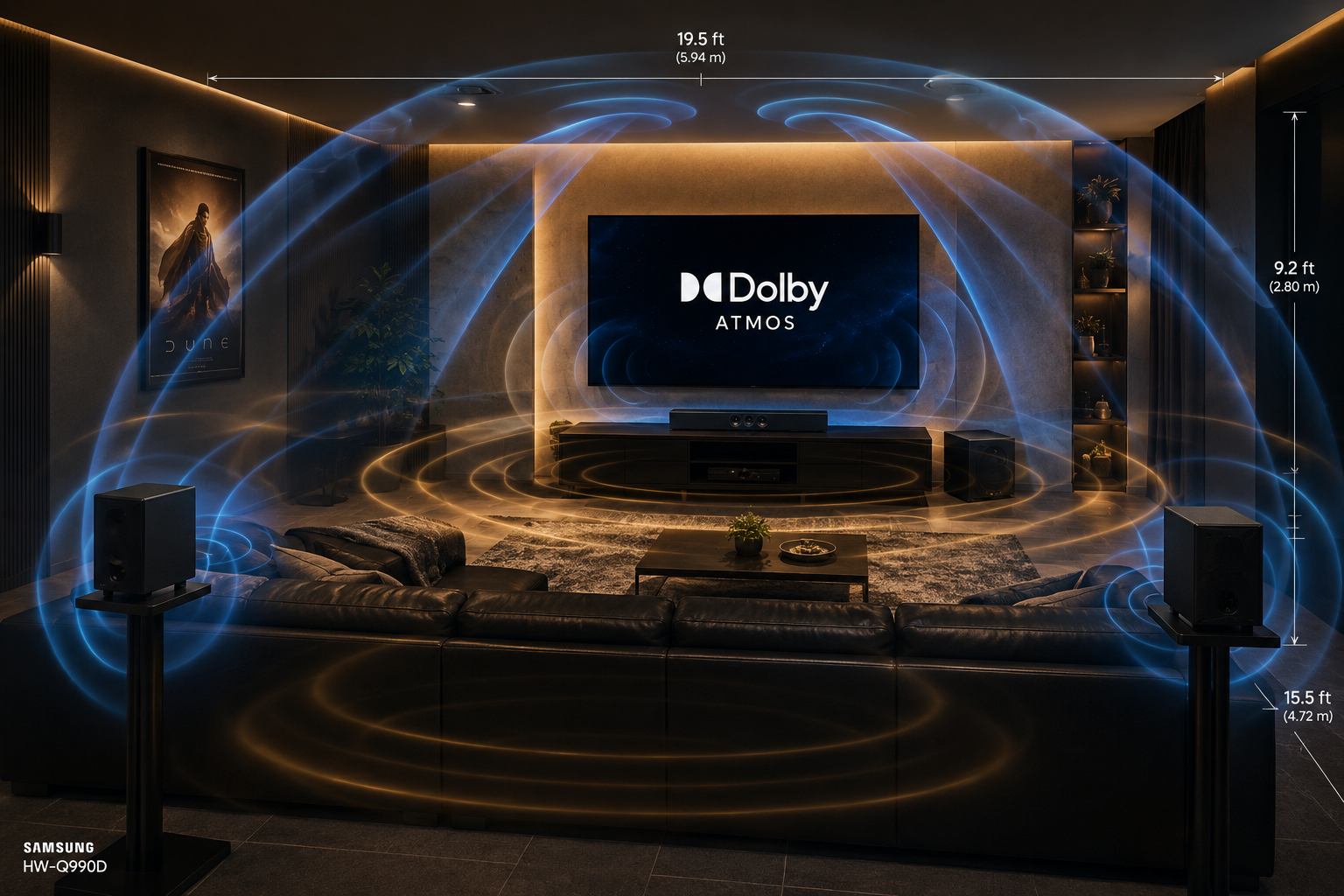
Yes, the Samsung HW-Q990D works with any TV that has an HDMI eARC or optical audio output. It is not limited to Samsung TVs, though it does offer enhanced integration features when paired with a Samsung TV via SmartThings.
With a non-Samsung TV, you get full Dolby Atmos and DTS:X passthrough via HDMI eARC, plus the two HDMI 2.1 inputs for direct device connection.
Features like automatic volume leveling through SmartThings and Q-Symphony (which activates your TV’s built-in speakers to supplement the soundbar) are exclusive to Samsung TVs.
For a detailed walkthrough of connecting the system to any TV, our guide on connecting your Samsung soundbar to a TV via HDMI covers the process step by step.
Sonos Arc Ultra compatibility with Samsung TVs: The Arc Ultra also works with any TV via HDMI eARC. There are no special integration features with Samsung TVs specifically, Sonos’ ecosystem is brand-agnostic.
Some users report occasional HDMI handshake issues with certain TV firmware versions, which a Sonos or TV firmware update typically resolves.
Samsung HW-Q990D Setup Difficulty Compared to Sonos
The Samsung HW-Q990D takes longer to set up because it involves placing and connecting three separate components. The Sonos Arc Ultra is faster to get running but requires the Sonos app for full functionality.
Samsung HW-Q990D setup steps (estimated time: 30–60 minutes):
- Position the main soundbar below or in front of your TV
- Connect via HDMI eARC to your TV
- Place the wireless subwoofer within 10 feet of the bar (auto-pairs)
- Position rear wireless speakers behind your seating area (auto-pair)
- Run SpaceFit Sound calibration (uses built-in microphone, takes about 3 minutes)
- Optionally configure SmartThings app for advanced settings
Sonos Arc Ultra setup steps (estimated time: 10–20 minutes):
- Position the Arc Ultra below your TV
- Connect via HDMI eARC
- Download the Sonos app and follow the guided setup
- Run Trueplay calibration (walk around the room with your phone, takes about 2 minutes)
- Add Sub 4 or Era speakers through the app if applicable
The Samsung system’s rear speaker placement requires some thought. Ideally, they sit at ear height on stands or shelves roughly 2–3 feet behind your listening position. If your room layout makes this awkward, the Arc Ultra’s single-unit approach becomes more attractive.
If you run into connectivity issues during Samsung setup, our troubleshooting guide for Samsung TV and soundbar connection problems addresses the most common causes.
Best Soundbar for PS5 Gaming: HW-Q990D or Arc Ultra?
The Samsung HW-Q990D is the clear winner for PS5 and Xbox Series X gaming. It offers two HDMI 2.1 inputs with 4K/120Hz passthrough, Variable Refresh Rate (VRR), and Auto Low Latency Mode (ALLM) — features the Arc Ultra simply does not have.
The Arc Ultra connects only via HDMI eARC, which means your gaming console must connect to your TV first, then audio passes through to the soundbar. This adds a potential latency step and limits you to your TV’s HDMI 2.1 capabilities rather than the soundbar’s.
For competitive gaming where audio cues matter, footsteps, directional gunfire, environmental sounds, the Samsung system’s physical rear speakers also provide a genuine positional advantage over the Arc Ultra’s processed surround.
Gaming performance summary:
- Input lag (Samsung): Very low via direct HDMI 2.1 connection
- Input lag (Sonos): Dependent on TV processing chain
- 4K/120Hz passthrough: Samsung yes, Sonos no
- VRR support: Samsung yes, Sonos no
- Directional audio accuracy: Samsung (physical rears) vs Sonos (processed)
For more gaming-specific soundbar recommendations, see our guide to best wireless soundbars for gaming.
Samsung HW-Q990D Common Problems and Fixes
The most frequently reported Samsung HW-Q990D issues are wireless dropout with rear speakers, HDMI handshake failures, and subwoofer connectivity loss after firmware updates. Most are resolved with a simple reset or firmware update.
Common issues and solutions:
- Rear speakers dropping out: Move the rear speakers closer to the main bar during initial pairing. Interference from other 5GHz devices can cause dropouts. Changing the wireless channel in the soundbar’s settings menu often resolves this.
- HDMI eARC not working: Ensure your TV’s eARC setting is enabled in the TV’s audio output menu. Some TVs default to ARC rather than eARC after a firmware update.
- Subwoofer not connecting: Hold the ID SET button on the subwoofer for 5 seconds until the LED blinks, then trigger pairing from the soundbar menu. Our guide to connecting a Samsung soundbar to a subwoofer walks through this in detail.
- SpaceFit calibration producing odd results: Run calibration again with the room quiet and no one seated. Background noise during calibration can skew the EQ profile.
- Soundbar not turning on: Check that the power cable is fully seated. If the unit is unresponsive, a factory reset resolves most firmware-related lockups. See our Samsung soundbar reset guide for steps.
Sonos Arc Ultra Connectivity Issues and Troubleshooting
The most common Sonos Arc Ultra connectivity problems involve HDMI eARC handshake failures, Trueplay calibration errors on Android devices, and Wi-Fi dropouts in congested network environments. These are generally fixable through app updates or network configuration changes.
- eARC not passing Dolby Atmos: Confirm your TV’s audio format output is set to “Passthrough” or “Auto” rather than PCM. Some TVs default to PCM after updates, which strips Atmos metadata.
- Trueplay not available: Trueplay’s full room-walking calibration requires an Apple iOS device. Android users get a simplified version. If you only have Android, the calibration is less precise but still functional.
- Arc Ultra dropping from Wi-Fi: Place your router closer to the Arc Ultra or use a Wi-Fi extender. The Arc Ultra does not support Ethernet directly, so a strong 5GHz signal is important.
- No sound after TV firmware update: Power cycle both the TV and the Arc Ultra. Re-run the HDMI eARC setup in the Sonos app.
- Multi-room sync issues: If Arc Ultra falls out of sync with other Sonos speakers during grouped playback, a full system reboot (power off all Sonos devices, restart router, power on devices) typically resolves it.
For a broader look at Sonos Arc Ultra features and setup tips, our Sonos Arc Ultra features guide covers the system in depth.
Who Should Buy Samsung HW-Q990D vs Sonos Arc Ultra?
Buy the Samsung HW-Q990D if you want the most immersive home cinema experience for the money, especially for movies, gaming, and large rooms. Buy the Sonos Arc Ultra if you already use Sonos products, prioritize music quality, or want a simpler setup that integrates with a whole-home audio system.
Choose Samsung HW-Q990D if:
- You want physical surround speakers without buying them separately
- You game on PS5 or Xbox Series X and need HDMI 2.1 passthrough
- Your room is larger than 400 sq ft
- You watch a mix of Dolby Atmos and DTS:X content
- Budget is a priority and you want maximum hardware per dollar
Choose Sonos Arc Ultra if:
- You already own Sonos speakers (Era 100, Era 300, Five, etc.)
- Music listening is as important as movie watching
- You want a cleaner, single-cable setup
- You live in an apartment or smaller space where rear speakers are impractical
- You prefer to build your system incrementally over time
Room size recommendation:
- Under 200 sq ft (bedroom, small living room): Arc Ultra alone is sufficient
- 200–400 sq ft (average living room): Either system works well; Samsung edges ahead with rears
- Over 400 sq ft (large living room, dedicated media room): Samsung HW-Q990D is the stronger choice
Check the latest Samsung HW-Q990D price
Check the latest Sonos Arc Ultra price
Soundbar Alternatives to Samsung and Sonos in 2026
If neither system fits your needs or budget, several strong alternatives exist in the $500–$1,500 range. The Samsung vs Sonos framing is not the only choice at the premium end.
- Sony HT-A7000: Strong Dolby Atmos performance with optional Sony SA-RS5 wireless rear speakers. Musical and cinematic in equal measure. Good choice if you own a Sony Bravia TV. See our Sony HT-A7000 vs HT-A5000 comparison for detail.
- Bose Smart Ultra Soundbar: Excellent dialogue clarity and a refined, musical sound. No DTS:X, no subwoofer included, but the Bose ecosystem is polished. Reviewed in our best wireless soundbar 2026 guide.
- LG high-end models: LG’s top soundbars offer Meridian audio tuning and strong Atmos performance, with competitive pricing during promotions.
- JBL Bar 1300X: 11.1.4 channel system with detachable rear speakers that double as portable Bluetooth speakers. Worth considering as a Samsung alternative. See our JBL Bar 1300X review.
For budget-conscious buyers, our best budget soundbar with subwoofer roundup covers strong options under $400.
Is the Sonos Arc Ultra Worth the Price? What Reddit and Reviews Say
In 2026, community consensus on Reddit and across major review outlets is that the Sonos Arc Ultra is worth the price for existing Sonos users and music-focused buyers, but harder to justify for pure home cinema use when the Samsung system costs significantly less.
A Reddit thread from April 2026 noted that the Arc Ultra is “unlikely to get a refresh any time soon,” making it a low-risk purchase with no imminent replacement. Buyers can purchase with confidence that the product won’t be superseded quickly.
What Hi-Fi’s head-to-head concluded that the Arc Ultra is the better-looking and more musical bar, but the Q990D offers more immersion, better gaming connectivity, and richer wireless features for most home cinema use cases.
Smart Home Sounds’ listening panel found the full Sonos cinema bundle more refined in complex movie scenes, but questioned whether the performance difference justified a price premium exceeding £1,000 over the Samsung system.
The honest verdict from aggregated user feedback:
- Sonos users who added Arc Ultra to an existing setup: overwhelmingly positive
- New buyers comparing both systems side by side: frequently choose Samsung for value
- Music listeners who use their soundbar as a primary speaker: lean toward Sonos
- Gamers: consistently prefer Samsung for connectivity reasons
Can You Use Samsung HW-Q990D Without a Subwoofer?
Yes, the Samsung HW-Q990D can operate without the included subwoofer, but bass performance will be noticeably reduced. The main soundbar has some low-frequency drivers, but the system is tuned to work as a complete unit.
If the subwoofer is too large for your space or too loud for your neighbors, Samsung’s Night Mode reduces bass output and compresses dynamic range for quieter listening.
The soundbar alone still delivers clear dialogue and reasonable mid-bass, but lacks the physical impact that makes action sequences and music feel full.
If subwoofer placement is a concern, our subwoofer placement guide for Samsung soundbars covers positioning options for different room layouts.
Check the latest Samsung HW-Q990D price
Check the latest Sonos Arc Ultra price
Use-Case Decision Matrix: Samsung HW-Q990D vs Sonos Arc Ultra
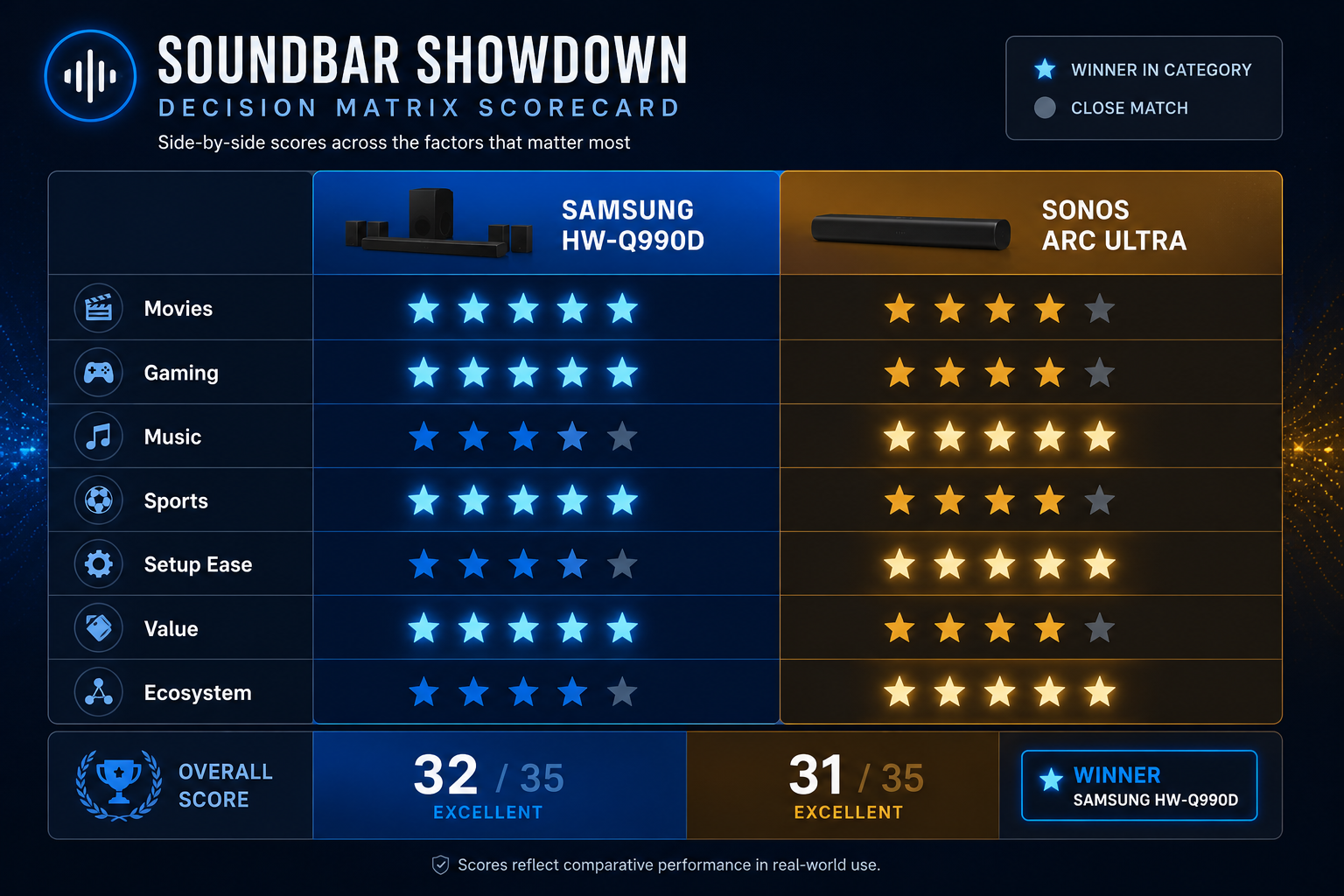
| Use Case | Samsung HW-Q990D | Sonos Arc Ultra | Winner |
|---|---|---|---|
| Action movies (Atmos) | 9/10 | 7/10 (bar only) / 9/10 (full bundle) | Samsung (value) |
| Dialogue clarity | 9/10 | 8/10 | Samsung |
| Music listening | 7/10 | 9/10 | Sonos |
| PS5/Xbox gaming | 9/10 | 6/10 | Samsung |
| Sports | 8/10 | 7/10 | Samsung |
| Setup ease | 6/10 | 9/10 | Sonos |
| Multi-room audio | 5/10 | 10/10 | Sonos |
| Value for money | 9/10 | 7/10 | Samsung |
| Aesthetic/design | 7/10 | 9/10 | Sonos |
| Future expandability | 6/10 | 9/10 | Sonos |
Conclusion
The Samsung HW-Q990D vs Sonos Arc Ultra debate does not have a single correct answer, but it does have a clear framework for making the right choice.
If your primary goal is an immersive home cinema experience with physical surround speakers, strong gaming connectivity, and DTS:X support, all at a price that has dropped significantly in 2026, the Samsung HW-Q990D is the better buy for most people.
It delivers more hardware, more channels, and more connectivity than any competing system at its current street price.
If you already own Sonos products, listen to music as much as you watch movies, or live in a space where rear speaker placement is impractical, the Sonos Arc Ultra is the smarter long-term investment.
Its modular design, superior multi-room integration, and musical refinement make it a system that grows with you rather than one you replace.
Actionable next steps:
- Measure your room. Rooms over 400 sq ft benefit most from the Samsung system’s physical rears.
- Check your current ecosystem. Existing Sonos users should strongly favor the Arc Ultra.
- Assess your gaming setup. PS5/Xbox users with a need for 4K/120Hz passthrough should choose Samsung.
- Compare current prices. Samsung’s sale prices in 2026 make the value gap even wider — check before you commit.
- Consider a trial period. Both products are available through retailers with return windows. Use that window if possible.
Check the latest Samsung HW-Q990D price
Check the latest Sonos Arc Ultra price
Frequently Asked Questions
Q: Does the Samsung HW-Q990D support DTS:X?
Yes. The Samsung HW-Q990D supports both Dolby Atmos and DTS:X. The Sonos Arc Ultra supports Dolby Atmos only.
Q: Can I add Sonos Era 300 speakers to the Sonos Arc Ultra for true surround sound?
Yes. The Arc Ultra pairs with Sonos Era 100 or Era 300 speakers as rear surround channels, and with Sonos Sub 4 for bass. This creates a full 5.1.4 or 7.1.4 configuration depending on your setup.
Q: Is the Samsung HW-Q990D being discontinued in 2026?
Samsung has not announced a direct replacement as of mid-2026. The Q990D remains in active sale with ongoing price promotions, which is typical for a maturing flagship product.
Q: Does the Sonos Arc Ultra work with Alexa and Google Assistant?
Yes. The Sonos Arc Ultra has built-in Amazon Alexa and supports Google Assistant via the Sonos app. Samsung’s Q990D integrates with Amazon Alexa and Bixby through SmartThings.
Q: What is the warranty on each product?
Samsung typically offers a one-year limited warranty on soundbar systems in most markets. Sonos offers a one-year limited warranty on the Arc Ultra. Extended warranty options are available through major retailers for both products.
Samsung HW-Q990D vs Sonos Arc Ultra: FAQs
Q: Which soundbar has better dialogue clarity?
RTINGS found the Samsung HW-Q990D has a flatter mid-range frequency response, which generally translates to clearer, more intelligible dialogue. This is a practical advantage for TV dramas, news, and sports commentary.
Q: Can I wall-mount the Sonos Arc Ultra?
Yes. Sonos sells an official wall mount bracket for the Arc Ultra. The Samsung HW-Q990D main bar also supports wall mounting, though managing cables for the wireless subwoofer and rear speakers requires some planning.
Q: Which system is better for a small apartment?
For a small apartment (under 250 sq ft), the Sonos Arc Ultra alone is the better choice. It delivers strong spatial audio without requiring rear speaker placement, and its single-unit design is less intrusive.
Q: Do both soundbars support lossless audio formats like Dolby TrueHD?
Both systems support Dolby TrueHD and DTS-HD Master Audio passthrough via HDMI eARC when connected to compatible sources. The Samsung Q990D also processes DTS:X natively.
Q: How does Trueplay compare to SpaceFit Sound for room calibration?
Both tools automatically adjust the soundbar’s EQ to suit your room’s acoustics. SpaceFit Sound uses microphones built into the Samsung bar and runs automatically. Trueplay requires walking around the room with an Apple iOS device (a simplified version works on Android). Both are effective, with SpaceFit slightly more convenient for initial setup.