
Soundbar Buying Guide 2026
Shopping for a soundbar in 2026 can feel overwhelming. With hundreds of models featuring confusing specifications like “11.1.4 channels” and “eARC compatibility,” how do you know which one actually delivers the cinematic experience you’re craving?
The right soundbar transforms your TV viewing from flat and muddy to immersive and crystal-clear—but only if you match it properly to your space, budget, and entertainment needs.
This comprehensive Soundbar Buying Guide 2026. How to Choose the Right Model for Your TV, Room, and Budget cuts through the marketing jargon to help you make a confident purchase decision.
Whether you’re upgrading from built-in TV speakers or replacing an older system, you’ll discover exactly which features matter, which ones don’t, and how to calculate the perfect setup for your unique situation.
Key Takeaways
- Channel configuration matters more than brand names: Understanding 2.1, 5.1.2, and 11.1.4 setups helps you match audio performance to your room size and budget
- HDMI eARC is non-negotiable in 2026: This connection standard ensures compatibility with Dolby Atmos and future audio formats
- Room dimensions directly impact soundbar selection: Small spaces (under 150 sq ft) need different specifications than large home theaters (over 300 sq ft)
- Budget tiers have clear performance boundaries: Entry-level ($200-400), mid-range ($400-800), and premium ($800+) categories deliver distinctly different experiences
- Expandability provides future-proof value: Systems that support adding wireless rear speakers or upgraded subwoofers protect your investment
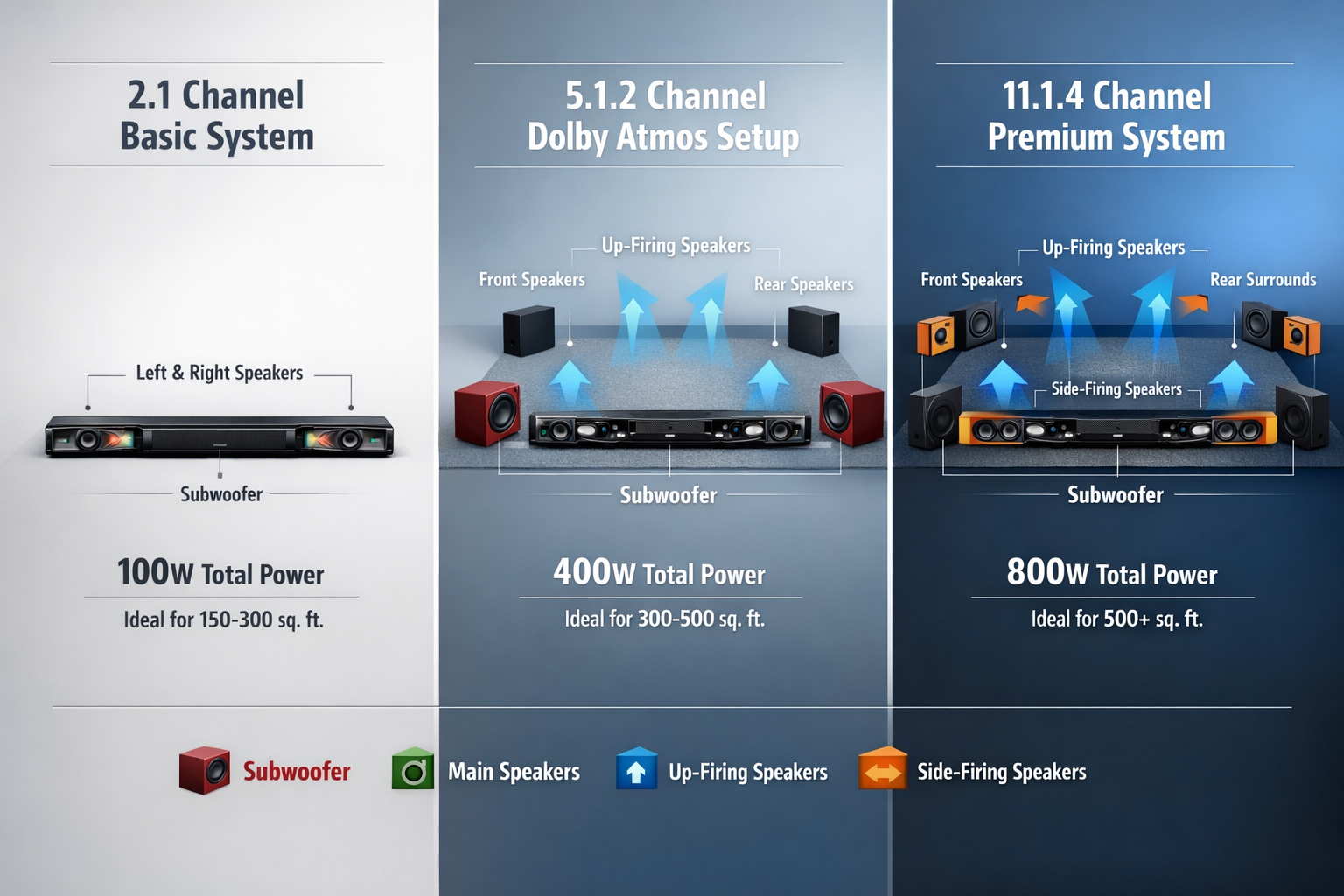
Understanding Soundbar Channels and Power Output 🔊
The numbers on soundbar packaging—like 2.1, 5.1.2, or 11.1.4—aren’t random. They represent a channel configuration system that tells you exactly how many speakers you’re getting and where sound comes from.
Decoding Channel Numbers
The first number indicates front-facing channels (left, center, right speakers). The second number represents the subwoofer (bass unit). The third number, when present, shows height channels for overhead sound effects.
Channel Configuration Breakdown:
- 2.1 channels: Basic left/right speakers plus subwoofer (entry-level)
- 3.1 channels: Adds dedicated center channel for clearer dialogue
- 5.1 channels: Full surround with rear speakers for immersive audio
- 5.1.2 channels: Adds two up-firing drivers for Dolby Atmos height effects
- 11.1.4 channels: Premium setup with side-firing, up-firing, and traditional speakers[2]
The Samsung HW-Q990F dominates 2026 recommendations with its impressive 11.1.4-channel setup featuring four up-firing and four side-firing drivers, plus included wireless subwoofer and surround speakers[2].
This configuration creates genuinely three-dimensional soundscapes that place helicopters overhead and footsteps behind you.
Power Output Requirements
Wattage determines volume potential and dynamic range. While manufacturers often inflate these numbers, here’s what actually matters:
| Room Size | Minimum Total Watts | Recommended Configuration |
|---|---|---|
| Small (< 150 sq ft) | 200-300W | 2.1 or 3.1 channels |
| Medium (150-250 sq ft) | 300-500W | 5.1.2 channels |
| Large (250-400 sq ft) | 500-800W | 7.1.2 or higher |
| Home Theater (400+ sq ft) | 800W+ | 11.1.4 channels |
The Bluesound Pulse Cinema delivers up to 500 watts across its 3.2.2 Dolby Atmos setup with 16 drivers, making it ideal for music enthusiasts who demand both cinematic impact and high-resolution audio streaming[1].
For those exploring different options, our guide to choosing the right soundbar speaker provides additional context on matching specifications to your needs.
Dolby Atmos: Worth the Investment?
Dolby Atmos adds overhead sound dimension by bouncing audio off your ceiling through up-firing drivers. In 2026, this technology has matured significantly, with even mid-range models delivering convincing height effects.
The Sony BRAVIA Theatre Bar 9 features a 13-speaker array supporting both Dolby Atmos and DTS:X, delivering impressively wide soundstage and spaciousness from a single unit[1].
Its price has dropped from £1,399 to approximately £900, dramatically improving its value proposition[1].
Atmos makes the biggest difference when:
- Your ceiling height is 8-10 feet (optimal for sound reflection)
- You watch action movies, nature documentaries, or immersive content
- Your room has minimal sound-absorbing materials (heavy curtains, thick carpets)
For budget-conscious buyers, the Bose Smart Soundbar offers impressive Dolby Atmos performance in a sleek, space-saving design without requiring additional components[2].
Check out our comparison of the best wireless soundbar options for 2026 to see how different models stack up.
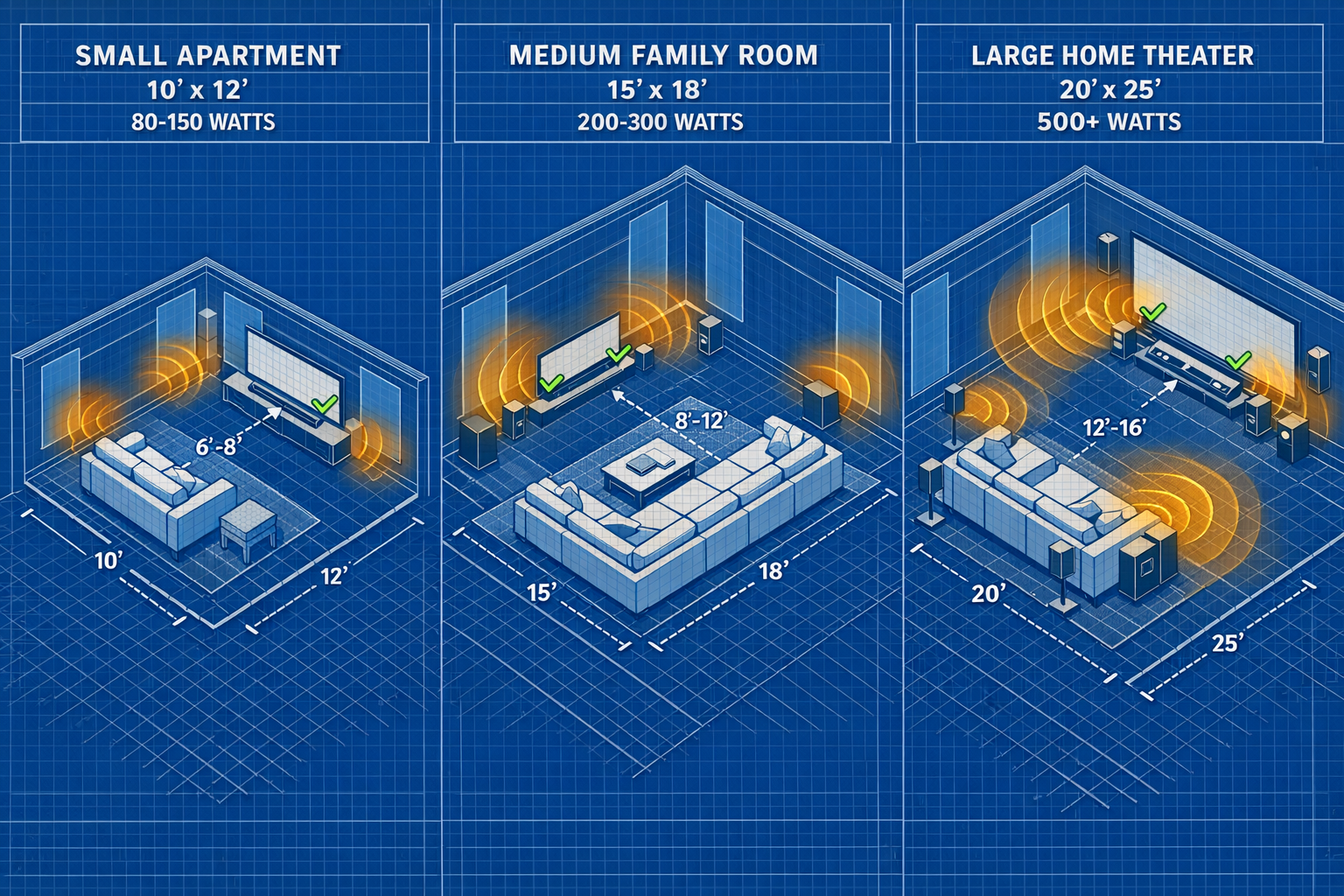
Matching Your Soundbar to Room Size and Layout 📐
Your room dimensions dramatically impact which soundbar delivers optimal performance. A premium 11.1.4 system in a small apartment wastes money, while an entry-level 2.1 bar in a large home theater disappoints.
Small Rooms (Under 150 Square Feet)
Compact spaces like bedrooms, dorm rooms, or small apartments need soundbars that excel at dialogue clarity without overwhelming the space with bass.
Optimal specifications:
- 2.1 or 3.1 channel configuration
- 200-300 total watts
- Soundbar length: 28-35 inches
- Integrated or compact wireless subwoofer
The Sony HT-SF150 delivers premium performance in smaller spaces at budget-friendly prices[6]. Its compact design doesn’t sacrifice clarity, making it perfect for late-night viewing without disturbing neighbors.
Medium Rooms (150-250 Square Feet)
Standard living rooms benefit from balanced surround sound that creates immersion without requiring extensive setup.
Optimal specifications:
- 5.1.2 channel configuration minimum
- 300-500 total watts
- Soundbar length: 40-48 inches
- Wireless subwoofer with 8-inch or larger driver
The Sonos Arc Ultra leads single-unit performance for those wanting powerful bass and Dolby Atmos without a multi-speaker setup, improving on the original Arc with deeper low-end response and sharper clarity[2].
It’s particularly effective in medium-sized rooms where a single soundbar can fill the space convincingly.
If you’re setting up a Samsung system, our guide to setting up your Samsung soundbar and subwoofer walks through optimal placement strategies.
Large Rooms and Home Theaters (Over 250 Square Feet)
Spacious environments demand full surround systems with dedicated rear speakers to prevent audio from feeling distant or disconnected.
Optimal specifications:
- 7.1.2 or 11.1.4 channel configuration
- 500W+ total power output
- Soundbar length: 48+ inches
- Wireless rear speakers included or available
- Subwoofer with 10-inch or larger driver
The Bose Smart Ultra Soundbar is highlighted as best for big rooms, delivering room-filling sound that maintains clarity even at high volumes[3].
For maximum impact, the JBL Bar 1300XMK2 excels with its wireless surrounds, reflecting the industry trend toward simplified multi-speaker setup without running cables[3].
Acoustic Considerations Beyond Size
Room materials affect sound quality as much as dimensions:
✅ Favorable conditions:
- Hardwood or tile floors (better sound reflection)
- Minimal soft furnishings
- Standard drywall construction
- 8-10 foot ceiling height
⚠️ Challenging conditions:
- Heavy carpeting throughout
- Extensive curtains or tapestries
- Open-concept layouts without walls
- Vaulted or very high ceilings (12+ feet)
For challenging acoustics, consider soundbars with room calibration technology that automatically adjusts output based on your space.
Many premium 2026 models include smartphone apps that use your phone’s microphone to optimize settings.
Our complete guide to soundbar wall mounting explains how proper placement maximizes performance in any room configuration.

Essential Connectivity Features and Future-Proof Technology 🔌
The connections on your soundbar determine compatibility with current and future devices. In 2026, certain features have transitioned from “nice to have” to absolutely essential.
HDMI eARC: The Non-Negotiable Standard
Enhanced Audio Return Channel (eARC) is mandatory for modern soundbars. This upgraded HDMI standard supports:
- Uncompressed Dolby Atmos and DTS:X audio
- High-resolution audio formats (up to 24-bit/192kHz)
- Simplified single-cable connection to TV
- Automatic device switching and volume control
All recommended 2026 models feature HDMI eARC connectivity as standard in mid-to-premium segments[2][7].
Without eARC, you’ll experience compressed audio that defeats the purpose of investing in a quality soundbar.
Connection priority hierarchy:
- HDMI eARC (best quality, most features)
- Optical/TOSLINK (acceptable for basic stereo or compressed 5.1)
- Bluetooth (convenient for music, not recommended for TV audio)
- 3.5mm aux (last resort, lowest quality)
Having trouble connecting your soundbar? Our troubleshooting guide for soundbar TV connection issues solves the most common problems.
Wireless Connectivity Standards
Modern soundbars function as entertainment hubs beyond just TV audio. Look for these wireless features:
🎵 Music streaming essentials:
- Wi-Fi connectivity for stable, high-quality streaming
- AirPlay 2 (Apple ecosystem integration)
- Chromecast built-in (Android and cross-platform)
- Spotify Connect (direct app control)
- Bluetooth 5.0+ (backup connection, lower quality)
The Sony BRAVIA Theatre Bar 9 excels here with comprehensive streaming support and seamless integration with Sony TVs through proprietary features[1].
For Samsung soundbar owners, our guide on connecting your Samsung soundbar to WiFi ensures you’re getting the most from wireless features.
Smart Home Integration
Voice control has matured significantly in 2026, with soundbars serving as smart home command centers:
- Amazon Alexa built-in (most common)
- Google Assistant support (Android ecosystem)
- Apple HomeKit compatibility (Siri control)
Learn more about the benefits of a soundbar with built-in Alexa for hands-free control and multi-room audio.
Expandability and Upgrade Paths
The best soundbars grow with your needs. Premium systems offer modular expansion:
Sony upgrade path:
- Add compatible rear speakers (SA-RS3S or SA-RS5)
- Upgrade to larger subwoofer (SA-SW5 or SA-SW3)
- Maintain wireless connectivity throughout
Bluesound expansion options:
- Add wireless rear speakers (Pulse Flex, Pulse M)
- Integrate passive speakers via Powernode
- Create multi-room audio system[1]
This modularity protects your investment, allowing you to start with a basic soundbar and add components as budget allows. Our expert tips for soundbar and subwoofer pairing help you expand your system successfully.
CES 2026 Technology Trends
FlexConnect technology emerged as a major innovation at CES 2026, alongside new Dolby Atmos implementations from established brands[5].
This technology allows soundbars to intelligently route audio to different speakers based on room layout and listener position.
Other 2026 innovations include:
- AI-powered room calibration that adapts in real-time
- Spatial audio personalization based on listening position
- Enhanced dialogue modes using machine learning
- Lower latency wireless for gaming applications
For gamers specifically, explore our guide to the best wireless soundbars for gaming to understand which features minimize audio delay.
Budget-Based Recommendations: Where to Invest Your Money 💰
Your budget determines which performance tier you’ll access, but smart shopping can maximize value at any price point.
Entry-Level ($200-$400)
Best for: Bedroom TVs, first soundbar purchase, apartment living
At this price, expect significant improvement over TV speakers but limited surround effects and modest bass output.
Key compromises:
- 2.1 or 3.1 channel configurations only
- No Dolby Atmos or height effects
- Smaller subwoofer (6-8 inch driver)
- Basic connectivity (HDMI ARC, not eARC)
Recommended models:
- Bose Smart Soundbar (budget Dolby Atmos option)[2]
- Sony HT-SF150 (compact performance)[6]
For those seeking maximum value in this range, our best budget soundbar with subwoofer guide identifies seven affordable combos that deliver surprisingly big sound.
Mid-Range ($400-$800)
Best for: Primary living room TV, movie enthusiasts, balanced performance
This sweet spot delivers genuine Dolby Atmos performance and quality that satisfies most users long-term.
What you gain:
- 5.1.2 or 7.1.2 channel configurations
- True Dolby Atmos with up-firing drivers
- Larger subwoofer (8-10 inch driver)
- HDMI eARC standard
- Room calibration features
- Wireless streaming (Wi-Fi, AirPlay 2, Chromecast)
Recommended models:
- Sonos Arc Ultra (best single-unit performance)[2]
- Sony BRAVIA Theatre Bar 9 (excellent spatial audio, now ~£900)[1]
Consumer Reports tested 19 different soundbars across multiple price points in their audio labs, with mid-range models offering the best performance-per-dollar ratio[8].
Premium ($800-$1,500+)
Best for: Dedicated home theaters, audiophiles, maximum immersion
Premium soundbars deliver reference-quality audio that rivals traditional speaker systems.
Premium advantages:
- 11.1.4 channel configurations with included surrounds
- Multiple subwoofers or premium large-driver units
- Advanced room calibration (laser or microphone-based)
- Premium build quality and materials
- Comprehensive expansion options
- Multi-room audio capabilities
Recommended models:
- Samsung HW-Q990F (best overall with 11.1.4 channels)[2][7]
- KEF XIO (best high-end performance)[3][6]
- Sennheiser AMBEO Max (best-sounding according to experts)[3][6]
- Bluesound Pulse Cinema (£1,149, music-focused with 16 drivers)[1]
Audio Advice reports their team spent countless hours in their home theater lab testing everything from compact bars to flagship Atmos systems, with premium models justifying their cost through measurably superior performance[7].
Value Calculation Formula
To determine if a soundbar offers good value:
- Divide total price by number of channels (lower = better value)
- Check if wireless subwoofer is included (adds $150-300 value)
- Verify rear speakers included (adds $200-400 value)
- Confirm HDMI eARC support (essential, not optional)
- Research expandability options (future-proofs investment)
Example: A $1,200 soundbar with 11.1.4 channels, included subwoofer, and rear speakers = $1,200 ÷ 15 total components = $80 per component, which represents excellent value.
Personalized Recommendation Checklist ✅
Use this decision framework to identify your ideal soundbar:
Step 1: Measure Your Room
- Calculate square footage (length × width)
- Measure ceiling height
- Note acoustic materials (carpet, curtains, furniture)
- Identify TV mounting (wall or stand)
Step 2: Define Your Budget
- Entry ($200-400): Basic improvement
- Mid-range ($400-800): Balanced performance
- Premium ($800+): Maximum quality
Step 3: Identify Primary Use Case
- Movies/TV (prioritize dialogue clarity, surround effects)
- Music (choose models with balanced frequency response)
- Gaming (select low-latency models with game modes)
- Mixed use (opt for versatile all-rounders)
Step 4: Check TV Compatibility
- Confirm TV has HDMI eARC port (check manual)
- Measure space below/above TV for soundbar placement
- Verify TV supports Dolby Atmos passthrough
- Check if TV brand offers proprietary integration features
Step 5: Evaluate Expansion Needs
- Plan to add rear speakers later? (Choose expandable system)
- Want multi-room audio? (Select Wi-Fi-enabled model)
- Need voice control? (Pick Alexa/Google Assistant model)
- Require music streaming? (Verify AirPlay 2/Chromecast support)
Step 6: Read Professional Reviews
- Check RTINGS.com for objective measurements[2]
- Review What Hi-Fi awards and recommendations[6]
- Watch Crutchfield video comparisons[3]
- Verify Consumer Reports ratings[8]
Step 7: Confirm Return Policy
- Verify 30+ day return window
- Check restocking fees
- Confirm ability to test in your actual room
- Save all packaging for potential return

Conclusion: Making Your Final Decision
Choosing the right soundbar in 2026 comes down to matching specifications to your specific situation rather than chasing the most expensive model or latest brand name.
A properly selected mid-range soundbar in a well-suited room will dramatically outperform a premium model in the wrong space.
Remember these critical factors:
🎯 Channel configuration must match room size – Don’t over-invest in 11.1.4 channels for a small bedroom or under-invest with 2.1 channels in a large home theater.
🔌 HDMI eARC is non-negotiable – This single feature ensures your soundbar remains compatible with current and future audio formats.
📏 Room acoustics matter as much as specifications – Hard surfaces, ceiling height, and furniture placement significantly impact performance.
💡 Expandability protects your investment – Systems that support adding wireless rear speakers or upgraded subwoofers grow with your needs.
Next Steps
- Measure your room and calculate square footage today
- Check your TV’s HDMI ports to confirm eARC capability
- Set a realistic budget based on the tier recommendations above
- Read professional reviews from RTINGS, What Hi-Fi, and Consumer Reports for your shortlisted models
- Purchase from retailers with generous return policies so you can test in your actual environment
The soundbar market in 2026 offers exceptional options at every price point, from budget-friendly best budget soundbar with subwoofer combos to flagship systems that rival traditional home theater setups.
By following this Soundbar Buying Guide 2026. How to Choose the Right Model for Your TV, Room, and Budget, you’re equipped to make a confident purchase that transforms your entertainment experience for years to come.
Ready to upgrade your audio? Start by measuring your room, confirming your TV’s connections, and exploring the specific models recommended for your budget tier.
Your perfect soundbar is waiting—now you know exactly how to find it. Click Here
=============================================================================
References
[1] Best Dolby Atmos Soundbars The Complete Buyers Guide – https://www.smarthomesounds.co.uk/blog/faqs/best-dolby-atmos-soundbars-the-complete-buyers-guide
[2] Best Dolby Atmos Soundbar – https://www.businessinsider.com/guides/tech/best-dolby-atmos-soundbar
[3] Watch – https://www.youtube.com/watch?v=_HJNoZszSeI
[5] The Best Soundbars Of Ces 2026 Dolby Atmos Flexconnect Audio By Bang And Olufsen And Icelandic Volcanoes – https://www.techradar.com/televisions/soundbars/the-best-soundbars-of-ces-2026-dolby-atmos-flexconnect-audio-by-bang-and-olufsen-and-icelandic-volcanoes
[6] Best Soundbars – https://www.whathifi.com/best-buys/home-cinema/best-soundbars
[7] Best Soundbars – https://www.audioadvice.com/blogs/expert-advice/best-soundbars
[8] Great Sound Bar Speakers At Every Price A1655356094 – https://www.consumerreports.org/electronics-computers/sound-bars/great-sound-bar-speakers-at-every-price-a1655356094/
Pingback: SVS R|Evolution Soundbar Review: Premium Audio Guide 2026