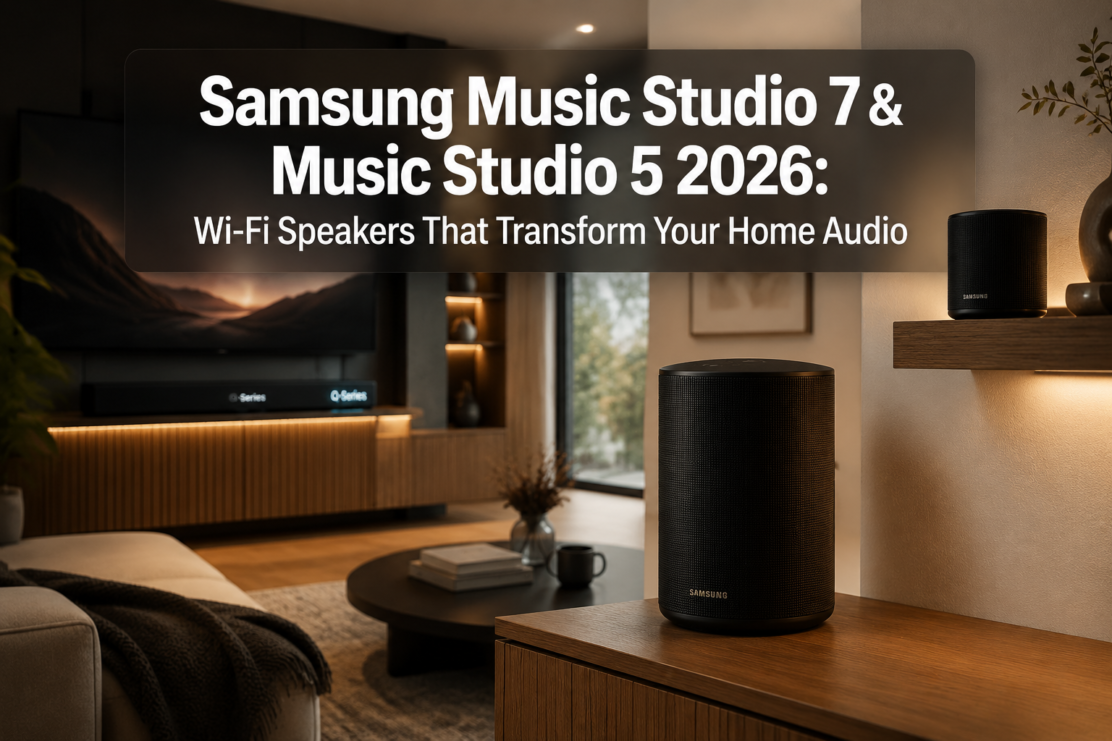
Samsung Music Studio 7 and Music Studio 5
Last updated: June 29, 2026
Quick Answer
Samsung’s Music Studio 7 (HW-LS70H, $499.99) and Music Studio 5 (HW-LS50H, $299.99) are Wi-Fi-enabled wireless speakers launched in 2026 that integrate with Samsung’s Q-Series soundbars through Q-Symphony technology, creating multi-room audio ecosystems without replacing your existing equipment.
Both models feature Dolby Atmos, voice assistant support, and cylindrical designs that blend into modern interiors while delivering room-filling sound for music and home theater use.
Key Takeaways
- Pricing and availability: Music Studio 7 costs $499.99 (AU$749) and Music Studio 5 costs $299.99 (AU$499), both available since spring 2026 in black and white finishes [1][4]
- Q-Symphony integration: Both speakers connect wirelessly to Samsung Q-Series soundbars to expand your audio setup without replacing existing gear [2]
- Dolby Atmos support: Upward-firing drivers in both models create height effects for immersive three-dimensional sound [3][9]
- Multi-room capability: SmartThings app lets you group speakers across rooms for synchronized whole-home audio
- Voice control: Built-in Alexa and Bixby support for hands-free operation and smart home integration
- Design philosophy: Cylindrical form factor and fabric grilles designed to complement modern furniture rather than dominate visual space [4]
- Connectivity options: Wi-Fi, Bluetooth, AirPlay 2, and Spotify Connect for flexible streaming from any device
What Are the Samsung Music Studio 7 and Music Studio 5 2026 Speakers?
The Samsung Music Studio 7 and Music Studio 5 are Wi-Fi wireless speakers introduced at CES 2026 as part of Samsung’s expanded home audio lineup.
Unlike traditional Bluetooth speakers, these models prioritize whole-home audio integration and work as standalone music players or as extensions of Samsung soundbar systems through Q-Symphony technology [2].
Core specifications:
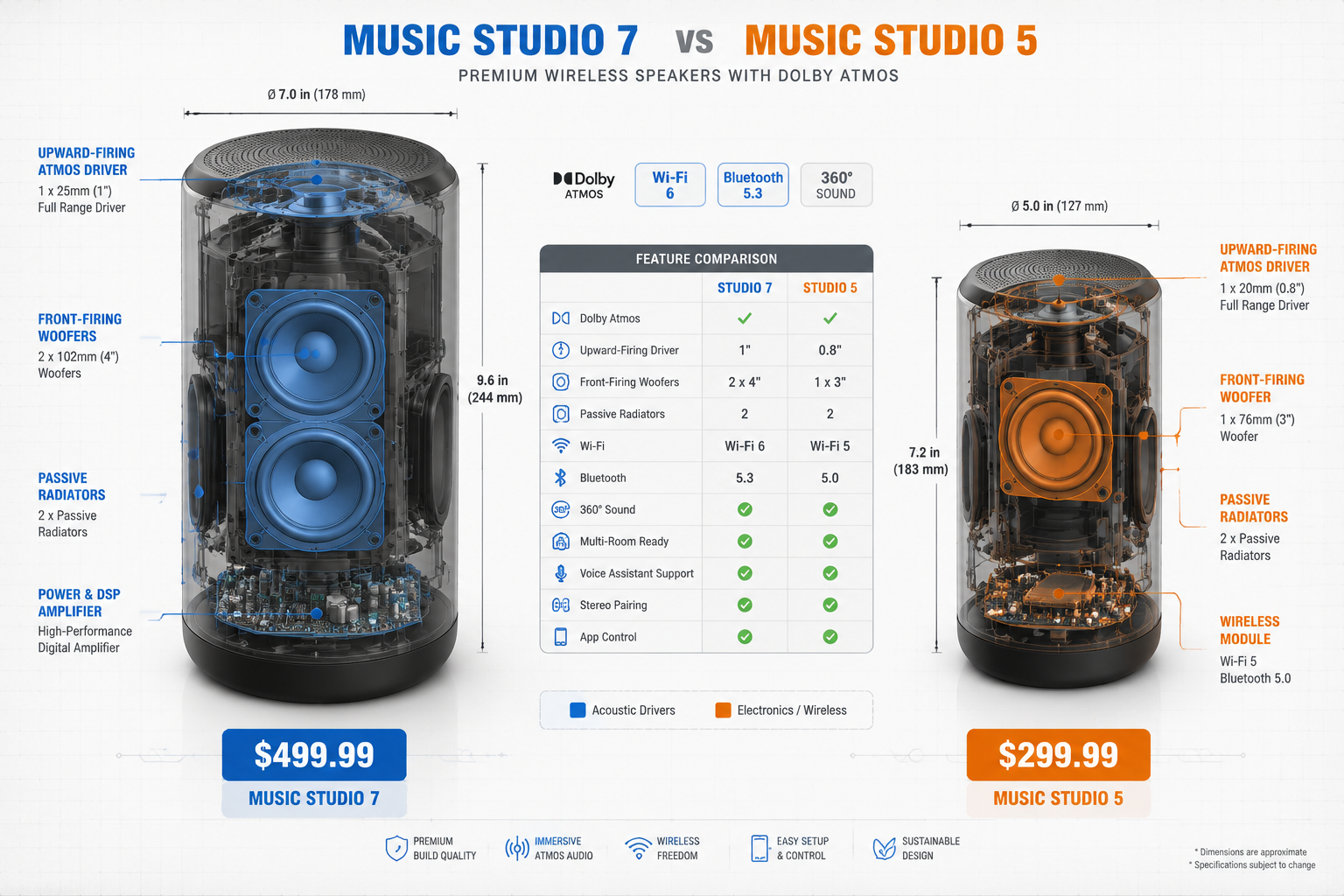
| Feature | Music Studio 7 (HW-LS70H) | Music Studio 5 (HW-LS50H) |
|---|---|---|
| Price (US) | $499.99 | $299.99 |
| Price (Australia) | AU$749 | AU$499 |
| Channel Config | 3.1.1 | 2.1 |
| Dolby Atmos | Yes (upward driver) | Yes (upward driver) |
| Dimensions | Larger cylinder | Compact cylinder |
| Wireless | Wi-Fi, Bluetooth, AirPlay 2 | Wi-Fi, Bluetooth, AirPlay 2 |
| Voice Assistants | Alexa, Bixby | Alexa, Bixby |
| Colors | Black, White | Black, White |
Both speakers launched in US retail (including Best Buy) in April 2026 and became available in Australian retailers shortly after [1][3][4].
Choose the Music Studio 7 if you want maximum bass response, wider soundstage, and plan to use the speaker as a primary music system in medium-to-large rooms.
Choose the Music Studio 5 if you need a compact option for smaller spaces, secondary rooms, or want to start a multi-room setup at lower cost.
How Do Samsung Music Studio 7 and Music Studio 5 2026 Integrate With Q-Series Soundbars?
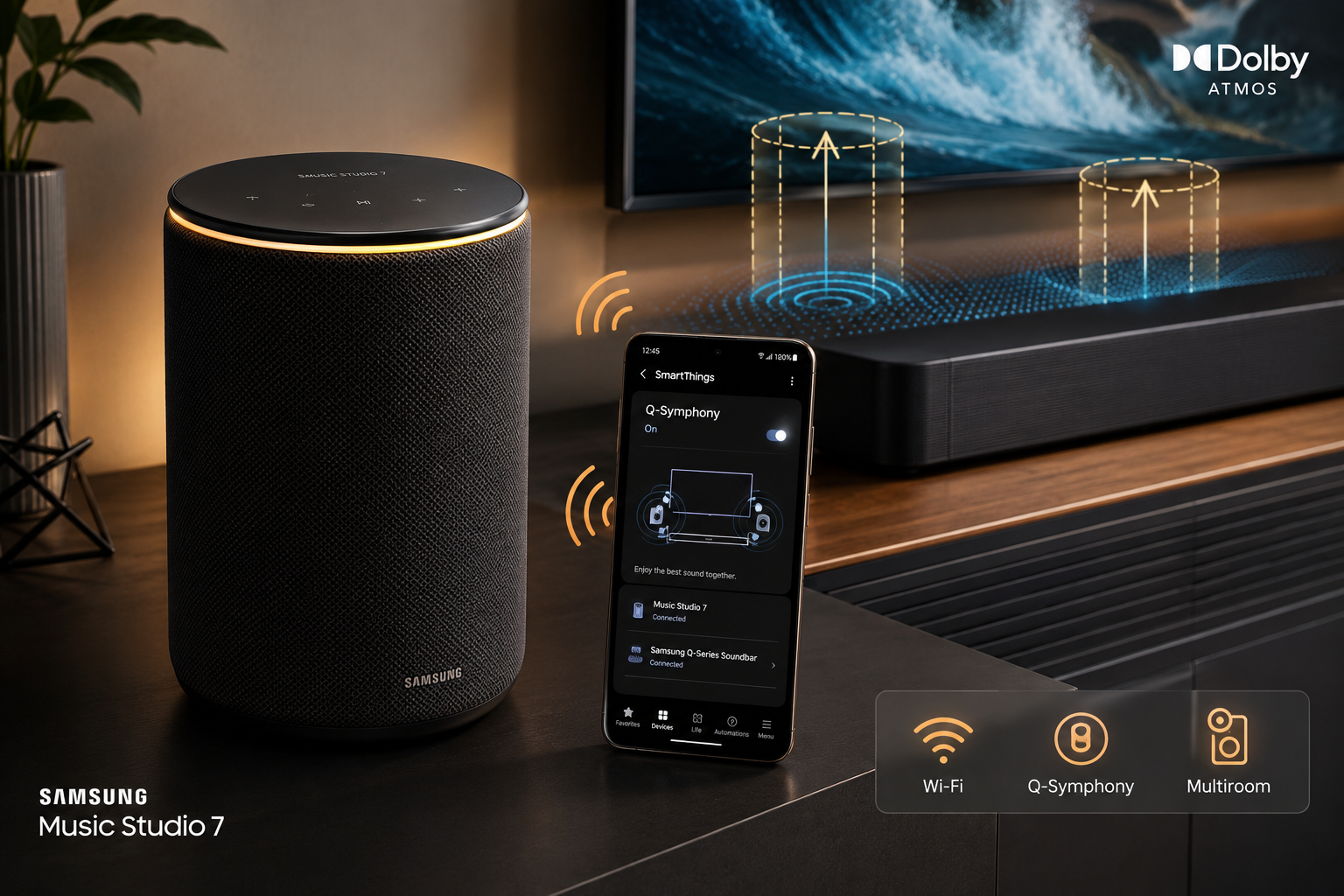
The Music Studio speakers connect to Samsung Q-Series soundbars through Q-Symphony technology, which synchronizes audio playback across multiple devices to create a unified sound field.
Instead of replacing your soundbar, you add Music Studio speakers as rear channels, height speakers, or room-filling extensions [2].
Setup process:
- Connect your Q-Series soundbar to your TV and complete initial setup
- Download SmartThings app on your smartphone (iOS or Android)
- Power on Music Studio speaker and press pairing button until LED flashes
- Add device in SmartThings and select “Q-Symphony” setup mode
- Position speaker according to app recommendations (behind seating for surrounds, corners for room fill)
- Run audio calibration through app to optimize timing and levels
The system automatically routes appropriate audio channels to each speaker. When watching movies, dialogue stays anchored to the soundbar while ambient effects and music spread to the Music Studio units. When playing music, all speakers work together for balanced coverage [8].
Common mistake: Placing Music Studio speakers too close to the soundbar reduces spatial separation. Position rear speakers at least 6-8 feet from the soundbar and 2-3 feet behind primary seating for optimal surround effect.
For those exploring Samsung soundbar options, the Q-Symphony ecosystem provides a modular upgrade path without requiring a complete system replacement.
What Sound Quality and Features Do Music Studio 7 and 5 Offer?
Both Music Studio speakers include Dolby Atmos processing with dedicated upward-firing drivers that bounce sound off ceilings to create height effects. The Music Studio 7 uses a 3.1.1 configuration (three front channels, one subwoofer, one height channel) while the Music Studio 5 uses a simpler 2.1 setup (two channels, one subwoofer) [3][9].
Audio performance characteristics:
- Frequency response: Music Studio 7 delivers deeper bass extension (down to approximately 45Hz) compared to Music Studio 5 (approximately 60Hz)
- Maximum volume: Studio 7 reaches higher SPL levels suitable for rooms up to 400 square feet; Studio 5 works best in spaces under 250 square feet
- Atmos height effects: Both models create noticeable overhead imaging in rooms with 8-10 foot ceilings; effectiveness diminishes with vaulted or very high ceilings
- Music tuning: Samsung’s audio engineers tuned both speakers for balanced frequency response across pop, rock, jazz, and classical genres rather than bass-heavy profiles
Streaming capabilities:
- Wi-Fi streaming via SmartThings app (lossless quality up to 24-bit/96kHz)
- Bluetooth 5.3 with AAC and SBC codecs (no aptX or LDAC)
- Apple AirPlay 2 for iOS device integration
- Spotify Connect, Tidal Connect, and Amazon Music built-in
- Multi-room grouping with other SmartThings-compatible speakers
Voice control through Alexa and Bixby lets you adjust volume, skip tracks, and control smart home devices without touching your phone. The speakers also support Alexa-enabled soundbar features when paired with compatible Samsung soundbars.
Edge case: If your ceiling height exceeds 12 feet, Dolby Atmos height effects become less pronounced. In these situations, position the speakers closer to seating areas and enable “Height Enhancement” mode in SmartThings app settings to boost upward-firing driver output.
How Does Music Studio Setup Compare to Traditional Home Theater Systems?
Samsung Music Studio speakers offer a middle ground between simple Bluetooth speakers and complex multi-component home theater installations. The wireless connectivity eliminates speaker wire runs, while Q-Symphony integration provides surround sound without dedicated AV receiver hardware.
Setup comparison:
| Aspect | Music Studio + Q-Soundbar | Traditional 5.1 System | Bluetooth Speakers |
|---|---|---|---|
| Installation time | 15-30 minutes | 2-4 hours | 5 minutes |
| Wiring required | Power only | Speaker wire to all channels | Power only |
| Equipment needed | Soundbar, speakers, TV | AV receiver, 5+ speakers, TV | Speakers only |
| Surround sound | Yes (Q-Symphony) | Yes (discrete channels) | No (stereo only) |
| Multi-room audio | Yes (SmartThings) | Limited (zone 2 output) | Limited (some models) |
| Upgrade flexibility | Add speakers incrementally | Replace entire system | Add speakers separately |
| Total cost (entry) | $800-1,200 | $600-2,000 | $200-600 |
The Music Studio approach works best for renters, apartment dwellers, and homeowners who want theater-quality sound without permanent installation. Traditional systems still offer superior channel separation and power handling for dedicated home theaters, but require more planning and installation work.
If you’re deciding between approaches, review our guide on choosing the right soundbar speaker to understand which setup matches your space and budget constraints.
What Are the Design and Placement Considerations for Music Studio Speakers?
Samsung designed both Music Studio models with cylindrical bodies wrapped in acoustic fabric, intentionally avoiding the rectangular black-box aesthetic of traditional speakers. The goal is furniture-like integration rather than tech-forward statement pieces [4].
Physical specifications:
- Music Studio 7: Approximately 7 inches diameter, 12 inches tall, 8-10 pounds
- Music Studio 5: Approximately 5 inches diameter, 9 inches tall, 5-7 pounds
- Finish options: Matte black fabric with black top cap, or light gray fabric with white top cap
- Controls: Touch-sensitive top surface for volume, play/pause, and voice assistant activation
- Ports: Power input (proprietary cable), USB-C service port, pairing button
Optimal placement guidelines:
For music listening (standalone use):
- Position 6-10 feet apart for stereo separation when using two speakers
- Place on stable surfaces at ear height (36-42 inches) when seated
- Keep 6-12 inches from walls to prevent bass buildup
- Avoid corners unless you want enhanced low-frequency output
For Q-Symphony home theater (paired with soundbar):
- Rear surrounds: 2-4 feet behind and 2-3 feet to the sides of primary seating
- Height speakers: Front corners of room, elevated 6-7 feet if possible
- Room-fill mode: Opposite corners from soundbar for maximum coverage
The cylindrical shape allows 360-degree placement flexibility, but the upward-firing Atmos driver works best when the top surface remains unobstructed. Don’t place objects on top of the speakers or position them under low shelves.
For more details on speaker positioning, see our subwoofer placement guide which covers similar acoustic principles.
How Do You Set Up and Configure Music Studio Speakers?
Initial setup requires the SmartThings app (free for iOS and Android), a Wi-Fi network (2.4GHz or 5GHz), and a Samsung account. The process takes 10-20 minutes for a single speaker, or 20-30 minutes when configuring multiple units or Q-Symphony pairing [8][9].
Step-by-step configuration:
- Unbox and power on
- Connect proprietary power cable to speaker and outlet
- Press power button on top surface (LED ring illuminates white)
- Wait for pulsing blue light indicating pairing mode
- Add to SmartThings
- Open SmartThings app and tap “+” icon
- Select “Device” then “Audio” category
- Choose “Music Studio 7” or “Music Studio 5” from list
- Follow on-screen prompts to connect to Wi-Fi
- Configure audio settings
- Name the speaker by room (Living Room, Bedroom, etc.)
- Run SpaceFit Sound calibration (app plays test tones and adjusts EQ)
- Enable Dolby Atmos processing in audio settings
- Set default music service (Spotify, Amazon Music, etc.)
- Set up Q-Symphony (optional)
- Ensure Q-Series soundbar is connected to SmartThings
- In Music Studio speaker settings, tap “Q-Symphony”
- Select your soundbar from available devices
- Choose configuration: Rear Surround, Height, or Room Fill
- Run multi-device calibration to sync timing
- Configure voice assistants
- Enable Alexa or Bixby in speaker settings
- Link your Amazon or Samsung account
- Set wake word preference and privacy options
Troubleshooting common setup issues:
- Speaker won’t connect to Wi-Fi: Reset network settings by holding pairing button for 10 seconds until LED flashes red, then restart setup
- Q-Symphony pairing fails: Update soundbar firmware through SmartThings app, then retry pairing
- Atmos effects not working: Verify ceiling height in app settings and enable “Height Enhancement” for rooms taller than 10 feet
- Audio delay with TV: Adjust lip-sync settings in soundbar menu (accessible through TV remote when soundbar is active input)
For additional connection help, review our guides on connecting Samsung soundbars to WiFi and troubleshooting soundbar issues.
What Are the Alternatives to Samsung Music Studio Speakers?
Several competing products offer similar wireless multi-room audio with home theater integration, though few match the specific Q-Symphony ecosystem approach.
Direct competitors:
- Sonos Era 100/300 ($249/$449): Established multi-room platform with Dolby Atmos (Era 300 only), broader music service support, but no soundbar synchronization feature comparable to Q-Symphony
- Bose Home Speaker 500 ($399): Strong voice assistant integration and 360-degree sound, lacks Dolby Atmos and soundbar pairing capabilities
- Apple HomePod (2nd gen) ($299): Excellent sound quality for size, seamless Apple ecosystem integration, but limited to AirPlay streaming and no expandability with soundbars
- Amazon Echo Studio ($199): Budget Dolby Atmos option with strong Alexa features, but lower audio fidelity and build quality than Music Studio line
Samsung ecosystem alternatives:
If you want Samsung integration but different form factors, consider the 2026 Q-Series soundbars themselves. The Q990D flagship includes wireless rear speakers in the box, eliminating the need for separate Music Studio units. However, the Q-Symphony approach lets you start with a mid-tier soundbar and add Music Studio speakers later as budget allows.
Decision framework:
Choose Music Studio 7/5 if:
- You already own or plan to buy a Samsung Q-Series soundbar
- You want modular expansion without replacing existing equipment
- Dolby Atmos height effects matter for your content preferences
- You prefer cylindrical design that blends with furniture
Choose alternatives if:
- You’re committed to Apple or Sonos ecosystems
- You need the absolute best music fidelity regardless of price (consider dedicated hi-fi speakers)
- You don’t plan to integrate with a soundbar system
- You want more third-party service compatibility (some streaming platforms work better with Sonos)
What Do Users Say About Music Studio 7 and 5 Performance?
Early adopter feedback from spring 2026 highlights both strengths and limitations of the Music Studio lineup. Reddit discussions and retailer reviews provide practical insights beyond manufacturer specifications [10].
Commonly praised aspects:
- Design integration: Users appreciate the furniture-like aesthetic and color options that match modern interiors
- Q-Symphony effectiveness: When paired with Q800 or higher soundbars, reviewers report noticeable surround immersion for movies
- Setup simplicity: SmartThings app configuration receives positive marks for clarity and speed
- Multi-room reliability: Wi-Fi streaming proves more stable than Bluetooth for whole-home audio compared to previous Samsung wireless speakers
Reported limitations:
- Bass response in Music Studio 5: Several reviews note the smaller model lacks low-end punch for bass-heavy music genres without a separate subwoofer
- Bluetooth codec support: Absence of aptX or LDAC disappoints audiophiles streaming from Android devices
- Voice assistant responsiveness: Alexa wake word detection occasionally misses commands in noisy environments
- Price-to-performance ratio: Some users question the $500 Music Studio 7 pricing when Sonos Era 300 offers comparable features at $450
Real-world use cases:
One user on Reddit reported using two Music Studio 5 speakers as rear surrounds with a Q700C soundbar in a 300-square-foot living room, noting “the Atmos effects during action movies are impressive, but music playback sounds better when I group them in stereo mode without the soundbar” [10].
Another Best Buy review mentioned the Music Studio 7 as a standalone bedroom speaker, stating “the sound quality rivals my old bookshelf speakers, and I can control everything from bed with Alexa. The cylindrical design looks better than a typical speaker box on my nightstand” [3].
For context on how these speakers compare to dedicated music-focused soundbars, see our best soundbar for music recommendations.
How Do Music Studio Speakers Fit Into Samsung’s 2026 Audio Strategy?
Samsung positioned the Music Studio 7 and 5 as complementary products within a broader 2026 home audio ecosystem that includes refreshed Q-Series soundbars and updated Sound Tower party speakers. The strategy emphasizes modular expansion and cross-device integration rather than standalone product excellence [2][4].
Ecosystem positioning:
- Entry tier: Music Studio 5 ($299) + Q600C soundbar ($399) = $698 complete 5.1 system
- Mid tier: Music Studio 7 ($499) + Q800C soundbar ($799) = $1,298 Atmos system
- Premium tier: Two Music Studio 7s ($999) + Q990D soundbar ($1,799) = $2,798 flagship setup
This modular approach lets buyers start with a soundbar and add Music Studio speakers as budget permits, or begin with standalone Music Studio units for music and later integrate a soundbar for home theater. Samsung’s SmartThings platform unifies control across all devices.
Competitive context:
Samsung’s strategy mirrors Sonos’s ecosystem lock-in model but leverages TV and smartphone market share to drive adoption. Owners of Samsung TVs get additional benefits like Q-Symphony support and simplified setup through TV menus. The approach differs from Sony’s strategy of selling complete soundbar packages with included rear speakers, and from LG’s focus on soundbar-only solutions.
The Music Studio line also competes with Samsung’s own Sound Tower speakers (primarily for parties and outdoor use) and Galaxy Home smart speakers (discontinued in 2025). By consolidating around SmartThings-compatible devices, Samsung aims to reduce product line complexity while maintaining coverage across use cases.
For buyers comparing Samsung’s full lineup, our Samsung soundbar comparison guide breaks down which models work best with Music Studio integration.
Conclusion
Samsung Music Studio 7 and Music Studio 5 2026 deliver on their promise as Wi-Fi speakers that transform home audio setups through Q-Symphony integration with Samsung soundbars.
The $499 Music Studio 7 offers room-filling sound with strong bass response for medium-to-large spaces, while the $299 Music Studio 5 provides a compact, budget-friendly entry point for smaller rooms or multi-room expansion.
Key advantages include seamless soundbar synchronization, Dolby Atmos height effects, furniture-like design, and SmartThings ecosystem integration.
Primary limitations are the lack of advanced Bluetooth codecs, premium pricing compared to some competitors, and bass performance that requires careful room placement or additional subwoofers for demanding listeners.
Actionable next steps:
- Assess your current setup: If you own a Samsung Q-Series soundbar (Q600C or higher), Music Studio speakers provide the most seamless expansion path
- Determine your primary use case: Choose Music Studio 7 for primary music listening or larger rooms; choose Music Studio 5 for secondary zones or rear surround duties
- Test before committing: Visit retailers like Best Buy to hear both models in person and verify the sound signature matches your preferences
- Plan your ecosystem: Decide whether you’ll start with speakers and add a soundbar later, or vice versa, to optimize your budget allocation
- Check for bundles: Samsung occasionally offers package deals combining soundbars and Music Studio speakers at 10-15% discounts during promotional periods
For those building a complete Samsung audio ecosystem in 2026, the Music Studio 7 and 5 represent solid modular components that deliver genuine home theater benefits without the complexity of traditional multi-speaker installations.
The wireless convenience and design aesthetics make them particularly attractive for modern living spaces where visible cables and bulky equipment detract from interior design goals.
To explore complementary setup options, review our guides on connecting soundbars to TVs and optimizing sound modes for the best audio experience.
FAQ
Q: Can I use Music Studio 7 or 5 without a Samsung soundbar?
Yes, both speakers function as standalone Wi-Fi/Bluetooth speakers for music streaming. Q-Symphony features only activate when paired with compatible Samsung Q-Series soundbars, but all other functionality works independently.
Q: Which Samsung soundbars support Q-Symphony with Music Studio speakers?
All 2026 Q-Series models (Q600C, Q700C, Q800C, Q900C, Q990D) support Q-Symphony. Most 2024-2025 Q-Series soundbars also work, but verify compatibility in the SmartThings app before purchasing.
Q: How many Music Studio speakers can I connect to one soundbar?
You can pair up to four Music Studio speakers with a single Q-Series soundbar through Q-Symphony. Common configurations include two rear surrounds, or two rears plus two height speakers.
Q: Does Music Studio 7 or 5 work with non-Samsung TVs?
Yes, the speakers work with any TV when paired with a Samsung soundbar (which connects to any TV via HDMI or optical). Standalone music playback works regardless of TV brand.
Q: What’s the difference between Q-Symphony and standard multi-room audio?
Q-Symphony synchronizes soundbar and speakers to play the same content with optimized channel routing (dialogue to soundbar, effects to speakers). Multi-room mode plays the same audio to all speakers without channel separation.
Samsung Music Studio 7 and Music Studio 5: FAQs
Q: Can I create a stereo pair with two Music Studio 5 speakers?
Yes, the SmartThings app lets you pair two identical Music Studio speakers for true stereo separation. This works for both standalone music and as rear surrounds in Q-Symphony mode.
Q: Do Music Studio speakers support hi-res audio streaming?
Wi-Fi streaming via SmartThings supports up to 24-bit/96kHz lossless audio. Bluetooth is limited to AAC/SBC quality (approximately 256-320kbps). AirPlay 2 supports up to 16-bit/44.1kHz.
Q: How much power do Music Studio speakers consume?
Music Studio 7 draws approximately 30-40W during playback and 3-5W in standby. Music Studio 5 uses 20-30W active and 2-4W standby. Both enter low-power mode after 15 minutes of inactivity.
Q: Can I use Music Studio speakers outdoors?
No, neither model is weather-resistant. They’re designed for indoor use only. For outdoor audio, consider Samsung’s Sound Tower line which offers water resistance and battery operation.
Q: What warranty coverage does Samsung provide?
Samsung includes a standard one-year limited warranty covering manufacturing defects. Extended warranty options are available through retailers like Best Buy at time of purchase.
Q: Do Music Studio speakers work with Google Assistant?
No, only Amazon Alexa and Samsung Bixby are supported as of May 2026. Google Assistant integration has not been announced.
Q: Can I connect Music Studio speakers to a non-Samsung soundbar?
No, Q-Symphony technology only works with Samsung Q-Series soundbars. The speakers will function as standalone Bluetooth/Wi-Fi speakers with other brands, but without synchronized home theater features.
References
[1] Samsung Music Studio 5 7 Wireless Speakers Launched Usa – https://www.sammobile.com/news/samsung-music-studio-5-7-wireless-speakers-launched-usa/
[2] cepro – https://www.cepro.com/news/samsung-reveals-q-series-soundbars-music-studio-7-and-5-wireless-speakers/624436/
[3] Jjgrf3qj3s – https://www.bestbuy.com/product/samsung-music-studio-7-smart-speaker-3-1-1-ch-wireless-dolby-atmos-q-symphony-wifi-and-bluetooth-2026-black/JJGRF3QJ3S
[4] Samsung Announces 2026 Home Audio Line Up With Timeless Music Studio Wi Fi Speakers And Advanced Q Series Soundbars – https://news.samsung.com/au/samsung-announces-2026-home-audio-line-up-with-timeless-music-studio-wi-fi-speakers-and-advanced-q-series-soundbars
[8] Music Studio 7 Dolby Atmos Speaker Sku Hw Ls70h Za – https://www.samsung.com/us/audio-devices/wireless-speaker/music-studio-7-dolby-atmos-speaker-sku-hw-ls70h-za/
[9] Music Studio 5 Dolby Atmos Speaker Sku Hw Ls50h Za – https://www.samsung.com/us/audio-devices/wireless-speaker/music-studio-5-dolby-atmos-speaker-sku-hw-ls50h-za/
[10] Pricing For Samsungs Music Studio 5 And Music – https://www.reddit.com/r/mobiles/comments/1qap959/pricing_for_samsungs_music_studio_5_and_music/